(800) 728 8391



Quick summary:
- Real estate agent tax deductions help you keep more of what you earn.
- You can write off marketing, travel, home office, website and many more everyday business costs.
- Most self-employed agents report these write-offs on Schedule C.
- Staying organized all year makes tax time much easier.
Real estate agents often invest their own money before earning income. Marketing a property, driving to showings and promoting yourself all come with out-of-pocket costs, many of which can qualify as real estate agent tax deductions when they’re tracked correctly.
According to NAR, roughly 87% of realtors in the US work as self-employed professionals. In this business model, work-related expenses play a direct role in how income is taxed. When eligible costs are deducted properly, they reduce your taxable income and help you keep more of what you earn.
This guide covers the most common income tax deductions for real estate agents, organized into 12 practical categories you’ll actually recognize from your daily work.
While hiring an accountant is non-negotiable, understanding these deductions helps you ask the right questions, budget smarter and stop leaving money on the table.
What are tax deductions for real estate agents?
Tax deductions for real estate agents are business expenses that reduce your taxable income, whether you work as a real estate agent or broker. Instead of being taxed on everything you earn, you are taxed on what remains after eligible costs are deducted, which then flows onto your individual income tax return. There are many tax deductions available to real estate professionals, from marketing and mileage to home office space, and the most common real estate deductions tend to fall into a handful of predictable categories.
If you are an independent contractor, which most agents are, you usually report income and expenses yourself. Most self-employed real estate agents report these income and expense details on Schedule C when filing their federal tax return. That also means you are responsible for tracking costs accurately and setting aside money for taxes throughout the year.
For a cost to be tax deductible, it must be ordinary, necessary and directly related to your business. Official IRS publications can help you determine whether a specific expense qualifies. In US tax law, this standard comes from Internal Revenue Code Section 162, which defines deductible business expenses as ordinary and necessary.
Why are tax deductions for real estate agents important?

Most real estate agents are not paid a fixed salary. Your income depends on commissions, while your expenses depend on how you run your business.
Income from real estate sales tend to come in unpredictable bursts, often with slower winters and busier spring and summer months, which makes deductions more useful as a cushion than they would be with a steady paycheck.
Agents also owe self-employment tax, which covers the Social Security and Medicare taxes an employer would otherwise split with you. Because nothing is automatically withheld from commission checks, many agents make quarterly tax payments toward their estimated taxes rather than waiting until they file taxes each spring. Staying ahead of these payments throughout the year helps you avoid an unpleasant surprise in April.
Many work-related costs are paid upfront. Advertising, traveling, education and software tools are often required before you earn anything. Yet they are essential to earning income.
Real estate agent tax deductions help reflect the real cost of doing the job. Every mile you drive, course you take, or AI-powered real estate tool you pay for can count, as long as it qualifies.
It’s also important to know where the line is. The US tax office has specific rules around business expenses and some costs are simply not deductible. For example, real estate agent tax deductions do not include entertainment expenses, so forget about writing off Taylor Swift concert tickets. 😜
Keeping things organized makes it easier to claim what you’re allowed to deduct and avoid issues later.
Keep documentation tied specifically to your real estate activities, such as a showing, a listing appointment or a client meeting, so it’s clear the expense wasn’t personal if the IRS ever asks.
According to IRS guidance, you must:
“Keep records that support an item of income, deduction, or credit shown on a return.”
Simply put, the more eligible expenses you deduct, the more of your income you get to keep. Tracking expenses consistently helps you plan ahead and make better decisions about where your budget goes.
Real estate agent tax deductions checklist for 2026
To help you stay organized, we’ve created a checklist of 12 tax deduction categories real estate agents often qualify for. Use it to spot potential write-offs and be ready for tax season before things pile up.
The deductions real estate agents can claim change slightly nearly every year, since mileage rates, contribution limits and thresholds get adjusted for inflation or new tax law. The table below covers the most common real estate agent tax deductions for 2026, including a few common tax deductions that are easy to overlook.
| # | Category | Common write-offs | 2026 limit or rate | Where can it be claimed |
|---|---|---|---|---|
| 1 | Marketing, online presence, and promotion | Website hosting, Canva and CRM subscriptions, PPC and social ads, print and digital out-of-home ads | No set cap. Must be ordinary and necessary. | Schedule C |
| 2 | Vehicle and travel | Mileage or actual vehicle costs, parking, tolls, business travel | 72.5 cents per mile from January through June, 76 cents per mile from July through December | Schedule C, Form 4562 |
| 3 | Home office | Simplified method or actual expense method | $5 per square foot up to 300 square feet, $1,500 maximum, unchanged for 2026 | Form 8829 for the actual expense method |
| 4 | Workspace and office expenses | Rent, coworking fees, furniture, supplies | No set cap | Schedule C |
| 5 | Equipment and devices | Cameras, drones, laptops, tablets, monitors | Items of $2,500 or less use the de minimis safe harbor. Items above that use 100 percent bonus depreciation, a permanent rule as of 2025. | Schedule C, Form 4562 |
| 6 | Daily business expenses | Phone, mobile data, cloud storage, e-signature tools | Only the business use percentage applies | Schedule C |
| 7 | Licenses, dues, and insurance | License renewal, MLS and board dues, errors and omissions insurance | No set cap | Schedule C |
| 8 | Commissions and referral fees paid | Referral fees, commission splits to non-employee team members | No set cap | Schedule C |
| 9 | Professional services and outsourcing | Bookkeeping, tax preparation, legal services, virtual assistant support | No set cap | Schedule C |
| 10 | Client and business-related expenses | Client gifts, client meals, staging, open house costs | Client gifts capped at $25 per client per year. Client meals are 50 percent deductible. | Schedule C |
| 11 | Education and networking | Courses, coaching, conference fees, related travel | No set cap, but the training must maintain or improve skills used in your current work | Schedule C |
| 12 | Healthcare | Self-employed health insurance premiums, HSA contributions | HSA limits for 2026 are $4,400 for self-only coverage and $8,750 for family coverage. This requires a high-deductible health plan with a minimum deductible of $1,700 or $3,400. | Schedule 1 for premiums, Form 8889 for HSA contributions |
| – | QBI deduction under Section 199A | A 20 percent deduction on net qualified business income | Made permanent for 2026 and beyond by OBBBA. The phase-in range widened to $75,000 above the threshold for single filers and $150,000 above the threshold for joint filers. A $400 minimum deduction now applies. | Form 8995 or Form 8995-A |
1. Marketing, online presence and promotion write-offs for real estate agents
Marketing expenses are one of the biggest ongoing costs for real estate agents. According to the industry 2025 data published by Resimpli:
up to
20%
On average, real estate agents allocate 10-20% of their annual budget into marketing and lead generation.
Promoting listings, building your personal brand and staying visible all require consistent investment. The federal tax agency generally treats marketing and advertising as deductible because they are directly connected to generating income, not personal benefit.
Here are some of the most common areas where those marketing costs show up.
Website setup and online presence

Your real estate website is often the first place potential clients interact with your business. It’s a basic part of your online presence and can have a massive impact on your success. It’s also a standard cost of operating as a real estate agent.
Your website supports credibility, marketing and lead generation.
Realtor.com claims that:
90%
Among agents who have a website, nearly 90% use it to showcase their listings.
Setting up your professional real estate website usually comes with upfront and ongoing costs. Many of these expenses can qualify as deductible write-offs in 2026.
Eligible costs may include:
- Website design services
- Setup or onboarding fees
- Templates or themes
- Hosting and domain registration
- Ongoing updates and maintenance
- Add-ons or plugins
- Analytics/performance tracking tools
Customizations that reflect your brand, listings and local market also typically fall into this category. Example: optimizing pages for specific cities or neighborhoods. This also applies to updates that improve how your site shows up in search engines and AI-based search tools.
If you use a subscription-based website builder like Placester, the recurring fees qualify as tax-deductible expenses. These costs often bundle the core elements needed to run and maintain a professional real estate website.
Monthly website subscriptions and one-time setup costs are treated differently for accounting purposes, but both are commonly deductible when used solely for business.
AI Websites for Real Estate
Get a custom, ready-to-edit website
in less than 4 minutes.
Marketing tools, apps and platforms
Marketing automation tools help real estate agents work more efficiently. You can use them to create content, manage leads, stay responsive and much more. When these tools are used for business purposes, their costs are often deductible.
For example, if you pay for Canva Plus to create social posts, listing graphics or property flyers, that subscription is typically a deductible marketing expense. The same applies to other paid design or branding tools used to promote your services.
Customer relationship management software is another common example. If you use a CRM to store leads, track follow-ups or manage client communication, the subscription fees are usually considered legitimate business expenses.
Apps used during open houses are another common example. Tools like Open Home Pro help collect visitor details and manage follow-ups, so they are commonly used as part of a marketing strategy.
>> You may also like: Best Real Estate Apps – Top 17 Selection
Paid promotion and advertising

Spending on advertising can lower your tax bill when you file as self-employed. This applies to both promoting your services and marketing individual properties.
Online advertising
Many agents build their business around a simple strategy: run online ads and stay visible.
54%
In 2024, over 54% of US real estate agents’ marketing budgets went to digital-first promotion.
(information provided by Digital Agency Network)
But promoting listings, staying visible and reaching new clients all require consistent spending. Fortunately, paid digital campaigns are considered deductible business expenses.
Here are some popular examples of online advertising expenses used by real estate agents:
- PPC advertising on Google and Bing
- Meta ads on Facebook and Instagram
- Paid listing boosts or featured placements on platforms like Zillow and Realtor.com
- Sponsored posts on social media networking channels
- Local online ads
Video marketing has also become a standard part of real estate promotion. According to YouTube internal data shared via Google:
Real estate videos are among the top content categories searched on YouTube, with home tours, neighborhood guides and agent explainers consistently ranking high.
For agents, this means spending on video tools, editing software and hosting platforms is no longer optional, it’s part of staying competitive and visible online.
Check out the best real estate social networks to help you grow.
Traditional advertising
Traditional promotion is still very much in use, especially in local markets. Offline marketing often works well with older buyers or in areas where online reach isn’t enough.
If you’re in luxury properties, these channels are often part of the strategy. High-quality print materials and outdoor signs help position the listing effectively.
Here, you’ll find:
- Postcards, flyers, mailers
- Print ads in newspapers and magazines
- Radio or TV advertising
- Billboards and outdoor signage
- Sponsorships and local event promotions
Another option that’s gaining attention in real estate marketing trends is DOOH, short for digital out-of-home advertising. These are digital billboards and screens placed in high-traffic areas like city centers, shopping malls, transit stations or busy intersections.

DOOH works best when you want broad local visibility in a short time. For example, when you want to promote a new development or your personal brand in a specific area.
2. Vehicle and travel expenses
Your car is one of the biggest tools of your trade. Showings, listing appointments, inspections, closings and open houses often mean spending a lot of time on the road.
According to industry expense data, travel is one of the largest consistent cost categories for agents:
8%
of a sole-proprietor agent’s annual revenue is spent on car and truck expenses.
Source: Projectionhub, May 2023 data
Because driving is so closely tied to the real estate job, the federal tax authority allows real estate agents to deduct vehicle-related expenses in a few different ways.
For 2026, you generally choose between deducting business mileage or deducting actual vehicle costs, depending on which makes more sense for how you work.
Business mileage
Many agents deduct vehicle costs using business mileage. This method is a good choice if you travel a lot but keep overall car costs fairly low.
For example, if you drive several thousand miles per year for showings and client meetings, mileage is often the simpler option. Track how many miles you drive for work and deduct them using the IRS standard mileage rate that applied on the date that each trip happened.
The standard mileage rate changed twice in 2026. At the beginning of the year, it was 72.5 cents per mile. On July 1, because of rising fuel costs, the IRS raised it to 76 cents per mile for the rest of the year. A mid-year change like this is unusual, so if you are logging trips from earlier in the year, use the rate that applied on that specific date instead of applying the second-half rate to the whole year.
Using a mileage tracking app, like Mileage Tracker Pro, makes this much easier.

You need to record the date, destination, and purpose of each trip to help support the deduction if questions come up later.
Vehicle operating costs
Instead of mileage, some agents deduct a portion of their actual vehicle expenses. This approach is often used when vehicle costs are high.
Tax write-offs for real estate may include fuel, maintenance, insurance, registration and repairs. Only the business-use portion qualifies, so personal driving must be excluded.
If you bought a vehicle used mostly for work in 2025 or 2026, ask your accountant about bonus depreciation. A 2025 tax law change called the One Big Beautiful Bill Act (OBBBA) restored 100 percent bonus depreciation as a permanent rule for qualifying vehicles and equipment placed in service on or after January 19, 2025. Combined with the actual expense method, this can produce a much larger first-year deduction than mileage alone, especially for a heavier vehicle used mainly for business.
If the vehicle is an SUV between 6,001 and 14,000 pounds gross vehicle weight, a separate rule under Section 179 allows up to $32,000 of the purchase price to be deducted in the first year for 2026, on top of what bonus depreciation covers.
This method usually requires more detailed records but may result in a larger deduction if you have higher vehicle expenses.
Parking, tolls and local travel
Parking fees and tolls related to business travel are commonly deductible. These costs are often deducted separately from mileage or vehicle expenses.
Traffic tickets and fines are not deductible, even if received during work hours. 🙄
Business travel outside your local area
Travel for conferences, training or business meetings outside your usual work area may qualify as well. This can include transportation, lodging and other necessary travel costs.
Meals during business travel may be partially deductible, depending on current tax filing rules.
3. Home office deductions
If you work from home, the US tax office allows deductions for home office expenses, but only under specific rules. For 2026, the space must be used regularly and exclusively for your real estate work. The IRS recognizes two methods for home office deductions: the simplified method and the actual expense method.
In practice, there are two ways to handle this. You can use a simple flat-rate deduction, or you can deduct a portion of your actual home expenses based on office size. A kitchen table used occasionally does not qualify. 🙂
Home office
With the flat-rate option, you deduct a set amount based on the size of your home office. In 2025, the rate was $5 per square foot, up to 300 square feet, for a maximum deduction of $1,500. This option is often chosen for simplicity.
The other approach uses actual expenses. The deductible amount is based on how much of your home is used for work. For example, if your home office takes up 10% of your home’s total square footage, you may be able to deduct 10% of certain eligible costs, which can include a share of your mortgage interest, homeowners insurance, and real estate taxes on the home.
Utilities and internet
Utilities like electricity, heating and water may be partially deductible when they support your home office. Internet service used for work usually qualifies as well.
The deduction is typically based on the same percentage used for your home office space. If these services are shared between personal and business use, only the business portion applies.
Repairs and maintenance
Repairs made directly to the office area may qualify in full. For example, fixing a wall or replacing flooring in the office space can count.
General home maintenance may be deducted proportionally when it supports the workspace. Larger upgrades usually require allocation and should be documented carefully.
4. Workspace and office expenses
If you work from a dedicated office outside your home, those costs are generally considered ordinary and necessary business expenses under Internal Revenue Service rules. When you file your business tax return, you can typically include rent for an office, a desk in a coworking space or fees paid for shared office arrangements through a brokerage.
Workspace-related items that support how the space functions may also qualify. This can include desks, chairs, filing cabinets, shelving and other furniture tied directly to your office setup.
Everyday office supplies are also deductible. Paper, pens, folders, mailing materials and printer ink may seem minor, but these costs add up over the tax year. Keep receipts and digital invoices, and record these purchases as you make them to get the most out of the deductions in this category.
5. Equipment and devices tax rules
In many cases, your phone and laptop are enough to run your real estate business, especially at the start. As your business grows, you’ll want to add tools that help you work faster, market better and manage your clients and customers more professionally.
A few examples of equipment agents commonly use, and often deduct:
- Extra monitors or screens
- Drones for aerial property shots
- Laser measurers for room dimensions
- Tablets for showings and presentations
- Scanners or mobile scanning apps for documents
- Cameras for property photos, walkthrough videos and virtual tours
- Tripods, gimbals and stabilizers for steady footage
- Microphones for clear audio during property videos
- Lighting equipment for filming interiors or recording content
Under the $2,500 expense rule, equipment costs of $2,500 or less per item are often deducted in full in the year of purchase, rather than depreciated over time. This rule comes from IRS de minimis safe harbor guidelines and is widely used by self-employed professionals and small businesses.
Items costing more than $2,500 per unit generally must be depreciated over time unless other IRS rules apply. This does not mean the deduction has to be spread out for years. OBBBA restored 100 percent bonus depreciation as a permanent rule for qualifying equipment placed in service on or after January 19, 2025. In practice, a $4,000 drone, camera rig, or laptop bought in 2026 can often still be fully deducted in the year you buy it, which can meaningfully lower the tax you owe for that specific year. You would be using bonus depreciation instead of the de minimis safe harbor to get there. The $2,500 threshold itself has not changed, so it is still the simplest method for smaller purchases.
6. Daily business expenses
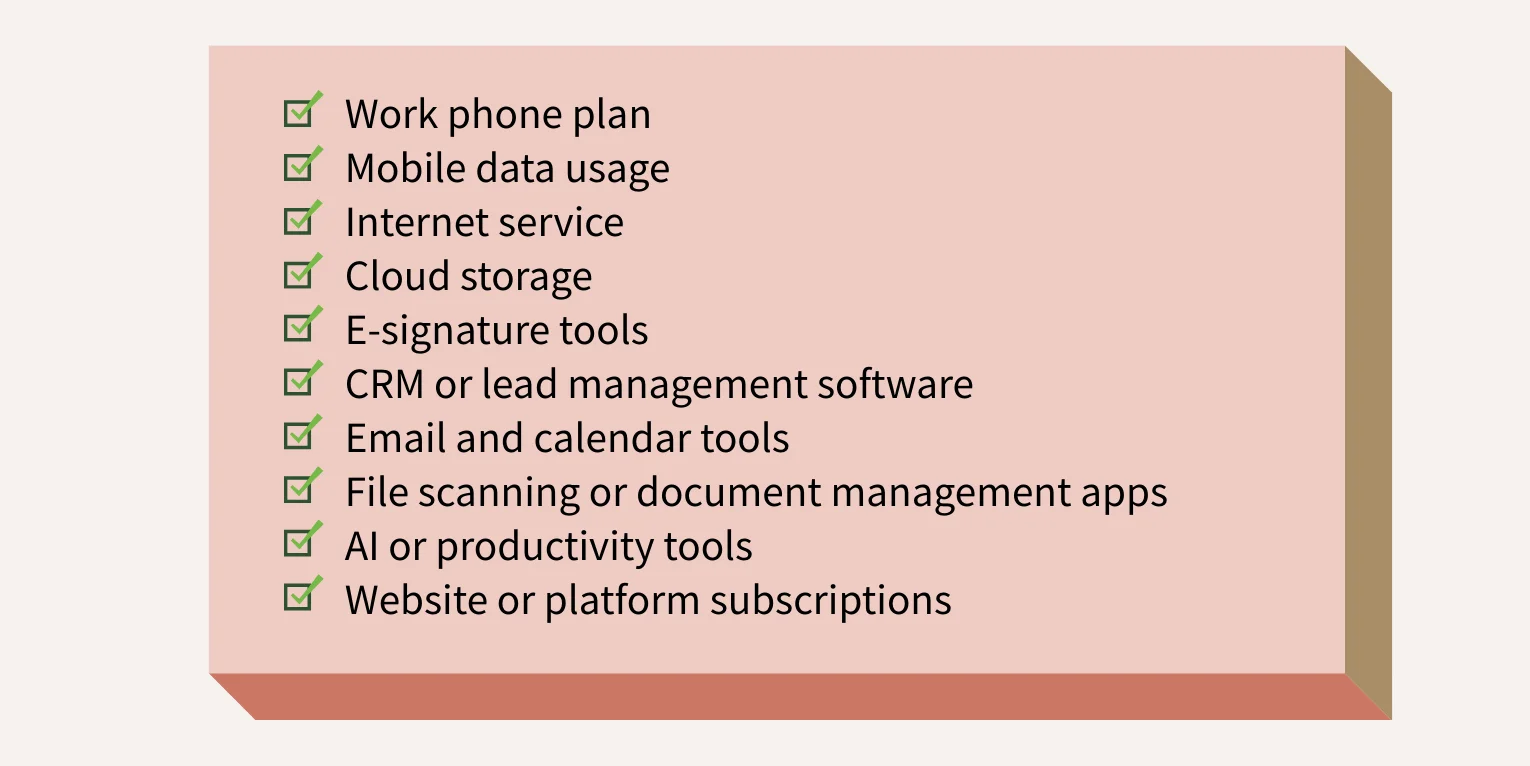
Some business costs show up almost every day. Daily operating expenses usually cover the tools and services you rely on to communicate, manage documents and keep transactions moving.
Common examples include work phone plans, mobile data, cloud storage, document signing tools and recurring software subscriptions used in your real estate business.
Under Internal Revenue Service guidance, these costs generally qualify when they’re considered ordinary and necessary for your work. For tax purposes, that means only the business-use share of a mixed expense like your phone plan is deductible, not the whole bill.
For example, if roughly 60% of your phone or internet use is work-related, that same percentage is typically the one used for deduction purposes.
7. License fees, professional dues and insurance tax write-offs for real estate
Certain costs are required just to operate legally and professionally as a real estate agent. As long as they support your work, they are usually treated as legitimate business expenses.
License and regulatory fees
Real estate agents must cover certain fees to legally work in the industry. Common examples: state license application and renewal fees, exam fees and required continuing education fees needed to maintain an active license.
Professional memberships and MLS access
Membership dues are another common expense in this category. Agents often pay fees to local real estate boards, REALTOR® associations and MLS access fees required to list properties and access market data. Depending on your market, these fees can total several hundred to a few thousand dollars per year.
Business insurance coverage
Insurance is also a typical cost for real estate agents. Errors and omissions insurance is a common example, along with general liability insurance, when required by a brokerage or used to protect your business.
8. Commissions and referral fees paid to others
In the real estate business, you often share commission with other people involved in the deal. These costs are part of doing business and may qualify as deductible expenses.
This usually includes referral fees paid to other agents, commission splits paid to team members who are not employees and fees paid under co-listing or partner agreements. When these payments are directly tied to earning commission, they are commonly treated as deductible business costs.
9. Professional services and outsourcing deductions
According to Enterprise Apps Today:
37%
Approximately 37% of small businesses outsource at least one business process in 2024.
Outsourcing tasks saves your time and often lowers stress and even improves the quality of work.
There’s just one catch: outsourcing costs money. The good news is that when these services support your real estate business, you can usually deduct the cost from your taxable income when you file your taxes.
Here’s a simple breakdown of common outsourced services for agents – and what you might gain by using them.
Common outsourced services for real estate agents
| Service | What it replaces | Benefit for you |
|---|---|---|
| Accounting and bookkeeping | Tracking income, expenses, and reconciliations yourself | Saves hours of admin work and helps avoid costly mistakes |
| Tax preparation | Filing and planning taxes on your own | Reduces errors and often leads to better use of deductions |
| Legal services | Reviewing contracts or resolving disputes alone | Adds protection and clarity in complex situations |
| Website setup and management | Building, hosting, updating a site yourself | Saves time and ensures your site stays professional and functional |
| Marketing support (photography, video, copywriting) | Creating all listing and marketing materials yourself | Improves quality and speeds up listing preparation |
| Virtual assistants or admin support | Managing scheduling, follow-ups, and paperwork | Frees up time for client-facing and revenue-generating work |
10. Client and business-related expenses
Some expenses are directly tied to working with clients and managing active listings. When these costs have a clear business purpose, they also qualify as deductible.
Client gifts
Client gifts may be deductible, but only within specific limits. The IRS generally allows you to deduct up to $25 per client per year for gifts.
Some good ideas include closing and thank-you gifts, holiday cards or small branded promotional products. The cost should be reasonable and clearly tied to your real estate work, not a personal occasion.
Things like engraving, packaging or shipping may not count toward the $25 limit, but the value of the gift itself does. Keep detailed records on who received each gift – this will help to track this category accurately.
Client meals
Meals with clients are not fully deductible, even when there is a clear business purpose. This includes listing meetings, negotiations, transaction updates or follow-up conversations related to a sale.
Currently, the IRS generally allows you to deduct 50% of the cost of qualifying business meals. The limit is part of current IRS business meal rules and applies to meals that are not considered entertainment. You must be present at the meal, and the expense needs to be reasonable and directly connected to your work.
Along with the bill, keep records on who attended, where the meeting took place and what was discussed, in case questions come up later.
Staging and listing preparation
Preparing a property for sale often involves additional expenses. Staging fees, furniture rentals, minor décor items and listing-related photography or video services may qualify when paid by the agent as part of marketing the property.
Virtual staging costs may also apply. You might use paid software or services to digitally stage rooms, enhance photos or visualize layouts for online listings. Tools like BoxBrownie help listings look polished and ready to grab attention.
As with other listing expenses, these costs should be clearly tied to an active property and documented as part of your marketing efforts.
Open houses and showings
Open houses and in-person showings often come with extra costs tied directly to promoting a property. Agents commonly cover refreshments for visitors, temporary décor, printed handouts and outdoor signage to guide people to the location.
Because the event is open to the public rather than a specific client, refreshments at an open house are generally treated as an advertising expense, not a meal, which means they can be 100 percent deductible instead of the usual 50 percent that applies to client meals.
Virtual open houses are usually cheaper to host, but they come with their own set of expenses. Software platforms, streaming tools and materials used to invite and manage online attendees can all be part of the process. Paid promotion used to drive traffic to virtual showings is usually treated the same way.
11. Education and networking tax write-offs
Education expenses can pay off twice, in skills and potential tax savings. Staying current as a real estate agent often requires ongoing learning and relationship-building and many related costs may qualify as deductible expenses.
Professional training and skill development

Training that helps you do your job better as a real estate agent generally qualifies here. IRS guidance generally allows education deductions only when the training maintains or improves skills required in your current profession.
Think practical knowledge you apply directly in day-to-day work, like pricing strategy, buyer and seller representation, negotiation, lead conversion or understanding your local market.
Marketing and tech-related learning also fits in this category. This often includes learning how to run Meta ads, use CRM systems more efficiently orimprove how listings are presented online. As long as the training supports your current real estate career, it usually qualifies.
Coaching and performance programs
Coaching focuses less on learning new skills and more on improving how you apply them. Business or sales coaching programs may qualify when they’re clearly tied to your real estate activity.
This can mean sales coaching, negotiation workshops, or productivity programs aimed at improving performance or helping you grow your existing business.
Programs meant to prepare you for an entirely new career path typically do not fit here.
Networking
Networking plays a huge role in real estate success. Daniel Ramsey, the founder and CEO of MyOutDesk, shared that:
82%
About 82% of all real estate transactions come from repeat and referral business.
Plus, there’s a lot to learn from other agents and investors along the way. Through networking, you gain perspective, pick up practical insights and learn what actually works from people in the field. If you’re early in your career, finding a real estate mentor through these connections can be incredibly valuable.
Each year, events like NAR’s national meetings and NAR NXT are held in major cities such as Houston, Denver, or Chicago, attracting thousands of real estate professionals.
Expenses tied to networking events and industry conferences may qualify as deductions when they’re directly connected to your real estate work. That can cover registration fees for industry events, local business meetups or real estate conferences and in some cases, travel costs.
12. Healthcare and retirement expenses
For many real estate agents and brokers, healthcare is a personal cost that still has tax implications. In some situations, insurance-related costs can qualify for 2026 tax deductions.
Health insurance premiums paid for yourself may qualify if you’re self-employed and not eligible for coverage through an employer. This can also include dental and vision insurance when they’re part of a qualifying plan.
To use this deduction, your real estate business generally needs to show a net profit for the year under Internal Revenue Service rules.
Some agents also contribute to a Health Savings Account as part of their coverage. HSA contributions are handled separately from regular expenses and may offer additional tax benefits, depending on your income and plan type. For 2026, HSA contribution limits rose to $4,400 for self-only coverage and $8,750 for family coverage, up from $4,300 and $8,550 in 2025. To contribute, you need to be enrolled in a qualifying high-deductible health plan. For 2026, that means a minimum deductible of $1,700 for self-only coverage or $3,400 for family coverage.
Because healthcare deductions depend heavily on personal and business circumstances, this is one area worth double-checking. A licensed advisor can give you tax advice and confirm what applies to you and how to handle it correctly.
Retirement contributions are another deduction available to self-employed agents. Contributions to a SEP-IRA or Solo 401(k) reduce your taxable income for the year, in addition to the deductions covered in the rest of this article. For 2026, the employee deferral limit for a Solo 401(k) rose to $24,500 and IRA contribution limits rose to $7,500. As with the health insurance deduction, your business generally needs to show a profit for the year to use this fully, so plan this before the end of the year, not right before filing.
The QBI deduction
Everything we described above is about deducting expenses. There is a separate and often larger deduction that applies to what is left over after expenses.
Under Section 199A, the Qualified Business Income (QBA) deduction lets many self-employed agents deduct up to 20 percent of their net business income before it is taxed. It has existed since 2018 and was originally set to expire after the 2025 tax year. A 2025 law, the One Big Beautiful Bill Act, made it permanent instead, starting with 2026 tax returns. The law also widened the income ranges where the deduction phases in, so more higher-earning agents can still claim it.
This is not a deduction you track receipts for. It is calculated from your net Schedule C income. Confirm this deduction with your accountant since it is easy to miss if no one has explained it to you before.
Key takeaways
Taxes may not be anyone’s favorite topic, but they come with running your own real estate business, and every tax deduction for real estate work adds up over time. Agents often invest their own money to grow. Many of those costs can qualify as real estate agent tax deductions when they are tracked properly and tied to earning income.
This includes ongoing basics like monthly website subscriptions and other tools you rely on to stay visible.
Knowing what you can write off gives you more control over your cash and your business choices. Stay organized during the year and you’ll thank yourself when April rolls around. A simple spreadsheet or app updated monthly, rather than a shoebox of receipts sorted every April, is usually enough to maximize your deductions.
Not every deduction applies to every agent. It depends on your income, business structure and local tax rules. If an expense is not directly connected to your real estate work, it likely does not qualify. The IRS expects consistency in how deductions like mileage, home office, and equipment are applied from year to year.
Separate from all of this, state and local tax deductions are a personal itemized deduction, not one of the business write-offs covered in this checklist, though the cap on that limit rose to $40,400 for 2026 under the same law that changed bonus depreciation and the QBI deduction.
If you’re unsure about what you can deduct, a CPA who works with self-employed professionals can help. They can explain how the rules apply to your situation and help reduce your tax liability while avoiding costly mistakes.
This is also the right place to raise less obvious tax questions, like whether you’re getting the full benefit of the QBI deduction or whether your quarterly payments are sized correctly for the year. A qualified tax advisor who does regular tax planning with self-employed clients can look at your specific numbers, rather than the general rules covered here.
Update Your Website Effortlessly with AI
Add content, images and videos, redesign pages
and create new ones just by chatting with AI.

FAQ
Can you get tax deductions as a real estate agent?
Yes, if you work as a self-employed real estate agent, many costs related to running your business can qualify as tax deductions. These typically include marketing, travel, office expenses, software and professional fees, as long as they’re ordinary, necessary and tied to your real estate work.
How to save on taxes as a realtor?
One of the best tax tips for realtors is to track business expenses year-round and deduct those that qualify. Set aside time each month to record costs and keep receipts or digital invoices. Make sure you understand what qualifies and review expenses like subscriptions, travel, marketing, and services with a tax professional when needed.
What is the $2500 expense rule?
The $2,500 expense rule allows business owners to deduct certain equipment or purchases costing $2,500 or less per item as regular business expenses instead of treating them as long-term assets. This rule comes from Internal Revenue Service guidance and is often used for computers, devices and office equipment purchased for business use.
What is the most overlooked tax break?
For real estate agents, the most overlooked tax break is the home office deduction. Many agents qualify but skip it because they think it’s risky or complicated. A close second is mileage tracking. Agents drive constantly but forget to log trips consistently, which turns a valid deduction into a missed one.
Published on
(Last updated on
)