 (800) 728 8391

Average Salary of Real Estate Agents in Every State (2026)


Quick summary:
- 💰 The salary range is very wide: Agents earn about $50K to $200K+ a year, depending on location and market.
- 📊 Income includes multiple streams: Agents earn from commission, fees, referrals, bonuses or salary.
- 🚀 Earnings grow with the right factors: Experience, certifications, and effective marketing all make a difference.
The average salary of real estate agents is one of the first things people look at when planning their next career move? One big question always comes up: “How much can I really make?”
Paychecks vary widely across the country, and knowing the numbers can shape your strategy.
~$68K
Annual earnings can swing by as much as $67,699 depending on the state!
Source: Indeed
In this guide, we break down earnings across all 50 states in 2026.
Real estate agents income: key components
How you get paid as a real estate agent depends on your compensation model, and these models can look very different from one office to the next. The most common piece is commission, of course—but that’s far from the whole story. Agents can also earn referral fees, bonuses, or flat‑fee payouts. Each component stacks together to form your total income, and knowing the options lets you boost your take‑home.
Commision
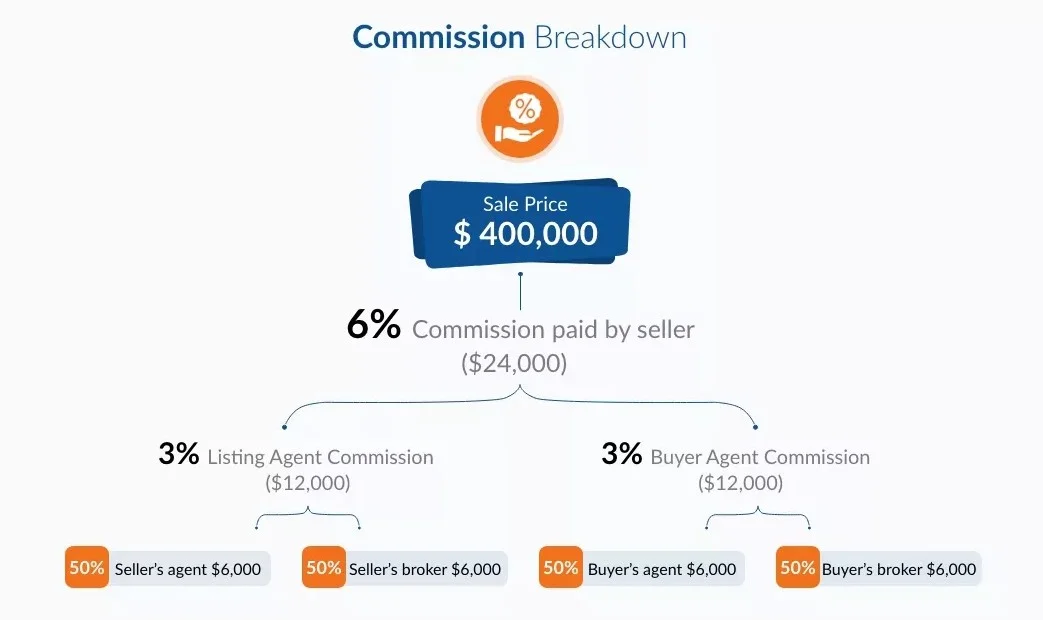
For most real estate agents, commission is the main source of income. It’s a percentage of the property sale price, often ranging from 5% to 6%. That might seem straightforward, but the way the money flows is anything but.
The total commission is first split between the listing agent and the buyer agent. For example, on a $400,000 home sold with a 6% commission, the $24,000 might be divided so each side gets $12,000. From there, each agent shares their part with their brokerage based on an agreed split.
Broker‑agent commision splits vary. Common models include 50/50, 60/40, or 70/30, and many brokerages offer tiered splits, where your percentage grows as you close more deals.
Timing is also important: you earn commission only when the deal closes. Until then, every showing, negotiation, and marketing effort is an investment of your time. That’s why it’s essential to ask your brokerage the right questions:
- How much commission do I keep after all splits and fees?
- Are there additional costs like desk fees or marketing fees?
- How do I qualify for better splits as I sell more?
Flat fee
Some agents work under flat‑fee models, where you earn a fixed amount per transaction instead of a percentage of the sale price. This approach flips the usual script: your income doesn’t rise or fall with the home’s price—it’s predictable, upfront, and lets you plan your cash flow.
Flat fees are perfect agents handling lower‑priced homes. You can close more deals without worrying that a cheap sale will barely move the needle. Some brokerages even combine flat fees with commission splits. That lets you stack income streams while keeping costs transparent.
The real power of a flat‑fee setup is that you can see the money before it even hits the table. No guessing, no “what if the house sells low” stress. You can crank through deals and watch your earnings grow predictably.
Referral fee
Referral fees let you make money from deals you don’t even close yourself. When you send a client to another agent—maybe in a different city or specialty—you earn a percentage of their commission. Typical rates hover around 25% of the closing agent’s commission, but the exact cut can vary.
This component rewards your network, not your schedule. You can keep building relationships, sharing leads, and earning while focusing on your own deals. Done right, it’s a passive income stream that turns your contacts into cash.
Bonuses
Some brokerages reward top performance with bonuses. It’s a flexible addition to your regular commission, most common in performance-based models. These payments should push agents beyond the baseline and reward measurable real estate success. Bonuses are not automatic but rather tied to specific goals.
On the real estate market, you’ll encounter a variety of bonus structures, each designed to reward different kinds of performance.
Some brokers offer a flat payout for hitting a certain number of closings. Others calculate bonuses as a percentage of sales volume or the final sale price. You might see incentives like:
- Closing 10 homes in a quarter earns a $2,000 bonus.
- Reaching $5 million in annual sales volume triggers a $3,500 payout.
- Selling a property at 10% above the local market average nets an extra 1% of the sale price.
- Maintaining client satisfaction ratings above 95% unlocks tiered rewards.
Bonuses shape your strategy, encouraging you to target higher-value deals. They turn good agents into high performers by aligning your effort with measurable outcomes.
To make the most of them, treat bonuses like part of your income plan. Track your progress, understand the qualifying criteria, and focus on deals that move you closer to your targets.
Real estate salaries or hourly rates
Not every agent relies purely on commission. Some real estate roles offer a base salary or hourly pay, especially in positions centered on client care, transaction support, or assisting high-volume teams.
Redfin, for example, hires agents as employees and provide benefits, expenses coverage, and structured commission plans. Under the Redfin Next model, many markets moved away from fixed salaries and toward higher commission splits. Agents can earn more while still receiving employee benefits and company-generated opportunities.
Hourly arrangements follow a similar idea, although they are far less common in residential sales. Agents might earn around $30–$40 per hour for hosting showings, meeting clients, or assisting senior agents. You know what your time is worth, which can help when you’re new or when deal flow slows.
Note that some brokerages even combine a base salary or hourly pay with performance bonuses or partial commission. They create a hybrid that balances security with earning potential.
Key factors influencing real estate agent earnings
In real estate, two agents can close the same deal and walk away with completely different paychecks. A luxury specialist in Miami plays by different rules than a new agent in Kansas City. Your zip code, your skill set, and your commission model all shape your bottom line. Let’s break down how each piece tilts the scales.
Location
Income for real estate agents varies widely based on region, state, city, and the health of the local market. The differences can be staggering.
~$30K
Even in neighboring states, average annual earnings may differ by up to $30,000 (e.g., North Dakota vs Minnesota).
Source: Indeed
It’s a mix of high-stakes deals, fewer agents relative to population, and a market that moves fast. The takeaway: succeed in the “right” place and your results skew upward.
At a broader level, the gaps are even larger. Differences between the highest- and lowest-paying states can reach as much as $67,699 per year (North Dakota vs Kentucky). That’s a solid reason to pack your bags and start fresh somewhere new.
Beyond raw prices, local norms matter. Commission splits and rebate practices vary by region. Regulatory and cost differences also bite into take-home pay. Local transfer taxes, licensing rules and regional costs of business can narrow profit margins in certain cities. At the same time, they may boost net returns in nearby suburbs.
Experience
Experience is the multiplier that turns activity into reliable income. Agents with a few years under their belt win better listings and convert referrals into repeat business.
10%
Properties listed by very new agents tend to sell for roughly 10% less than those listed by experienced agents.
Source: Journal of Housing Research
The gap shows up in price realization, not just closed-deal counts. Experience improves negotiation, pricing, and buyer confidence.
That doesn’t mean time alone pays the bills. Experience compounds when you pair it with a system:
- A niche specialty
- A reliable lead source
- Repeatable listing processes
- And strong client care.
Invest in trackable wins, and you convert “years in the business” into tactical upgrades you can sell to brokers and clients alike.
Education and certification
As NAR’s data shows, agents who invest in recognized designations tend to earn more and win tougher listings.
45%
Realtors holding at least one designation earn about 45% more than those without any credentials.
Source: NETAR survey
Not every credential carries the same weight. CRS, ABR, GRI, and CCIM each highlight a different skill set:
- CRS (Certified Residential Specialist)—boosts your expertise in listings, pricing, and running a high-volume residential business.
- ABR (Accredited Buyer’s Representative)—sharpens your work with buyers, from home search to negotiation strategy.
- GRI (Graduate, REALTOR® Institute)—builds a broad foundation: contracts, marketing, legal issues, and risk management.
- CCIM (Certified Commercial Investment Member)—focuses on investment analysis, site selection, and commercial deal structures.
Career impact shows up in three concrete ways:
- Credentials increase trust with higher-value clients and institutional sellers who screen for expertise.
- They plug you into networks and referral pools that feed deals you otherwise wouldn’t see.
- Specialized training improves pricing, negotiation, and marketing. These are the things that raise the actual sale price and, therefore, your commission.
Industry guides note these channels as the primary ROI drivers for credentialed agents.
Technology
Technology has become a real lever for agent earnings. According to NAR’s 2025 Technology Survey, 79% of Realtors use eSignature tools, and 75% rely heavily on social media to reach and engage clients. What’s more, about 70% of NAR’s members regularly use AI tools.
82%
82% of clients respond positively when agents use more technology.
Source: NAR
That pays off, and sales agents know it. About 34% spend $50–$250 per month on their tech stack, while 24% invest over $500. Tools like AI, digital marketing, CRM systems and even drone photography give them more bandwidth.
Pro tip: Modern real estate apps like Open Home Pro make open houses easier to manage and turn visitor information into organized contacts. Agents can collect digital sign-ins, keep everything in one place and follow up faster. There’s a forever free version, while paid plans add extra features like automated follow-ups and branding options.
Marketing
Smart marketing can make a real difference in what you take home at the end of the month. The more people see your name, the more likely they are to pick you when it’s time to buy or sell. Consider these statistics:
- 52% of agents say platforms like Instagram, Facebook, and TikTok delivered their most valuable leads last year (NAR).
- 87% of consumers admit they’ve been convinced to buy after watching a video (Wyzowl).
- Homes captured with aerial shots are 68% more likely to sell (NAR).
Agents aren’t stopping at video and social media marketing. Email campaigns nurture past clients and warm leads without feeling pushy. CRMs keep track of every contact and interaction, making it easy to follow up at the perfect moment.
Virtual open houses and 3D walkthroughs give buyers the freedom to explore every corner of a home from their couch.
Don’t forget about targeted ads that place your listings in front of people already looking for a home like yours.
Pro tip: A professional real estate website gives your marketing a place to convert. Social posts, ads and emails can spark interest, but your site is where clients check listings, read about your services, and decide if they want to contact you. It also helps you capture inquiries, showcase credibility and stay discoverable in search long after a post disappears.
Relations with clients
20%
Repeat clients accounted for about 20% of a typical Realtor’s business.
Source: 2025 NAR Member Profile
Every past client who comes back or refers a friend is essentially handing you a warm lead without you spending a dime. Building such relationships is about meaningful touchpoints. Think of a quick check-in after closing, sharing neighborhood updates, or sending a thoughtful note on a personal milestone.
Loyal clients become your advocates. According to NAR, referrals and repeat business consistently produce higher-quality leads. Moreover, they often close faster and with less negotiation friction. That translates directly into bigger earnings and more predictable cash flow.
Pro tip: Keep a simple follow-up system so no relationship goes cold. Calendar reminders, home-anniversary messages and quick market updates help you stay top of mind without feeling intrusive.
Market conditions
Industry conditions play a huge role in shaping what you can actually make, and it’s not always under your control.
During boom years, agents can ride a wave of demand. Take the mid‑2000s: house prices peaked around 2006, which fueled a massive run‑up in deals and happy commissions. But it didn’t last. By 2008, the housing bubble burst, leading to the subprime crisis, widespread foreclosures, and a sharp drop in market activity.
863K
unit drop
In July 2005, new‑home sales hit a seasonally adjusted annual rate of about 1.389 million units. By March 2008, that number had dropped to 526,000 units.
Source: Joint Economic Committee
Conversely, when the economy slows or interest rates rise, buyers pull back and your pipeline thins. During those phases, even the smartest agent can’t fully offset shrinking demand. Higher rates kill affordability, and a flood of supply can suppress prices.
The silver lining? No industry is completely immune to economic swings. So, no matter the market, everyone faces challenges—and opportunities.
What is the average real estate agent salary?
$100,876
The average salary of a real estate agent is $100,876.
Source: Indeed
Entry-level agents can earn around $49,734, while top performers make over $204,606. Pay varies by experience, location, and closed deals. Knowing the range helps you plan your career and set realistic income goals.
Real estate agent salary by state (US)
Wondering how much a real estate agent makes in California compared to the rest of the country? We’re covering earnings in all 50 states using salary data from Indeed. By the end, you’ll know exactly which states pay top dollar and which lag behind.
| State | Average salary |
|---|---|
| Alabama | $139,539 |
| Alaska | $88,899 |
| Arizona | $109,951 |
| Arkansas | $99,906 |
| California | $118,969 |
| Colorado | $103,802 |
| Connecticut | $99,123 |
| Delaware | $103,096 |
| Florida | $103,771 |
| Georgia | $109,304 |
| Hawaii | $97,377 |
| Idaho | $104,126 |
| Illinois | $95,637 |
| Indiana | $92,873 |
| Iowa | $85,054 |
| Kansas | $93,765 |
| Kentucky | $72,369 |
| Louisiana | $96,865 |
| Maine | $134,564 |
| Maryland | $106,960 |
| Massachusetts | $100,198 |
| Michigan | $98,561 |
| Minnesota | $110,430 |
| Mississippi | $96,633 |
| Missouri | $94,423 |
| Montana | $114,357 |
| Nebraska | $136,382 |
| Nevada | $101,455 |
| New Hampshire | $109,966 |
| New Jersey | $106,820 |
| New Mexico | $89,102 |
| New York | $105,780 |
| North Carolina | $100,689 |
| North Dakota | $140,068 |
| Ohio | $89,724 |
| Oklahoma | $95,444 |
| Oregon | $97,904 |
| Pennsylvania | $96,357 |
| Rhode Island | $107,089 |
| South Carolina | $96,820 |
| South Dakota | $79,339 |
| Tennessee | $105,337 |
| Texas | $102,220 |
| Utah | $101,170 |
| Vermont | $132,368 |
| Virginia | $108,950 |
| Washington | $94,564 |
| West Virginia | $137,719 |
| Wisconsin | $96,654 |
| Wyoming | $137,524 |
Real estate agent salary: Alabama
Alabama is the highest-paying state for real estate agents, with an average annual income of $139,539. Tuscaloosa, Hoover, and Dothan are standout markets where top producers earn the most.
Real estate agent salary: Alaska
In Alaska, agents earn an average of $88,899 annually. The strongest markets include Fairbanks, Anchorage, and Wasilla.
Real estate agent salary: Arizona
Real estate agents in Arizona make around $109,951 per year on average. Chandler, Mesa, and Phoenix are key cities where the market activity helps boost earnings.
Real estate agent salary: Arkansas
In Arkansas, agents earn an average of $99,906 annually. Fayetteville, Russellville, and North Little Rock offer the best opportunities to maximize commissions.
Real estate agent salary: California
Real estate agents in California bring in an average of $118,969 per year. Cities such as Irvine, Santa Ana, and Sacramento stand out as lucrative markets for driven agents.
Real estate agent salary: Colorado
In Colorado, agents earn an average of $103,802 annually. In Lakewood, Pueblo, and Centennial, strong market activity translates into higher commissions.
Real estate agent salary: Connecticut
In Connecticut, real estate agents make around $99,123 per year on average. Norwich, Westport, and Stamford are key cities where local demand drives top earnings.
Real estate agent salary: Delaware
In Delaware, agents earn an average of $103,096 annually. Brookside, Smyrna, and Rehoboth Beach stand out as markets where commissions tend to be higher.
Real estate agent salary: Florida
In Florida, real estate agents bring in an average of $103,771 per year. Markets like Apopka, Miami, and Sarasota offer some of the strongest earning potential in the state.
Real estate agent salary: Georgia
In Georgia, agents earn an average of $109,304 annually. Cities such as Woodstock, Peachtree City, and Atlanta stand out for their vibrant markets.
Real estate agent salary: Hawaii
In Hawaii, real estate agents make an average of $97,377 per year. Kahului, Pearl City, and Kaneohe are among the top markets where strong demand drives earnings higher.
Real estate agent salary: Idaho
In Idaho, agents earn around $104,126 annually. Nampa, Caldwell, and Hayden are key cities where market activity helps boost commissions.
Real estate agent salary: Illinois
In Illinois, real estate agents make an average of $95,637 per year. Glen Ellyn, Arlington Heights, and Orland Park are standout markets where agents can capture higher earnings.
Real estate agent salary: Indiana
In Indiana, agents earn an average of $92,873 annually. South Bend, Bloomington, and Fort Wayne offer some of the best opportunities to maximize commissions.
Real estate agent salary: Iowa
In Iowa, real estate agents bring in an average of $85,054 per year. Ames, Ankeny, and Urbandale stand out as markets where strong sales activity drives higher earnings.
Real estate agent salary: Kansas
In Kansas, agents earn an average of $93,765 annually. Topeka, Leawood, and Olathe are the cities that offer the greatest opportunities.
Real estate agent salary: Kentucky
Kentucky is the lowest-paying state for real estate agents, with an average salary of $72,369. Still, in cities like Covington, Elizabethtown, and Frankfort, it’s possible to earn more.
Real estate agent salary: Louisiana
Louisiana ranks as a mid-tier state for real estate earnings, with agents averaging $96,865 annually. New Orleans, Denham Springs, and Shreveport are the top-paying cities.
Real estate agent salary: Maine
In Maine, real estate agents take home an average of $134,564 per year. Strong markets in Kennebunk, Bangor, and Brunswick give agents plenty of chances to capitalize on local demand.
Real estate agent salary: Maryland
In Maryland, agents earn an average of $106,960 annually. Baltimore, Gaithersburg, and Columbia seem to be the best markets for skilled agents.
Real estate agent salary: Massachusetts
In Massachusetts, real estate agents typically make around $100,198 per year. Braintree, Worcester, and Wakefield are the most promising markets for skilled agents.
Real estate agent salary: Michigan
In Michigan, the average annual salary for real estate agents is $98,561. Troy, Detroit, and Royal Oak stand out as hubs where savvy agents can turn listings into significant paychecks.
Real estate agent salary: Minnesota
In Minnesota, real estate agents earn an average annual salary of $110,430. Rochester, Roseville, and Plymouth allow for translating busy markets into higher-than-average earnings.
Real estate agent salary: Mississippi
In Mississippi, agents take home an average annual income of $96,633. Biloxi, Jackson, and Olive Branch stand out as the highest-paying cities.
Real estate agent salary: Missouri
In Missouri, real estate agents typically earn $94,423 a year. Top markets include Independence, Lee’s Summit, and Blue Springs.
Real estate agent salary: Montana
In Montana, real estate agents earn around $114,357 a year. Markets in Kalispell, Great Falls, and Bozeman provide the most fertile ground for agents.
Real estate agent salary: Nebraska
In Nebraska, agents typically bring in $136,382 a year. Cities like Papillon, Bellevue, and La Vista are buzzing markets where strong demand can translate into higher payouts.
Real estate agent salary: Nevada
In Nevada, real estate agents earn around $101,455 per year. Enterprise, Spring Valley, and Paradise stand out as markets where a steady flow of deals can significantly lift earnings.
Real estate agent salary: New Hampshire
In New Hampshire, a real estate agent’s salary averages $109,966 annually. Cities such as Bedford, Concord, and Portsmouth help agents maximize their commissions the most.
Real estate agent salary: New Jersey
In New Jersey, agents earn an average income of $106,820 per year. The highest earning potential can be found in Morristown, Livingston, and Sewell.
Real estate agent salary: New Mexico
In New Mexico, real estate salaries average $89,102 per year. Carlsbad, Hobbs, and Tijeras offer the strongest opportunities for agents to increase their earnings.
Real estate agent salary: New York
In New York, a typical real estate agent earns about $105,780 annually. Yorktown Heights, Franklin Square, and New York City are among the areas where agents see the most opportunity.
Real estate agent salary: North Carolina
In North Carolina, the salary range for real estate agents averages $100,689. Cities like Raleigh, Asheville, and Wilmington often reward agents with higher commission rates.
Real estate agent salary: North Dakota
In North Dakota, real estate agents get paid an average of $140,068 per year. Minot, Grand Forks, and Mandan are key markets characterized by solid earnings.
Real estate agent salary: Ohio
In Ohio, the average pay for real estate agents is $89,724 per year. Westlake, West Chester, and Strongsville offer some of the best opportunities to close deals and increase earnings.
Real estate agent salary: Oklahoma
In Oklahoma, earnings as a real estate agent average $95,444 annually. Oklahoma City, Moore, and Lawton are among the most active markets there.
Real estate agent salary: Oregon
In Oregon, the typical pay for an agent in the real estate industry is $97,904. The highest-paying markets include Beaverton, Gresham, and Eugene.
Real estate agent salary: Pennsylvania
In Pennsylvania, real estate agents make around $96,357 a year. Opportunities are especially strong in Exton, King of Prussia, and West Chester.
Real estate agent salary: Rhode Island
In Rhode Island, real estate agents earn roughly $107,089 per year. East Providence, Central Falls, and North Providence stand out as areas with the most lucrative deals.
Real estate agent salary: South Carolina
In South Carolina, agents earn around $96,820 annually. A real estate career can be most rewarding in Myrtle Beach, Conway, and Bluffton.
Real estate agent salary: South Dakota
In South Dakota, real estate agents earn about $79,339 annually. The strongest markets include Aberdeen, Watertown, and Sioux Falls.
Real estate agent salary: Tennessee
In Tennessee, agents generally make around $105,337 per year. Johnson City, Murfreesboro, and Hendersonville offer the best opportunities to grow earnings.
Real estate agent salary: Texas
In Texas, the typical annual income for agents sits at $102,220. Top-earning opportunities can be found in Plano, Fort Worth, and Killeen.
Real estate agent salary: Utah
In Utah, the average agent takes home around $101,170 annually. Orem, South Jordan, and Ogden lead the state in transaction activity.
Real estate agent salary: Vermont
In Vermont, real estate agents bring in about $132,368 annually. Barre, Rutland, and Woodstock are standout markets for strong sales.
Real estate agent salary: Virginia
In Virginia, real estate agents earn around $108,950 per year. Virginia Beach, Alexandria, and Arlington show the highest market activity for agents.
Real estate agent salary: Washington
In Washington, real estate agents make roughly $94,564 annually. Kirkland, Spokane, and Bellevue stand out as cities where agents can capitalize on a busy market.
Real estate agent salary: West Virginia
In West Virginia, agents take in around $137,719 annually. The busiest activity can be found in Wheeling, Morgantown, and Martinsburg.
Real estate agent salary: Wisconsin
In Wisconsin, real estate agents earn approximately $96,654 per year. Milwaukee, McFarland, and Sun Prairie see the highest levels of market activity for agents.
Real estate agent salary: Wyoming
In Wyoming, real estate agents make $137,524 annually on average. The markets in Jackson, Sheridan, and Rock Springs see the most consistent activity.
US cities with the highest real estate agent salaries
According to the Bureau of Labor Statistics, a few US metro areas stand out for offering the highest real-estate pay:
| Rank | Metro area | Annual mean wage (sales agents) |
|---|---|---|
| 1 | Midland, TX | $118,560 |
| 2 | Napa, CA | $114,680 |
| 3 | New York-Newark-Jersey City, NY-NJ-PA | $111,750 |
| 4 | Boston-Cambridge-Nashua, MA-NH | $108,620 |
| 5 | Oxnard-Thousand Oaks-Ventura, CA | $103,770 |
| 6 | Burlington-South Burlington, VT | $103,680 |
| 7 | New Bedford, MA | $102,830 |
| 8 | Casper, WY (metro) | $100,750 |
| 9 | Buffalo-Cheektowaga–Niagara Falls, NY | $99,790 |
| 10 | Rochester, NY | $98,950 |
How much do new real estate agents make?
$20–50K
Most new agents who work as real estate professionals earn $20,000–$50,000 in their first year, based on data from major industry training programs.
NAR reports that many first-year agents fall below $10,000, which shows how tough the ramp-up can be. Income rises fast once you build your client base and start getting referrals.
Online conversations among agents show how wide the spectrum can be. In a 2025 Reddit discussion on r/realtors, many professionals shared that income often starts slower, then grows fast once referrals and repeat clients kick in. High performers reported strong, stable earnings, while newer agents talked about building momentum in their first years.
How much can a part-time real estate agent earn?
Part-time agents often make between $20,000 and $50,000 a year, depending on how much time they put in and how many deals they close. Some part-timers working under 20 hours per week report a median gross income of around $60,897. On the other hand, full-time agents can make $40,000–$80,000 annually, according to the BLS.
How much does a real estate broker make?
$86,130
The average pay of a real estate broker is $86,130 per year.
Source: BLS
Broker income may appear lower in some cases because it accounts for the costs of operating a brokerage, including overhead and business expenses. In commercial real estate, they tend to make more. Indeed lists a typical base of around $123,099/year for commercial brokers.
Factors that influence a broker’s income include:
- How big their deals are
- Whether they run a commercial real estate firm
- How high property values climb in their area
How much does a Realtor earn?
$104,454
Realtors make around $104,454 a year.
Source: Indeed
Realtors are no exception, and their income depends on the average commission on the sale. In many cases, members of NAR tend to earn a little bit more than the rest of the real estate agents.
Income potential for agents and brokers across different real estate career stages
If you’re considering a career in real estate, it’s important to understand how your choices shape your income potential. How you work as a real estate professional—and which direction you take—can lead to wide variations in earnings.
Because the real estate market varies by location and specialization, income levels can shift significantly from one path to another. So, if you’re thinking about a new career, take a look at the table below to see how agents and brokers compare across various operating models:
| Career stage | Typical annual earnings |
|---|---|
| New real estate agent | $20,000–$50,000 |
| Real estate agent (average) | ~$100,000 |
| Experienced real estate agent | $100,000–$200,000+ |
| Realtor | ~$105,000 |
| Part-time real estate agent | $25,000–$50,000 |
| Real estate broker | ~$85,000 |
| Real estate commercial broker | ~$125,000 |
How to increase your real estate salary? 10 strategies for agents
If you want to become a successful real estate agent and boost your salary, focus on marketing and ongoing education. Follow these tips:
1️⃣ Generate more leads through referrals and marketing.
2️⃣ Leverage your social media, branding and SEO strategies.
3️⃣ Enhance your skills (e.g., specialization, negotiation, marketing).
4️⃣ Develop a niche (e.g., become a luxury real estate agent).
5️⃣ Get real estate certificates (e.g., CRS, ABR, GRI, and CCIM).
6️⃣ Connect with other professionals and host community events.
7️⃣ Find a real estate mentor.
8️⃣ Increase your average home sale price.
9️⃣ Diversify your income streams (e.g., become a real estate trainer).
🔟 Work smarter with AI tools for real estate agents.
Pro tip: Find opportunities others don’t see.
Another way agents raise their income is through off-market opportunities. Finding sellers before a property hits the MLS means less competition, stronger relationships, and often smoother negotiations. Agents who build local networks, talk to homeowners regularly, and stay visible in their communities can secure listings others never even know existed.
How much do real estate agents make? Final thoughts
Are you thinking about becoming a real estate agent? Or maybe you’re already working in the industry? Regardless of the situation, you can always increase your earnings. Start by creating a professional website on Placester. This will allow you to easily promote your business and manage all your listings in one place. For agents and brokers, this is the first step to success in real estate!
AI Websites for Real Estate
Get a custom, ready-to-edit website
in less than 4 minutes.
FAQ
Do real estate agents earn a base salary?
Most real estate agents don’t get a base salary—they’re paid on commission. Some brokerages (like Redfin) offer salaries, but that’s the exception, not the rule.
How do real estate agents get paid?
To understand how real estate agents get paid, it’s important to know that most of their income is based on commission from property sales. Agents can also earn from referral fees, bonuses, or, in some cases, a base salary—but those are usually smaller parts of total income. Because earnings depend on closed deals, new agents often earn less until they build a steady pipeline.
What is the average real estate commission?
The average real estate commission rate usually falls between 5% and 6% of the sales price.
What are the highest-paying states for real estate agents?
According to Indeed, the highest-paying states include Alabama, Hawaii, Maine, North Dakota, Nebraska, West Virginia, Wyoming, Iowa, and Vermont.
How many houses do I need to sell to make $100k?
That depends on your commission rate and the average property’s sale price. For example, with a 5% commission on a $400,000 home, that’s $20,000 total commission. If you split with your broker, you might need to close about 10–15 homes to hit six figures.
What percent of Realtors make 100k a year?
Around 20% of real estate agents reportedly earn more than $100,000 a year.
What’s the highest paid job in real estate?
Top 10 highest paying real estate jobs include:
– Real Estate Broker
– Commercial Real Estate Sales Agent
– Real Estate Developer
– Real Estate Attorney
– Luxury Agent
– Real Estate Investment Trust Manager
– Property Manager
– Mortgage Loan Officer
– Real Estate Attorney
– House Flipper
How much does a Realtor in Virginia earn?
The average salary for a Realtor in Virginia is $99,607, according to Indeed.
What is the average salary for a real estate agent in California?
According to Indeed, the average salary for an agent working in real estate in California is $118,969.
How much do successful real estate agents earn?
Successful real estate agents typically earn above the industry average, which is around $100,000 annually. In practice, any income that exceeds this benchmark can be considered a sign of success in the field.
How much do top real estate agents earn?
Top real estate agents in the US make between $125,000 and more than $1,000,000. Since most agents are paid on commission, income has no fixed ceiling and can vary dramatically across the industry.
Published on

Take your real estate website to the next level with Placester!
Discover new opportunities and save thousands of dollars every year.