(800) 728 8391



Quick summary:
- AI is moving from drafting text to completing tasks. Over 97% of brokerage leaders say their company uses AI, but most still use it for content, leaving workflow tasks open for agentic tools (Delta Media Group, 2026).
- Tool fatigue is pushing agents toward fewer, connected platforms. 81% of agents choose tools mainly to save time.
- Real estate fraud losses reached $275.1 million in 2025, up about 59% from 2024, according to FBI data (ALTA).
- Private listings, conversational search and digital closings are changing where listing data lives and how deals close.
- Blockchain, digital twins and crypto closings remain fringe topics: fewer than 8% of agents are even watching them.
AI stopped being optional for real estate agents this year. In The REALTORS® 2026 Technology Report, only 12% of agents said they don’t use AI and have no plans to, down from 32% a year earlier.
The way agents use AI hasn’t changed much, though: listing descriptions are still the top task. The real estate technology trends heading into 2027 are less about what software writes and more about what it does: running follow-ups, checking contracts, verifying identities, and moving listing data.
Most proptech trends lists mix residential and commercial real estate, tools for real estate investment, property management software, construction technology, and marketing tactics. This list covers only the residential side of the real estate sector: agents, teams and brokerages. For the marketing side, see our guide to real estate marketing trends.
Real estate technology trends for 2027 at a glance
The verdict column shows how much attention each trend deserves over the next 12 months.
| Trend | What’s changing | Affects most | Industry readiness | Verdict |
|---|---|---|---|---|
| 1. AI that does the work | From drafting text to completing multistep tasks | Agents and teams | Growing | Act now |
| 2. All-in-one platforms | Fewer tools, connected data | Agents and brokerages | Growing | Act now |
| 3. Digital closings | E-signature to fully online closings | Agents and brokerages | Growing | Act now |
| 4. Fraud prevention | Identity checks and secure wiring become standard | Everyone in the deal | Growing | Act now |
| 5. Listing access rules | Private listings and portal standards | Brokerages | Early | Watch closely |
| 6. Conversational search | Buyers search in plain language | Agents | Early | Watch closely |
| 7. Smarter pricing tools | Better AVMs and comps | Agents | Mainstream | Use, don’t rely on |
| 8. Flexible, safer showings | Self-scheduling and verified access | Agents | Mainstream | Act now |
| 9. Smart home data | Connected devices in the listing | Agents | Early | Watch |
| 10. AI governance | Written AI policies and human review | Brokerages | Early | Act now |
1. AI shifts from writing content to doing the work
Generative artificial intelligence is already standard for drafting. The 2027 shift is agentic AI, software that carries out multistep tasks without a new prompt at every step. Think following up with a lead, reviewing a contract, or keeping real estate transactions on schedule.
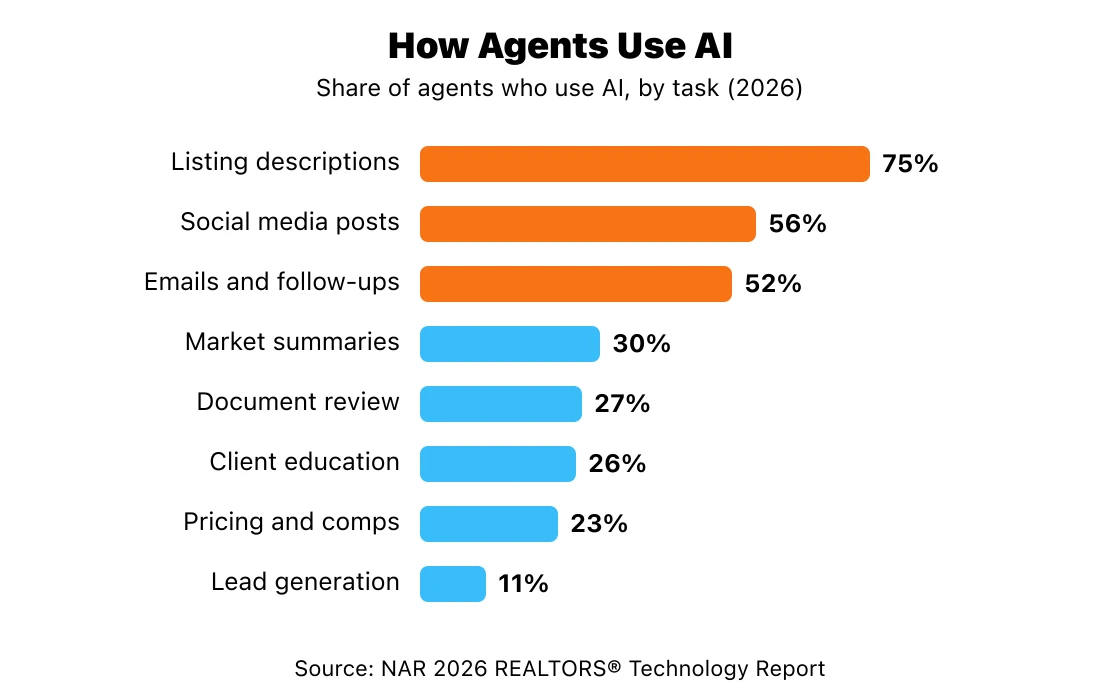
NAR’s data shows the gap. Listing descriptions (75%), social posts (56%), and emails (52%) top the list of AI uses. At the bottom, used by 10% or fewer of AI users, are exactly the routine tasks agentic tools target: transaction timeline next steps, summarizing disclosures and contracts, and auto-filling forms.
Brokerage leaders are betting on AI too. In Delta Media Group’s 2026 survey of more than 100 brokerage leaders, conducted in December 2025, over 97% said their company uses AI, up from 87% a year earlier.
Their plans still center on content, though. Listing descriptions and content creation top the list of how agents use AI and the areas where leaders plan to expand it. Agentic AI still largely leaves routine workflow tasks untouched, creating new opportunities for agents that automate them first.
What this trend looks like in practice: In February 2026, Lofty launched what it calls an agentic AI operating system, a set of specialized AI agents that includes a transaction coordinator (RISMedia). For more options, see our list of AI tools for real estate agents.
Before 2027: Pick one repetitive workflow, such as post-showing follow-ups, and automate it from start to finish instead of just drafting faster.
2. All-in-one platforms replace the patchwork tech stack
Agents are tired of paying for and switching between a dozen real estate apps. In 2027, more agents and brokerages will choose platforms that combine multiple services, such as website building, IDX search, CRM, automation, and AI.
NAR’s survey names the learning curve, cost, and too many options as the biggest barriers to new technology. When choosing tools, 81% of agents prioritize saving time and 71% a better client experience. Disconnected apps work against both, because every handoff between tools is a place where a lead or a deadline can slip.
There’s an adoption gap, too: 51% of agents are watching CRM tools as an emerging technology, but only 46% use one. Our guide to real estate CRM software compares the main options.
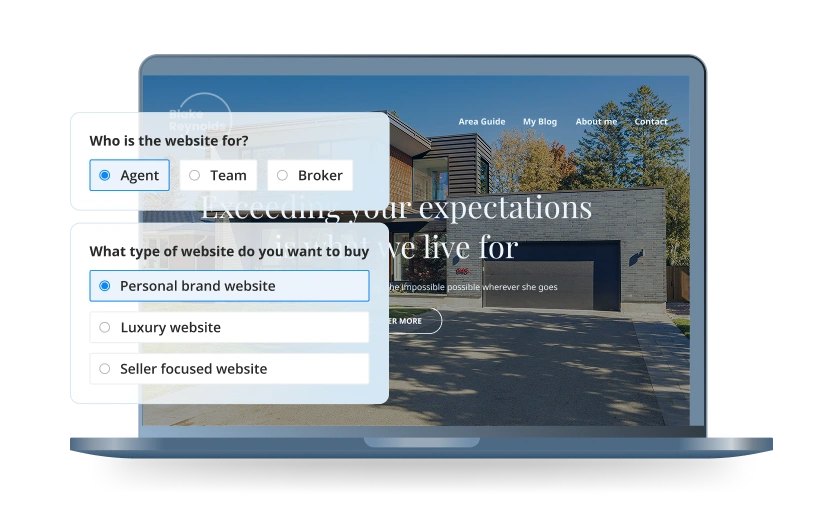
What this trend looks like in practice: Placester’s AI website builder creates an agent website with built-in IDX search. It connects to CRMs such as Follow Up Boss, Cloze, and Rechat, giving real estate agents one place to manage the leads their site brings in.
AI Websites for Real Estate
Get a custom, ready-to-edit website
in less than 4 minutes.
Before 2027: List every tool you pay for, mark which ones share data, and cancel at least one that duplicates another. You’ll be surprised how much you can save by unsubscribing from redundant tools.
3. Digital closings move from optional to expected
E-signature is close to universal, used by 79% of agents (NAR). But what if you wanted to make the purchase journey completely online? That’s where remote online notarization (RON) comes in. It allows real estate buyers and sellers to notarize documents over a secure video call.
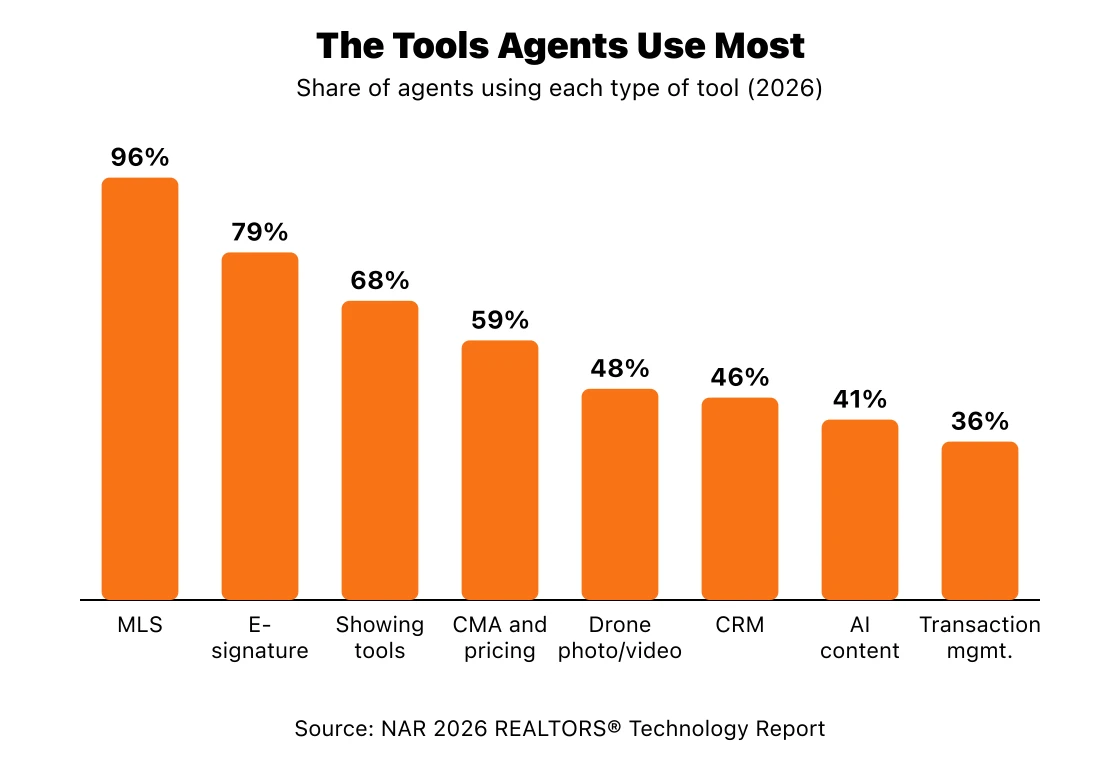
The rest of the closing process lags behind. Only 36% of agents use transaction management software, the type of real estate software that tracks deadlines and documents from offer to closing.
On the lender side, a 2025 study by Snapdocs, a digital closing vendor, found that 90% of lenders offer digital closings, but only 14% close more than 80% of their loans digitally.
The legal groundwork is mostly in place: at least 45 states and Washington, D.C. had permanent RON laws as of early 2025 (NotaryCam).
What this trend looks like in practice: NotaryCam reported passing 2 million lifetime notarizations in January 2026, including more than 238,000 in 2025 alone.
Before 2027: Ask your title partners which parts of the closing they can already handle remotely, and explain that process to clients at the offer stage.
4. Fraud prevention becomes a core part of the tech stack
Less in-person interaction means more room for online fraud. Fortunately, technology keeps up with nefarious actors, and in 2027 more tools will help real estate professionals catch fraud before money moves.
Identity verification and secure wire tools are becoming part of the agent’s toolkit, not just the title company’s.
The FBI’s Internet Crime Complaint Center received 12,368 real estate fraud complaints in 2025, with $275.1 million in reported losses. That’s up 59% from about $173 million in 2024. The category also includes rental and timeshare scams, but criminals clearly target the moments when money moves.
The common schemes are business email compromise (a fake “title company” email with new wiring instructions) and seller impersonation, where a scammer poses as the owner of a vacant lot or paid-off home. AI-generated voices and documents make both harder to spot.
What this trend looks like in practice: CertifID’s 2026 State of Wire Fraud report surveyed more than 1,400 consumers and real estate professionals. It found that 1 in 5 homebuyers received suspicious or fraudulent communication during closing (ALTA).
Before 2027: Tell every client in writing, at the first meeting, that you will never send wiring instructions by email. Ask them to confirm any instructions by phone, using a number they look up themselves.
5. Listing access rules are rewriting how data flows
Private listings, office exclusives, and portal listing standards are changing where listing data lives and who gets to see it. Agents’ websites, IDX feeds, and syndication settings have to keep up.
Zillow introduced its Listing Access Standards in April 2025, which block listings that were marketed privately before going public. On March 17, 2026, Zillow updated them to allow office-exclusive listings within a single brokerage, as long as the seller signs a disclosure (Zillow; RISMedia).
Some MLSs have built their own private networks. In Chicago, MRED reported about 30,000 listings, or 16% of its total, on its private network in 2024 (RISMedia).
One effect is already clear: a listing’s visibility now depends on choices made before it goes live.
What this trend looks like in practice: A brokerage using Zillow’s office-exclusive exception needs a signed seller disclosure for every one of those listings. That means it needs a way to collect, store, and prove each one.
Before 2027: Review your brokerage’s private-listing policy and check that your IDX website shows the listings you expect it to.
6. Conversational search changes how buyers find homes
Buyers are starting to search in plain language instead of filters. They ask for “a three-bedroom near a good middle school under $600K with a yard.” AI assistants and portals translate that into results, streamlining property searches that used to take dozens of filter clicks.
In NAR’s 2025 Profile of Home Buyers and Sellers, 52% of buyers found the home they bought online, and 70% used a phone or tablet during their search. Conversational search raises the bar for listing data: an AI assistant can only match a request if details like school zones and yard size are complete and accurate.
What this trend looks like in practice: On October 6, 2025, Zillow launched an app inside ChatGPT that lets U.S. users ask about homes in plain language and see listings with photos, prices, and maps. Zillow said it built protections into the app to reduce the risk of bias or discrimination.
Before 2027: Pick three of your active listings and check that every field buyers might ask about, including HOA rules, school zones, and lot size, is filled in correctly.
7. Pricing tools get smarter, but judgment still wins
AI-powered valuation keeps improving, but pricing is still where local expertise matters most.
According to NAR, 59% of agents use CMA or pricing tools, and 23% of AI users apply AI to pricing and comps. Yet NAR lists predictive analytics among the least popular tools in its survey. Agents use data analytics to support decision-making on price, but few trust a model to set one.
Automated valuation models (AVMs) rely on big data from public records and past sales. They miss what that data doesn’t capture: an unpermitted renovation, a busy road behind the fence, or a block that’s suddenly in demand. AI and machine learning can narrow the price range, speed up market analysis, and spot market trends. It can’t replace walking the property.
What this trend looks like in practice: Zillow publishes Zestimate accuracy by market, with separate error rates for homes on and off the market. Showing sellers those numbers explains why a pricing conversation matters.
Before 2027: In your next listing presentation, show the AVM estimate next to your CMA and explain exactly where and why they differ.
8. Showings get more flexible and safer
Showing scheduling is already mainstream, used by 68% of agents (NAR). The next step is more self-scheduled and verified-access showings, with agent safety as a major reason.
32% of agents are watching agent safety and secure showing tools, second only to CRM in NAR’s survey. Expect more ID verification before a showing is confirmed, smart lockboxes that log every entry, and real-time check-ins that alert a contact if an agent doesn’t check out.
What this trend looks like in practice: Platforms such as ShowingTime already handle scheduling, confirmations, and feedback, and verification and safety features are the natural next layer.
Virtual tours, used by 29% of agents, and other virtual and augmented reality tools are mainly for marketing. We cover them, along with 3D tours, in our marketing trends guide.
Before 2027: Set a rule that no first meeting with an unverified buyer happens at a vacant property, and use a showing tool that confirms identity first.
9. Smart home and IoT data become part of the listing
Connected-home devices, known as the Internet of Things (IoT), are becoming a normal part of what’s being sold. Agents will need to present them in listings and handle their transfer at closing.
18% of agents are watching smart home integration as a technology to market, according to NAR. The practical questions already show up in transactions: Who owns the thermostat account? Does the video doorbell’s subscription transfer? Has the seller removed their access to the smart lock?
Commercial smart building systems, such as predictive maintenance sensors, are outside the scope of this list.
What this trend looks like in practice: Matter, the smart home standard backed by Apple, Google, Amazon, and Samsung, is designed so devices from different brands work together. That makes a home’s devices easier to hand over to a new owner.
Before 2027: Add a smart home section to your listing checklist that records each device, its app, and the account the seller needs to transfer or reset.
10. AI governance and compliance catch-up
As AI touches contracts, pricing, and client messages, many real estate companies are writing policies on disclosure, data privacy, and fair housing. In 2027, having no AI policy will look like a risk.
NAR’s position is that AI should complement professional judgment, and that the Code of Ethics applies to whatever tools an agent uses. The risks are concrete: AI can invent amenities, sound confident when it’s wrong, or produce phrases like “perfect for young families” that raise fair housing problems. Transparency with clients about how you use AI is becoming part of the job.
What this trend looks like in practice: In March 2026, NAR released a brokerage AI policy template in condensed and comprehensive versions, covering generative and agentic AI, human review, and fair housing (NAR). Trust problems such as low-quality AI listing content are covered in our AI news roundup.
Before 2027: Adopt a one-page AI policy, starting from NAR’s template, that requires human review of anything client-facing.
Overhyped real estate tech trends to watch with caution
Blockchain title, digital twins, crypto closings, VR showings and the metaverse feature in most trend lists. NAR’s 2026 data shows little interest in any of them among residential agents.
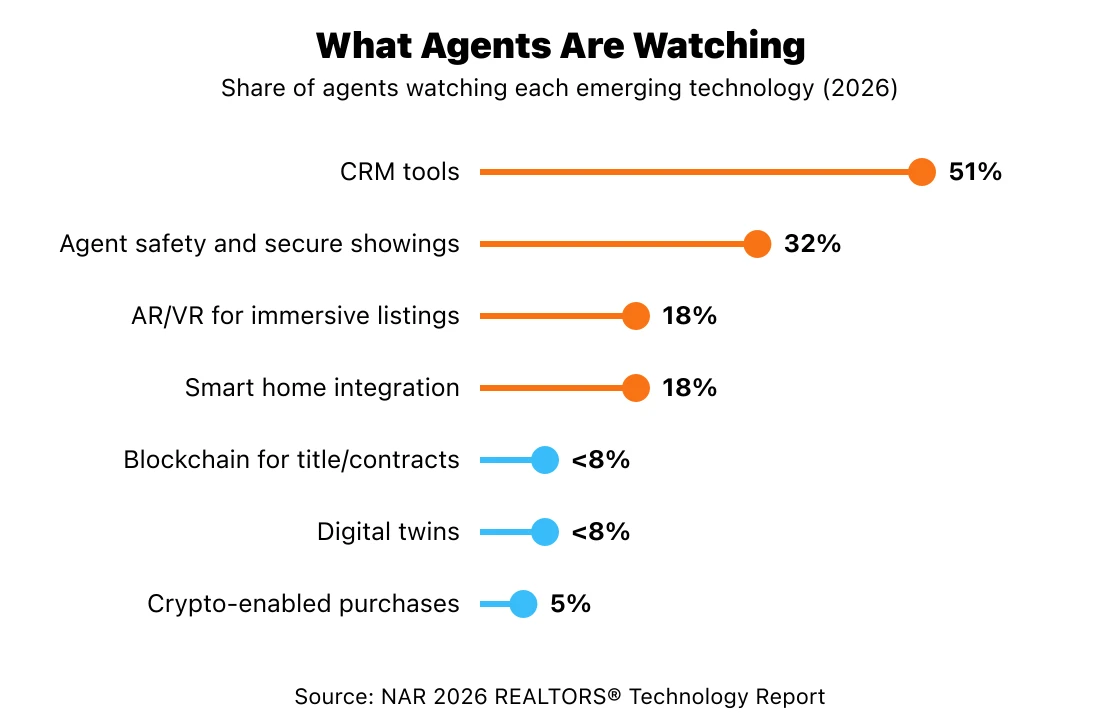
- Blockchain for title and contracts: Fewer than 8% of agents are watching it. It would matter if county recorders and title insurers adopted blockchain technology for property records, and few have.
- Digital twins: Also under 8%. A digital twin, a detailed virtual replica of a building, makes sense for a large commercial property. A three-bedroom house doesn’t need one.
- Crypto-enabled purchases: 5% of agents are watching, and 9% have had a client bring up crypto in a transaction. Until lenders and title companies handle it routinely, it stays an edge case.
- VR showings and the metaverse: 18% are watching virtual reality and augmented reality for immersive listings.
Proptech venture funding was also flat in the first half of 2026: $4.53 billion across 231 rounds, according to the Center for Real Estate Technology & Innovation, as cited by NAR. The money is going to AI and workflow tools, not moonshots.
How to get your real estate business ready for 2027
You don’t need to adopt all ten trends at once. Start with these four:
- Audit your stack and cancel tools that duplicate each other.
- Send every client a wire fraud warning at the first meeting.
- Adopt an AI policy that requires human review of client-facing content.
- Test your website on a phone. Buyers search on mobile, and a slow or outdated IDX search costs you leads.
For the last one, Placester’s AI website builder creates a fast, mobile-ready agent website with built-in IDX search in minutes. The website is only the starting point, though. Placester also handles several jobs agents usually pay separate apps for, which helps with step 1 as well:
- CRM and email: a real estate CRM with drip campaigns, autoresponders, and tracking of what leads do on your site.
- Lead capture and live chat: forms, pop-ups, Google One Tap sign-in, home valuation pages and live chat you can answer from the Placester mobile app.
- Content and social automation: localized blog posts published to your site on a schedule, plus listings and articles turned into video posts for Facebook and Instagram.
- Agent management: brokerages can set up and manage a website for every agent from one place.
If you’re happy with your existing CRM, you can easily connect it to Placester, so you only cancel the tools you no longer need.
AI Websites for Real Estate
Get a custom, ready-to-edit website
in less than 4 minutes.
Frequently asked questions
What are the biggest real estate technology trends for 2027?
The biggest real estate technology trends for 2027 are agentic AI, all-in-one platforms, fully digital closings, fraud prevention, and new rules for how listing data is shared.
What technology do real estate agents use most?
The MLS is the most-used tool (96% of agents), followed by e-signature (79%), showing scheduling tools (68%) and CMA or pricing tools (59%), according to NAR’s 2026 technology survey of about 1,200 agents.
Will AI replace real estate agents?
No. Agents mostly use AI for drafting and routine tasks, while pricing, negotiation, and guiding clients still depend on human expertise.
What is proptech, and what are some examples?
Proptech, short for property technology, is software and hardware used to buy, sell, manage, or finance real estate. Common examples for residential agents include MLS and IDX home search, e-signature platforms, showing scheduling apps, real estate CRM software, and wire fraud prevention tools.
How much do real estate agents spend on technology?
About half of agents spend $50 to $500 a month on technology, 22% spend more than $500, and 18% spend less than $50, according to NAR’s 2026 survey.
Published on