(800) 728 8391



Quick summary:
- 🏡 Real estate has deep roots: Property ownership has shaped how people live, work, and build wealth for thousands of years.
- 👩💼 The industry keeps evolving: Women now make up most of the Realtor community, climate change is driving up construction costs, and more buyers are choosing to work with agents.
- 💰 It’s still a good investment: Whether it’s luxury estates or haunted homes, real estate reflects trends, behavior, and opportunity.
Did you know that the average American homeowner stays in their property almost 12 years before selling? Or that there’s a secret apartment at the top of the Eiffel Tower? In this article, we’ve collected 31 interesting facts about real estate from around the world. Want to hear the hottest, weirdest, and most surprising truths about the industry? Keep reading and see it from a whole new angle.
5 historical facts about real estate
1. The oldest real estate deal is 5,000 years old
Real estate deals aren’t as modern as you might think. Around 3,000 B.C., the Sumerians of Mesopotamia were already signing off on land transactions—only their “paperwork” was written on clay tablets.
These early records listed details about the land, its purpose, and even what crops could grow there. It’s proof that thousands of years ago, people already understood the power of land ownership and the need to make it official.
2. The Hollywood Sign started as a housing ad
Before it became the world’s most famous landmark, the Hollywood Sign was just a giant real estate ad. Built in 1923, it originally read “Hollywoodland” and promoted a new housing development in the hills. When the last four letters came down years later, the sign shed its sales pitch and took on a new life. Now, it’s the ultimate symbol of fame, ambition, and dreams.

3. In the early 1900s, Sears offered mail-order houses
Long before Amazon Prime, there was Sears, Roebuck & Co. At the beginning of the 20th century, Americans could flip through a Sears catalog, order an entire house, and have it shipped by rail straight to their lot. Between 1908 and 1940, more than 70,000 of these mail-order homes were built across the U.S. Today, surviving Sears houses are collectors’ gems—beautifully crafted and instantly snatched up when they hit the market.
4. Matera’s homes have been occupied for 9,000 years straight
Hidden in southern Italy’s Basilicata region, Matera is one of the oldest continuously inhabited towns on Earth. Locals still live in cave homes carved into the rock—the very same dwellings their ancestors occupied nearly 9,000 years ago. According to the Daily Mail, it’s the only place on the planet where people can truly say they sleep under the same roof as their prehistoric family.
5. Realtors have been around for over a century
Back in 1908, a group of real estate pros in Chicago formed what would become the National Association of Realtors. Eight years later, they rebranded as the National Association of Real Estate Boards, and that’s when the term “Realtor” was officially born. It wasn’t just a title—it marked a new standard of professionalism in the growing real estate industry.

5 facts about real estate agents
6. Realtors and real estate agents are not the same
People mix up these titles all the time, but they’re not identical. Every Realtor is a licensed real estate professional—but not every agent is a Realtor. What’s the difference? Realtors belong to the National Association of Realtors (NAR) and commit to a strict Code of Ethics that shapes how they work and serve clients. Regular agents do have a license, but they’re not required to follow NAR’s ethical rules or membership standards.
👉 Curious how that difference plays out in real life? Check out our deep dive on Realtor vs. real estate agent.
7. The USA leads the world in the number of real estate agents
No other country comes close to the size of America’s real estate workforce.
$2M
Data collected by RubyHome shows that the U.S. has over 2 million licensed professionals.
The hotspots? Florida and California lead the way, with 225,563 and 204,678 active agents. These states’ booming housing markets, warm climates, and steady migration trends make them prime territory for real estate careers.
8. Most Realtors are women
Here’s a fact that might surprise some: the majority of Realtors are women.
63%
According to NAR, 63% of Realtors are women.
The typical Realtor is a 57-year-old white female who owns a home and has at least some college education. It shows how deeply women shape the industry—leading real estate transactions, building client trust, and driving business at every level.
9. Brokers earn more than agents
Experience—and a broker’s license—pay off. Data from the U.S. Bureau of Labor Statistics (2024) shows that real estate sales agents earned a median of $56,320 per year, while brokers brought in around $72,280. That’s a solid gap driven by higher responsibility, experience, and managing a team. If you’re thinking about the next step in your career, the broker’s path clearly comes with higher rewards.
👉 You may also be interested in: Average Salary of Real Estate Agents in Every State
10. The average Realtor closes 10 deals a year
According to NAR, the average Realtor manages about 32 properties and closes 10 transactions annually. That might not sound like much at first, but in a competitive market, it represents months of prospecting, negotiations, and client management. Behind every deal are dozens of calls, showings, and follow-ups—proof that real estate is as much about persistence as it is about property.
5 facts about real estate homebuyers
11. First-time home buyers are older than ever
First-time buyers now make up just 21% of the market—the lowest share ever. The data comes from NAR’s 2025 Profile of Home Buyers and Sellers. The same report shows that:
40
years old
The typical first-time buyer is now 40 years old—an all-time high.
This marks a dramatic shift from 2007, when first-timers made up nearly half the market. The reasons are clear: soaring home prices, low inventory, and high interest rates have pushed ownership further out of reach. Add student debt and rising living costs, and it’s no surprise that many younger buyers are waiting longer to purchase their first home.
Jessica Lautz, NAR’s deputy chief economist, notes that this trend leaves new buyers building less wealth and making fewer moves over their lifetime.
12. Married couples still lead, but single women outbuy men
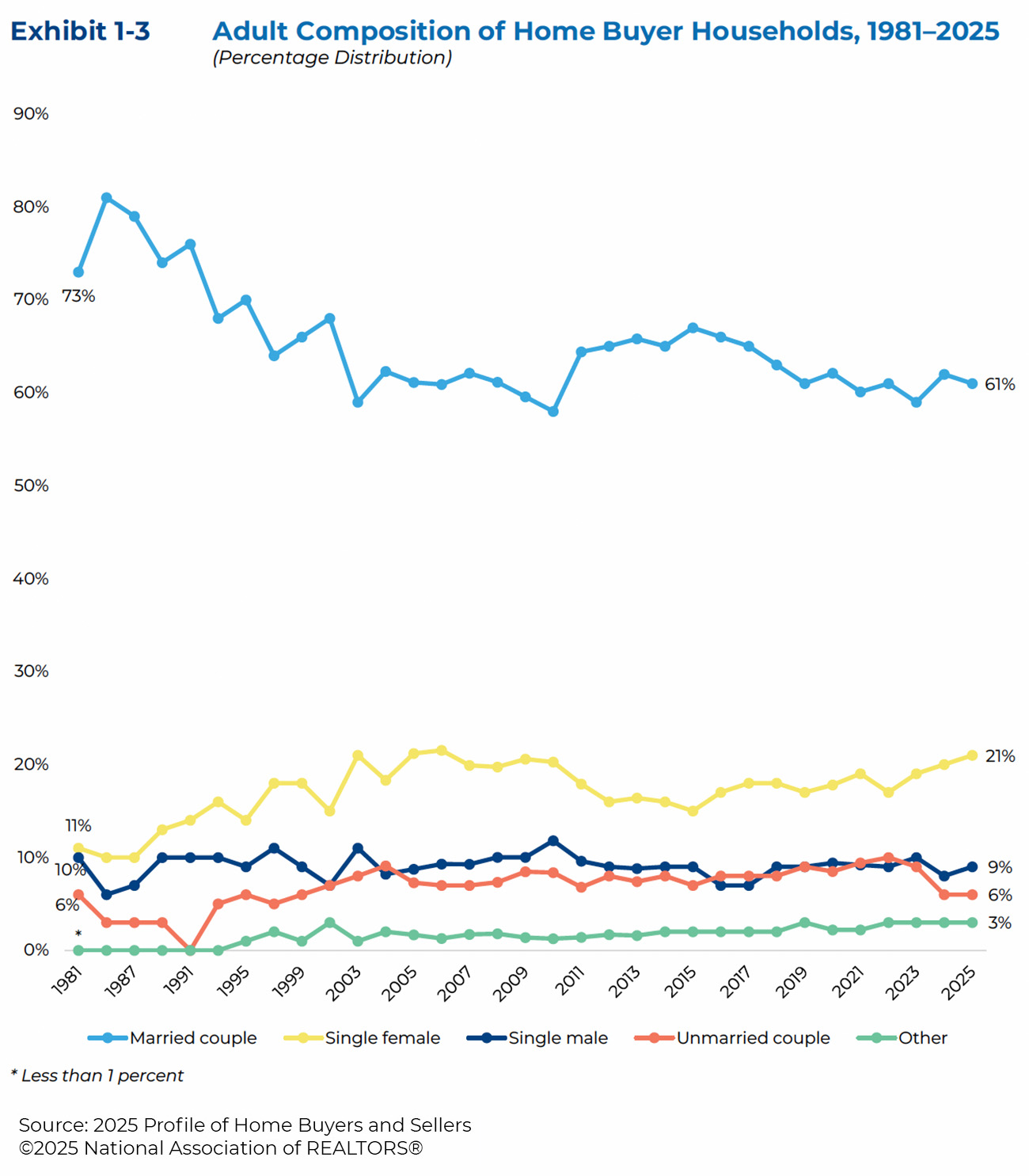
Most homebuyers still shop in pairs.
61%
61% of recent buyers are married couples.
But here’s the twist: among those buying solo, women are far ahead of men. Single females now make up 21% of all buyers and 25% of first-timers, while single males account for just 9% overall and 10% among new buyers.
Families with kids are becoming rarer on the market, too. Only 24% of recent buyers have children under 18—the lowest level ever recorded. With birth rates falling, repeat buyers getting older, and childcare costs eating into savings, today’s housing landscape looks very different from a decade ago.
13. Almost everyone buys with an agent
91%
9 out of 10 buyers work with a real estate agent or broker.
As NAR’s 2025 Profile of Home Buyers and Sellers shows, most say their top reason is simple: finding the right home. Others count on their agent’s negotiation skills to secure the best price and handle the paperwork smoothly. Even with all the online tools out there, nothing beats having a pro by your side.
14. 71% of Americans are putting life on hold to save for a home
Buying a home is reshaping how Americans plan their lives. According to Coldwell Banker’s 2025 American Dream Report, 71% of future homeowners are postponing major life events like marriage, having kids, or even switching careers just to save for a down payment.
Gen Z is feeling it the hardest. A staggering 84% of young adults say they’re delaying milestones—including getting a pet—until they can afford their first home. Despite the struggle, the dream is alive: 56% still believe homeownership is the ultimate symbol of the American dream, ranking it higher than family life, retirement, or career success.
For many, that dream now comes with a new timeline. Over half of potential buyers don’t expect to own a home before turning 40. But it’s not all doom and gloom—experts see a shift toward smarter, more intentional buying. Smaller homes, fixer-uppers, and properties with rental potential could define the next chapter of American homeownership.
15. Most Americans find their homes on the internet
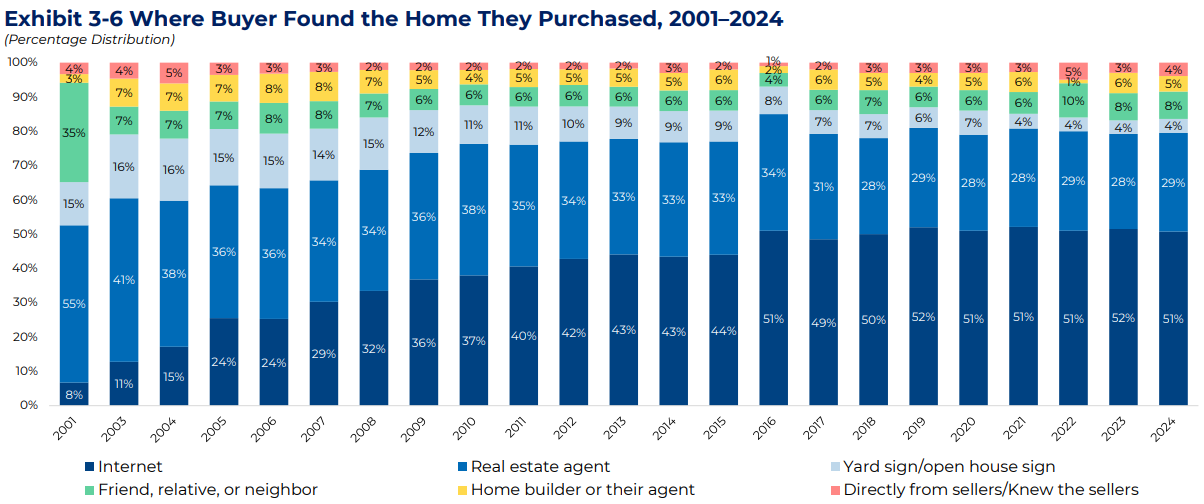
51%
According to the National Association of Realtors, 51% of buyers found their home online.
29% discovered it through a real estate agent. 8% relied on a friend, relative, or neighbor. 5% bought through a home builder or the builder’s agent. Just 4% found their property through a yard sign or an open house, and another 4% bought directly from the home seller.
3 facts about real estate investment & market
16. The U.S. housing market is practically frozen
According to Business Insider, only 28 out of every 1,000 homes changed owners in the first nine months of 2025. That’s the lowest turnover in at least three decades.
Homeowners are holding on to their properties because they locked in record-low mortgage rates during the pandemic. Why trade a 3% mortgage for 7%? On the other side, buyers face sky-high prices and limited inventory. The result? A market where almost no one wants to sell and even fewer can afford to buy.
17. Investors are grabbing a bigger piece of the market
27%
As reported by AP News, investors bought 27% of all homes sold in early 2025.
These aren’t just corporate giants—small-scale landlords and cash buyers are jumping in, too. With high interest rates pushing regular buyers out, investors are finding deals and turning them into long-term rentals. For agents, this shift means fewer first-time buyers and more business-driven transactions.
18. Luxury real estate is on fire
The ultra-luxury market is booming. The New York Post reports that more than 1,700 U.S. homes sold for over $10 million in 2024, up 350% year-over-year. Total sales hit $31 billion, with hotspots like New York, California, Florida, and Colorado leading the pack.
Wealthy buyers are chasing privacy, lifestyle, and tax advantages, not just square footage. While the mid-tier market cools, luxury properties keep breaking records. If you’re in high-end real estate, this is your moment to shine!
👉 Learn how to become a luxury real estate agent!
3 facts about real estate industry in USA
19. Median home price in the U.S. hits around $415,000
Right now, the national median sales price for existing homes sits at $415,200, according to the National Association of Realtors. For newly built homes, the latest data from the U.S. Census Bureau puts the median price at $413,500. That means, whether clients are buying an established property or a brand-new build, they’re looking at similar price points across the country.
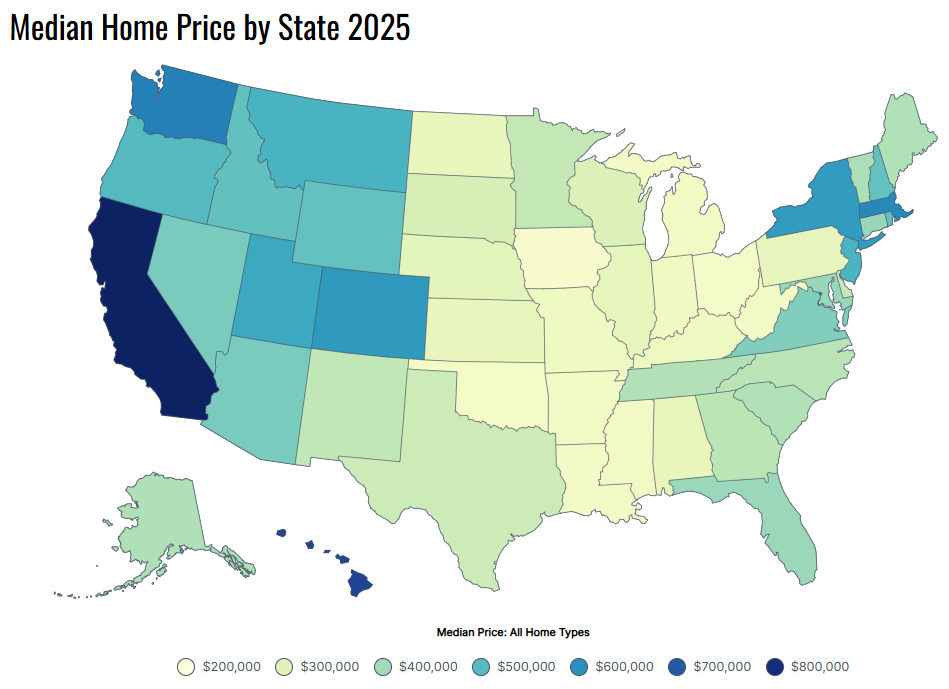
The median price for single‑family homes varies dramatically by state. In some of the priciest markets, you’ll find them listed around $866,000 in California and nearly $976,000 in Hawaii. Meanwhile, in more affordable states like Iowa, the median home price hits only about $231,000.
20. An average homeowner stays in a single property for almost 12 years
11.8
years
A 2024 Redfin study showed that the average duration of homeownership in the U.S. reaches about 11.8 years.
That is down from a pandemic-era peak of 13.4 years five years ago. However, it is still nearly double the tenure from 2005, when the median stay was just 6.5 years.
Some cities take “staying put” to the extreme. Los Angeles leads the nation with a median homeowner tenure of 19.4 years. San Jose follows at around 18 years. San Francisco, Cleveland, and Providence round out the top five.
Two California metros, Los Angeles and San Jose, saw the biggest increases over the last decade. They added 4.8 and 4.6 years, respectively.
21. Climate disasters push annual home repair costs past $23 billion
By breaking records, natural disasters are also breaking budgets. According to the Joint Center for Housing Studies of Harvard University, the cost of repairing homes after wildfires, floods, and hurricanes now totals about $23 billion a year. That’s more than 6% of all home repair spending in the U.S.
Carlos Martín from JCHS points out that climate change is pushing housing costs higher from every angle. Stricter building codes and costly retrofits make new construction harder to afford. Rising insurance premiums add even more pressure—especially in high-risk areas like Los Angeles.
Attribution science now shows just how much climate plays a role. The deadly L.A. wildfires, for instance, were 35% more likely because of extreme heat, dry weather, and strong winds tied to climate change. Those fires caused between $76 and $131 billion in total losses, yet only about $20 billion of that was insured.
With rising risks and shrinking federal disaster aid, the burden of rebuilding increasingly falls on homeowners and insurers.
22. You need a full work week just to cover rent
38.3
hours/month
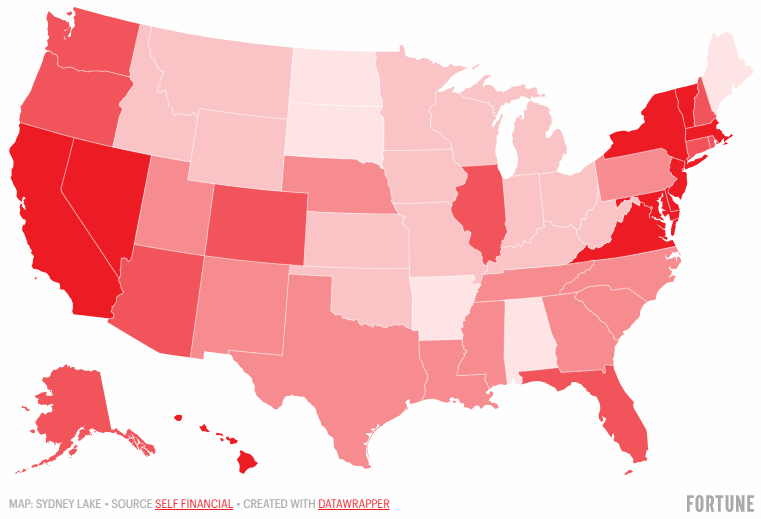
On average, Americans spend 38.3 hours a month just to pay rent, according to Fortune.
That’s basically a full work week. But the number of hours swings dramatically depending on where you live. Some states push residents well past a standard 40-hour week, while others barely break half that.
Here are the five states where it takes the most work hours to cover the average monthly rent:
- Vermont: 60.2 hours
- Hawaii: 59.9 hours
- California: 52.4 hours
- New Jersey: 50.4 hours
- Maryland: 50.3 hours
On the other hand, rent is easiest on the paycheck in states like:
- Maine: 32.3 hours
- North Dakota: 32.2 hours
- Alabama: 31.4 hours
- Arkansas: 31.1 hours
- South Dakota: 27.6 hours
23. FSBO homes sell for $65,000 less than agent-assisted properties
Going it alone can cost you, as reported by NAR’s 2025 Profile of Home Buyers and Sellers.
$360K
Last year, homes sold as For Sale By Owner (FSBO) fetched a median price of $360,000.
That’s $65,000 less than the $425,000 median for properties sold with a real estate agent.
Perhaps that’s why FSBO remains rare: only 5% of sellers choose to go it alone, while the vast majority (91%) rely on an agent. Those who try often do it to sell to family, friends, or neighbors. Others want to avoid paying commission fees. But going solo comes with challenges.
Pricing usually leans on an appraisal or recent neighborhood sales, yet hitting the right number without professional guidance is tricky. Marketing seems limited, and only a few FSBO sellers offer buyer incentives. On top of that, handling paperwork and sticking to the planned timeline can be stressful and confusing.
👉 Read more about FSBO and other key industry terms in our real estate definitions guide.
3 quick real estate facts in numbers
24. In the priciest ZIP 94027, homes sell for about $12 million
Atherton, CA (ZIP 94027) tops the list as the most expensive ZIP code in America. In February 2025, the median home price hit $12 million, according to Redfin. The town attracts tech billionaires and CEOs who value privacy over proximity. Wide lots, tree-lined streets, and strict zoning rules keep new construction rare—and prices sky-high. If your clients are eyeing luxury markets, Atherton is the benchmark for exclusivity in U.S. real estate.
25. The White House has 132 rooms
America’s most famous home is massive. The White House spans 132 rooms, 32 bathrooms, and 6 levels to accommodate presidents, staff, and guests. It also has:
- 412 doors
- 147 windows
- 28 fireplaces
- 7 staircases
- And 3 elevators.
Moreover, residents have access to a tennis court, jogging track, swimming pool, movie theater, billiards room, and even a bowling lane. The house is so big that covering its exterior requires 570 gallons of paint.
Over time, the residence has worn several names, including “President’s Palace,” “President’s House,” and “Executive Mansion.” In 1901, Theodore Roosevelt officially dubbed it The White House.

26. 1% of Americans could theoretically buy every home in the U.S.
The wealthiest 1% own more than 13% of the country’s real estate. Their fortunes have soared amid high rates and housing shortages over the past two years. The NY Post reports that their combined wealth is now enough to purchase almost every home in the nation.
Digging deeper, the top 0.1% alone could buy every property in the 25 largest U.S. metro areas—from New York City to San Antonio. To join this elite club, you need a net worth of at least $11.2 million. Around 1.3 million American households meet that mark, with a combined net worth of $49.2 trillion.
For perspective, the total value of roughly 100 million U.S. homes is $49.7 trillion. This shows how closely the net worth of the richest Americans has tracked home values over the past two decades. It’s a striking illustration of real estate’s role in fueling wealth at the top.
5 fun facts about real estate
27. In Scotland, red doors tell a success story
In Scotland, a red front door means one thing—the mortgage is paid off. It’s a bold way to say, “I own this place, free and clear.” The tradition goes back generations and still pops up in modern neighborhoods. Forget champagne—some homeowners celebrate financial freedom by painting their door red.
28. A knife as a housewarming gift may be a bad idea
In many cultures, giving a knife as a housewarming present is considered bad luck. The sharp edge symbolizes cutting ties and bringing conflict into the home. If you really want to give a gift, there’s an easy fix—attach a coin to the gift. When the new homeowner gives it back to you as “payment,” the bad luck disappears, and the gesture turns into a symbol of respect and friendship.
29. 65% of Americans would consider buying a haunted house
According to The New York Post, nearly two-thirds of Americans (65%) are open to buying a haunted home. 39% said yes outright, while another 26% would consider it under the right circumstances. One in three respondents reports they’ve already lived in a home they believe was haunted.
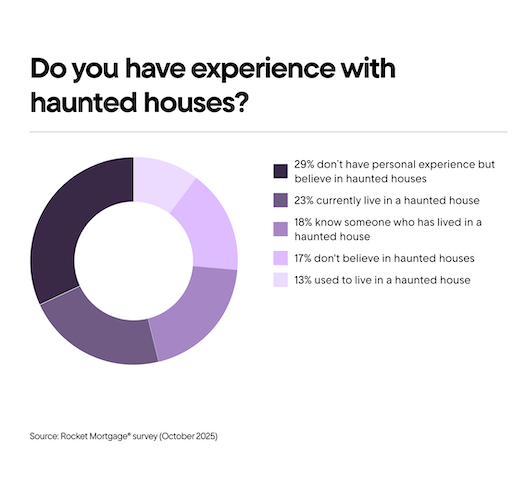
Even if a property comes with paranormal activity, it rarely scares buyers away. Only 18% would sell immediately upon discovering a haunting. 41% would get curious, researching the home’s backstory or even trying to coexist peacefully with the ghost.
Supernatural signs include:
- Mysterious noises (61%)
- Strong presence (64%)
- Apparitions (37%)
- Moving objects (24%).
Most spirits are friendly (43%) or playful (20%), while fewer are spooky (18%) or angry (8%).
Ghosts can affect price, but buyers are flexible. 39% expect a discount of at least 40%. Another 29% would settle for 20–39% off. Only 15% would accept less than a 20% discount. Even deaths on the property or proximity to cemeteries aren’t always deal-breakers.
Real haunted homes aren’t just the stuff of legends—they’re hitting the headlines and grabbing buyers’ attention. Comedian Matt Rife bought Ed and Lorraine Warren’s Connecticut home, complete with the infamous Annabelle doll. The Rhode Island farmhouse that inspired The Conjuring was sold after an abruptly canceled auction. What’s more, New Jersey’s “Watcher House” remains a case study in fear-based valuation, with some ominous letters and dozens of police calls.
30. The largest mall in America has its own ZIP code
The Mall of America is the largest in the U.S. It’s so huge it even has its own ZIP code. The property belongs to the Ghermezian family, who run the Canadian company Triple Five Group. If that name rings a bell, it’s because they also built the West Edmonton Mall in Canada and the American Dream Mall in New Jersey. The Ghermezians, originally from Iran, turned mega-malls into global landmarks—and the Mall of America remains their crown jewel.
31. You could actually live at the top of the Eiffel Tower
High above Paris, hidden at the very peak of the Eiffel Tower, sits a tiny apartment that once belonged to Gustave Eiffel himself. He used it as a private office, complete with a bedroom, bathroom, and sitting area. Today, visitors can step inside and see where the mastermind behind one of the world’s most famous landmarks worked and entertained guests.
32. AI has quietly become a standard tool in real estate offices
Artificial intelligence is no longer a futuristic add-on in real estate — it’s becoming part of everyday work. According to Delta Media, over 87% of brokerages are using AI, a 7% increase in the last year. From writing listing descriptions to analyzing market trends and automating client follow-ups, AI is now embedded in how agents operate. What once felt experimental is quickly turning into an industry standard. Just look at this explosion of AI tools — there’s an army of solutions for every use case.
Key takeaways
The real estate business is full of surprises, and these examples show just how diverse it can be. They’re more than fun facts—they highlight market trends, buyer behavior, and the property information that matters most to clients. Paying attention to these patterns can give you an edge and even inspire your next good investment. With Placester’s website builder, you can easily turn these insights into actionable strategies for smarter deals and better results.
AI Websites for Real Estate
Get a custom, ready-to-edit website
in less than 4 minutes.
Published on