(800) 728 8391



Quick summary:
- Your real estate resume should clearly show results, skills and how you work.
- Simple structure and readable formatting help decision-makers scan it fast.
- Tailoring your resume to the role improves your chances of getting an interview.
- Pairing your resume with a professional website strengthens credibility.
Your real estate resume has one primary job: to get you an interview. The content, format and style of your real estate agent resume are essential to success.
Get it wrong and you risk being overlooked before anyone reads your experience. Get it right and it clearly shows where you fit and what you bring to the table.
Research shows that employers receive around 180 applications per role, but usually only around 3% get invited to interview. In practice, this means five or six applicants (High5, 2026).
In this post, you’ll learn how to structure your resume, what to include and what hiring managers (and ATS software) look for. We’ll also share real estate resume examples and explain why they work, so you can apply the same ideas to your own.
What is real estate agent resume?
A real estate agent resume is a short document that highlights your licensing, experience, skills and market exposure. It shows a brokerage or team leader how you work and where you add value.
Unlike many other industries, real estate hiring is results-driven and peer-led. Hiring decisions tend to focus on what you’ve actually done, such as transaction support, client relationships, local knowledge, lead handling or deal exposure, rather than formal titles or career paths.
That’s why generic resumes often fall short. Real estate resume templates are designed to surface results, relevant tools and hands-on experience quickly. They help future teammates see if you’re a fit at a glance.
Is real estate agent’s resume a bio?
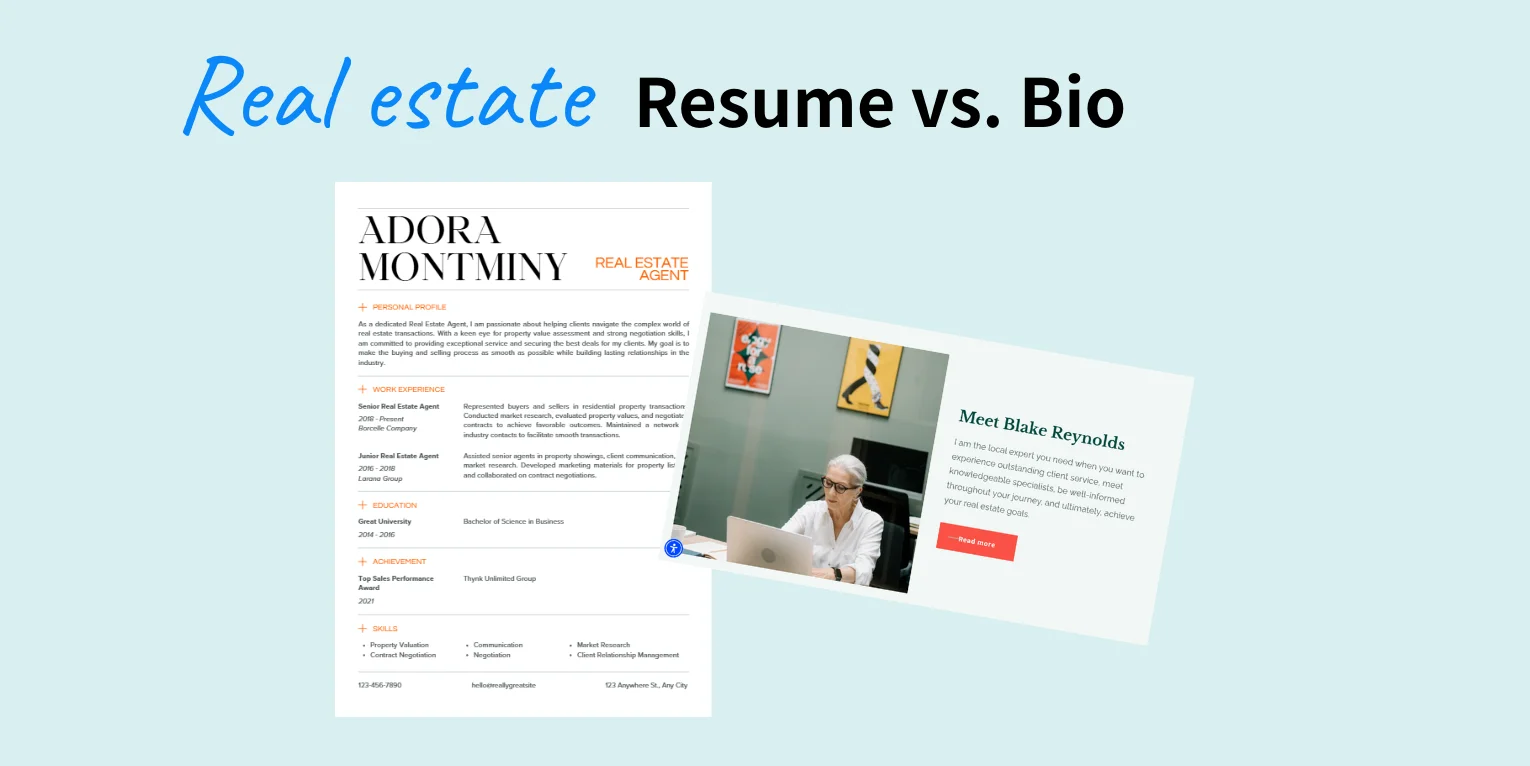
No. Agents use resumes and bios for different reasons, even if some details overlap. A resume helps with hiring decisions, while a bio supports client trust.
Your resume is factual and role-focused. It highlights experience, results and skills that matter to a brokerage or team leader. It answers a simple question:
Can this person do the job I need filled?
The summary section on your resume is not the place to paste your bio. It should stay short and focused on the role.
A bio is more personal and promotional. You’ll use it on your website, social media or listing pages to build trust with clients and customers. Even though a bio should stay concise, it leaves room for light storytelling and personality. A resume does not.
When do you need a real estate agent resume?
You’ll need a resume when you’re starting or changing roles. In the real estate industry, having one ready also saves time when the right opportunity comes up. (You never know!)
Below are a few common situations where a real estate agent resume is especially important.
First job in real estate
If you have no real estate experience yet, your resume needs to show why you’re a good hire despite that. A beginner real estate resume should focus on transferable skills, reliability and motivation. Sales, customer service or local business experience all count here.
You should also highlight anything that shows strong communication or community involvement. Brokerages often care more about work ethic and potential than past transactions. The goal is to show that you’re ready to learn and contribute from day one.
Moving from a solo agent to a team
When you want to join a new team, your resume needs a different focus. Team leaders want to see how you support buyers or sellers and follow systems. Highlight volume, consistency and collaboration.
Here, you need to match your resume to the role you want, not the one you had.
Switching specializations
You’ll also need a resume when changing your specialization, such as moving into commercial work or shifting from buyer representation to listings. In these situations, your resume should clearly reflect that new direction.
For example, a commercial real estate resume uses different language than a residential one. The structure may stay the same, but the emphasis changes to match the role and type of clients you want to work with.
Relocating
When you relocate, your resume helps explain your experience before you have a local track record. It gives decision-makers clarity around your licensing status, transaction history and areas of expertise.
This is especially important when you’re transferring a license or working toward local certification.
A well-written resume also shows how your skills carry over between markets. Sales volume, buyer or listing focus, and team experience still provide useful context while you build new local relationships.
Expert tip: In most cases, your branded real estate website will be even more effective than a resume. If your site shows active listings, past work and testimonials, it presents you as an active and credible professional.
What to include in a resume as a real estate agent?
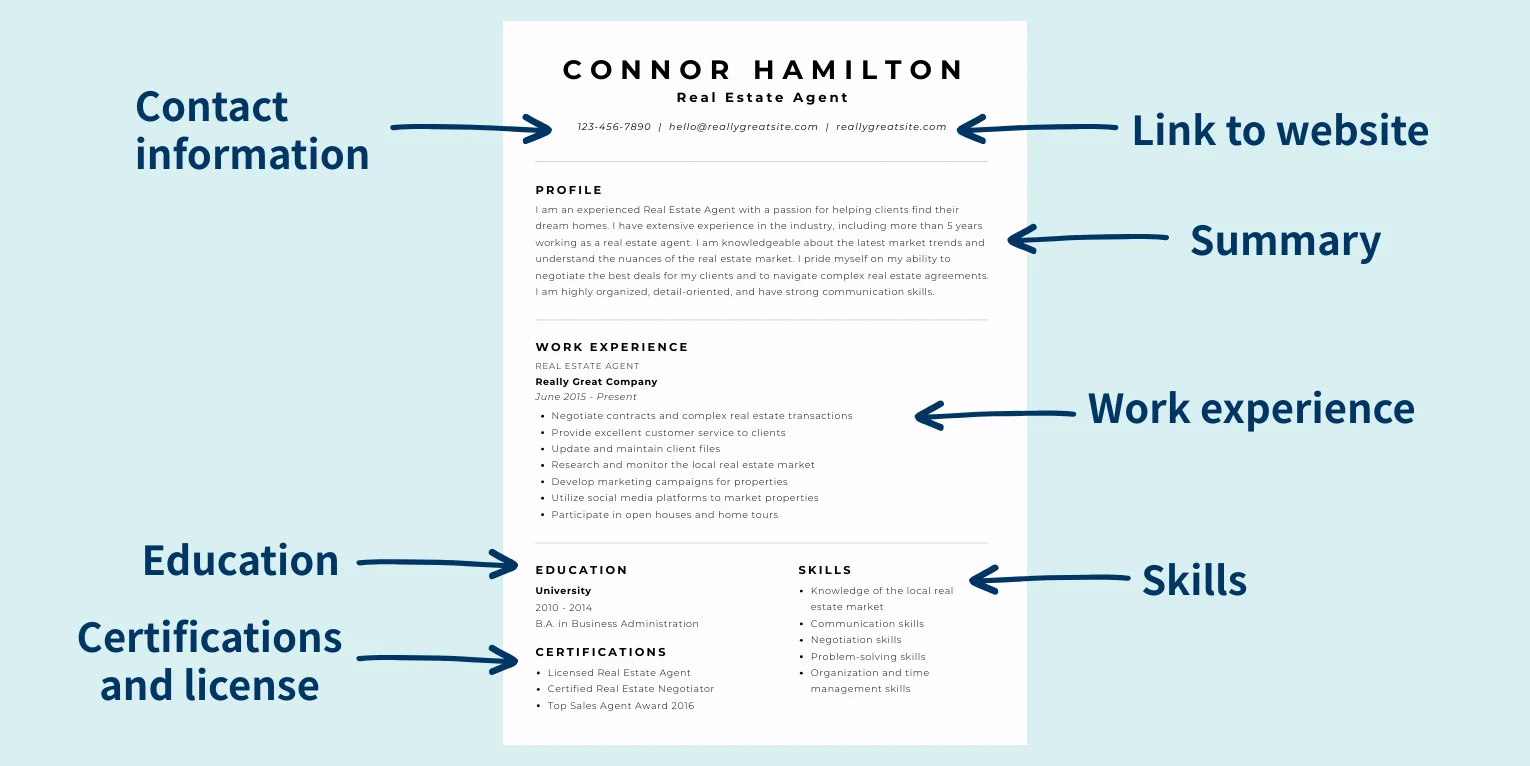
Your real estate agent resume should include your contact details, professional summary, work experience, skills, education, license status and certifications. These sections give recruiters the context they need to assess your background quickly.
The design is also important. Your resume should be clear, easy to scan and structured in a way that highlights relevant information first.
In real estate, HR often plays a smaller role than in other industries. In many cases, the person reviewing your resume is also the person you’ll work with day to day.
“If you can use a resume template that employers are more familiar with, it is more likely that it’ll be read. This makes sense, especially if your resume is in front of a busy real estate professional who’s been tasked with sifting through a pile of resumes.”
— Spencer Burton, Co-Founder and CEO of CRE Agents, in a 2024 publication
Larger companies may use ATS software to screen resumes before a human ever sees them. Once your resume passes that stage, a recruiter or team leader decides who moves forward.
To get through both, your resume needs a clear structure and the right keywords tied to your role and experience.
How to write real estate agent resume step-by-step?
Writing a killer real estate resume is easier when you follow a clear process, starting with the right format, adding all the information, then refining the layout and proofreading. Below, we’ll walk through each step in more detail.
Step 1: Start with the right resume format
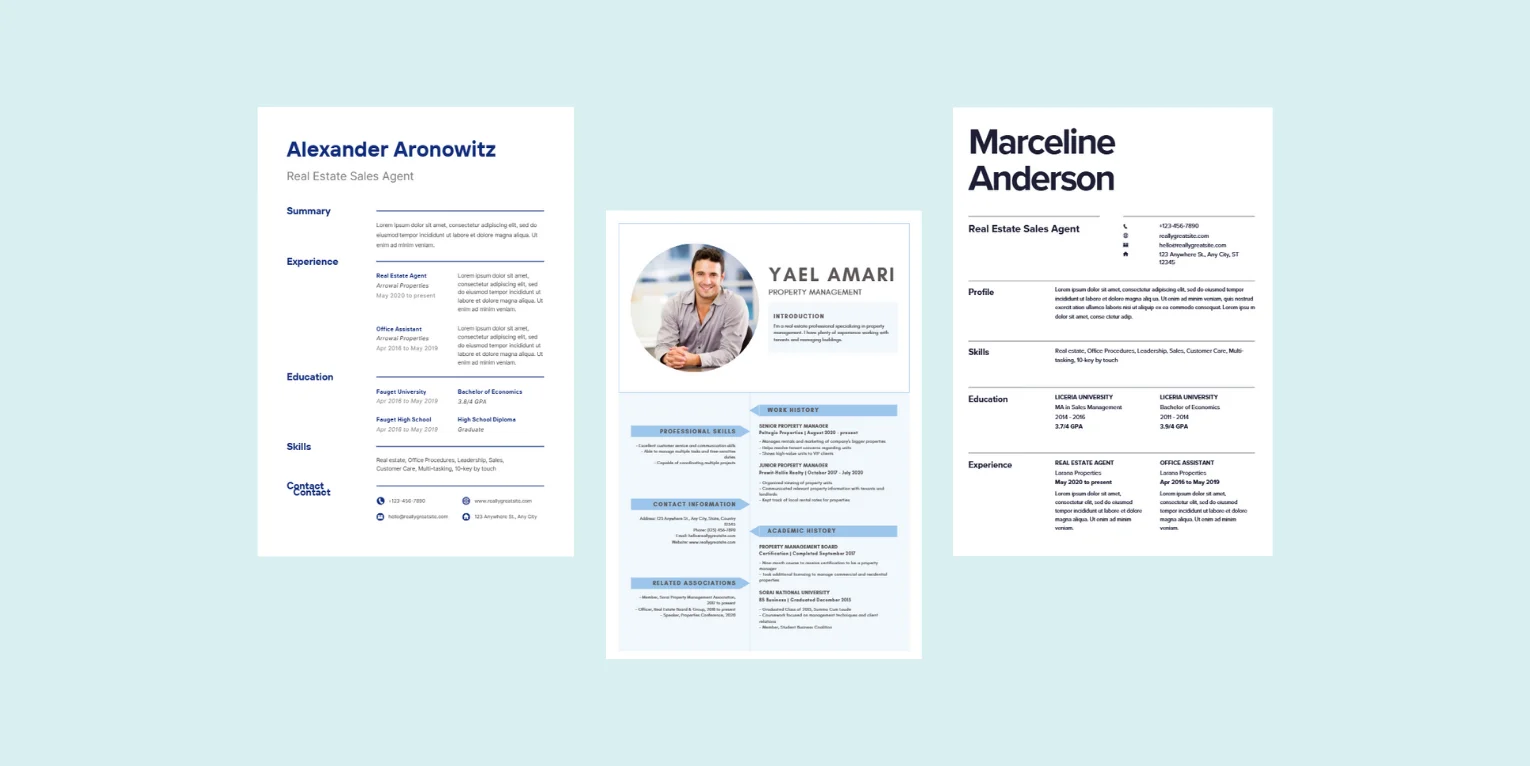
Choose a simple, readable format that keeps everything easy to scan. One page is enough for most jobs. Two pages are also acceptable, if you have extensive experience. Whatever doesn’t fit, you can talk about it in person.
Keep these formatting basics in mind:
- Use clear section headings so key information stands out.
- Stick to standard fonts and font sizes, like Times New Roman, Calibri, Ariel, Helvetica or Verdana at 11pt.
- Align your resume text to the left.
- Keep margins consistent to avoid a cluttered layout.
- If you’re experienced, lead with work history and follow with education and skills. If you’re early in your career, start with education and then list experience and skills.
Step 2: Add contact information
Include your full name, city and state, phone number and professional email address. Place these details at the top of the page, so they’re easy to find.
In most cases, you don’t need to include a photo on your resume. A professional headshot belongs on your website or social network profile, not in the resume itself.
Step 3: Write resume summary
Use the profile section to explain who you are as an agent and what you’re aiming for. Keep it short and role-focused. This is often the first section a hiring manager reads, so make sure you own it.
Step 4: Showcase work experience
List your real estate experience in reverse chronological order. Add your responsibilities and scope next to job titles. Use short bullet points to present key tasks and achievements, so your experience is easy to scan. Hiring managers will understand better how you actually work.
If you don’t have much experience in real estate, you need to win the recruiter with something else.
Lean into what supports success in this industry. Any related sales experience, customer-facing work, property management, volunteer activity, PTA involvement or community groups that show how you connect with people.
Include examples that point to local involvement and an existing sphere. In real estate, they carry as much weight as transaction history.
Use strong action verbs like “led,” “managed,” “collaborated,” “developed,” and “created” when describing your experience. This makes your role and level of responsibility clear at a glance – incredibly important given resumes are usually reviewed quickly.
6–8
seconds
Recruiters typically spend about 6–8 seconds scanning a resume.
Source: Indeed, 2025
Step 5: Highlight skills and technology
The skills section is where you can show your practical abilities. Include real estate skills like lead follow-up, negotiation, listing coordination and client communication, along with sales skills and the languages you speak.
Add the tools you use, such as CRMs, Canva, marketing apps and platforms, listing presentation tools or anything relevant to the role.
Step 6: Show education, licensing and certifications
This section confirms credibility and shows you’re actively developing your skills. Add your real estate license, issuing state and current status, including whether it applies to residential real estate, commercial real estate, or both.
Show relevant certifications or training that support your role. Examples include buyer or seller representation courses, negotiation training, fair housing education or MLS and CRM training.
If you’ve completed any brokerage onboarding programs or continuing education, list those as well.
You can also list college or university education, especially if you’re early in your career or it relates to business, marketing, finance or law.
Step 7: Back up experience with achievements (optional)
Where you can, support your experience with real achievements. Show the number of real estate transactions you supported, deals closed, sales volume or fast response times.
10%
Only about 10% of resumes include measurable results, even though including numbers makes your accomplishments clearer and more memorable to hiring managers.
Source: ResumeNow study from 2025
If you don’t have many stats yet, describe situations where you took responsibility or helped improve results.
Step 8: Link to online presence (optional but recommended)
Include links to your professional website and social media profiles. Your online presence shows more than a resume can and helps confirm your experience. A branded website brings together your listings, past work and testimonials in one place.
>> You may also be interested in: 24 Best Real Estate Website Examples
Step 9: Clean up layout and formatting
Once you have all your copy in place, check spacing, headings and font sizes throughout the document. A clean layout improves readability for both people and AI systems.
Step 10: Proofread and tailor
Your resume must be error-free. Paste it into ChatGPT and ask for a grammar and clarity check.
Another very important step that many jobseekers skip is tailoring the resume to the role you’re applying for. Start with the real estate agent resume job description and look for repeated skills, tools, and responsibilities. Small tweaks will help your resume feel relevant and intentional.
According to a Job Search Trends report for Q2 2025, published by Huntr:
115%
Tailored resumes lead to a 115% higher success rate, more than doubling the chances of moving from application to interview or offer.
Example: If you’re moving into a role focused on real estate finance, adjust your resume to reflect that. Highlight analytical skills, financial modeling, deal evaluation or market analysis to match what decision-makers expect in that role.
7 Best real estate agent resume examples to follow + Tips
The best real estate agent resume examples are the ones that match your situation and career stage. We’ve gathered templates that cover different scenarios, including beginners, career switchers, creative agents, team-focused roles, and larger brokerages. Each one highlights what works and includes a practical tip you can apply to your own resume.
1. Beginner real estate resume template (Resume.io)
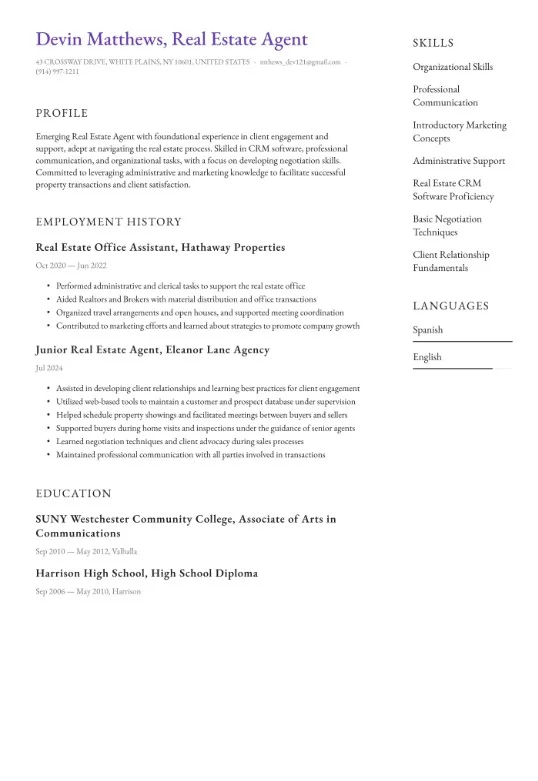
Why Resume.io works here
Resume.io templates work well for beginners because they provide a good structure and guidance from the start. The design stays simple and easy to scan, which is often more important than visual flair. As long as the resume is clear and well organized, a plain layout works in your favor.
It’s a safe choice for agents applying to their first brokerage or team. The templates also help beginners frame transferable experience in a way that fits real estate, even without transaction history.
What to point out
- Clear section order and hierarchy
- Strong summary placement
- Skills and experience framed for entry-level roles
- Clean layout that works with automated screening
Pro tip: If you’re at the beginning of your professional career, you’re best using a resume platform or working with a professional resume writer. You’ll find it easier to follow a set structure to write your resume correctly, avoid common mistakes and present your experience in a way brokerages expect.
2. Career switcher real estate resume example (LiveCareer)
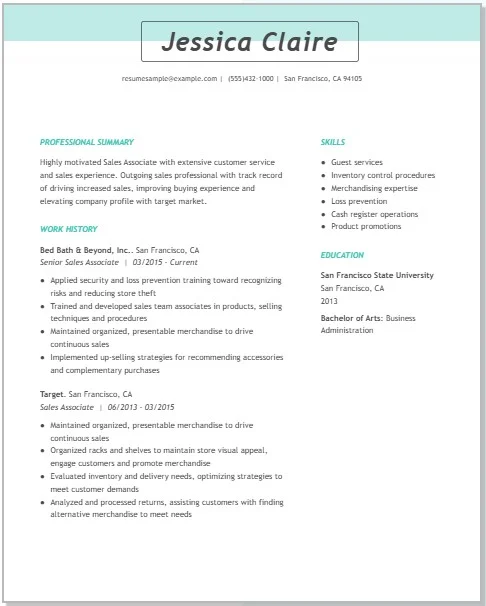
Why LiveCareer works here
LiveCareer’s template works well for career switchers because it provides a clean structure that can be easily adjusted for real estate jobs. It’s simple, readable and ATS-friendly, which makes it a solid base to build on.
With small changes to the summary, skills and experience sections, the template can be tailored to highlight your knowledge and client-facing strengths.
What to point out
- Strong summary section
- Skills framed in context
- Flexible structure
Pro tip: Researchers from West Virginia University found that blue tones like navy, slate and teal signal trust, stability and professionalism. Using blue for headers, lines or small accents can help your resume feel more credible.
>> Also read: Average Salary of Real Estate Agents in Every State
3. Experienced agent resume for teams or brokerages (Resume.org)
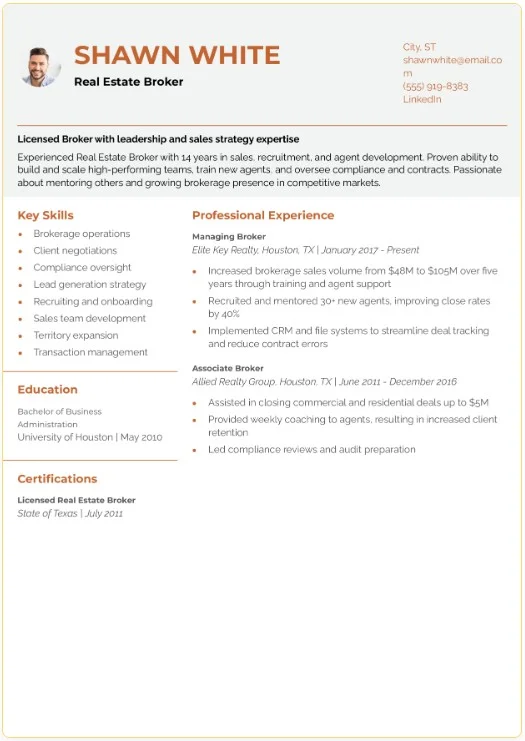
Why Resume.org works here
This resume works well for experienced agents because it focuses on leadership, growth and measurable results. It goes beyond personal production and shows how the candidate contributes to team performance and brokerage operations. That balance is exactly what team leaders and brokerages look for.
Clear metrics help show impact quickly, while the structure keeps everything easy to scan. The resume also shows that this job seeker understands real estate sales and the operational side of the business.
What to point out
- Leadership and team management experience
- Clear performance metrics and growth results
- Strong focus on compliance and operations
Pro tip: If you’ve led a team or worked at brokerage level, show how your work helped others perform better.
4. Brand-driven real estate agent resume example (Canva)
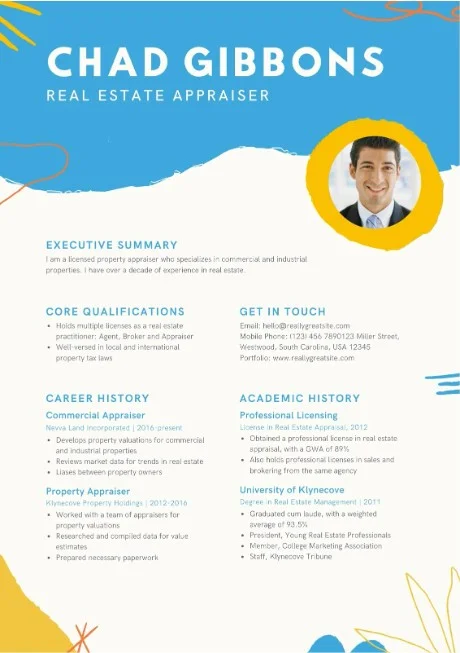
Why Canva works here
Creative Canva templates work well for personal branding and presentation. They’re a good option if design and marketing are part of how you work.
For agents who create flyers, social posts, listing presentations, or other marketing materials themselves, this type of resume highlights those skills clearly. The layout can still stay polished and professional.
What to point out
- Clear visual hierarchy
- Consistent use of color and fonts
- Easy-to-edit sections
- Balance between content and design
Pro tip: Canva has thousands of design templates. Choose one that’s clean and readable. Use Canva to support your brand but not to distract from your experience.
5. Senior or role-specific real estate resume example (Enhancv)
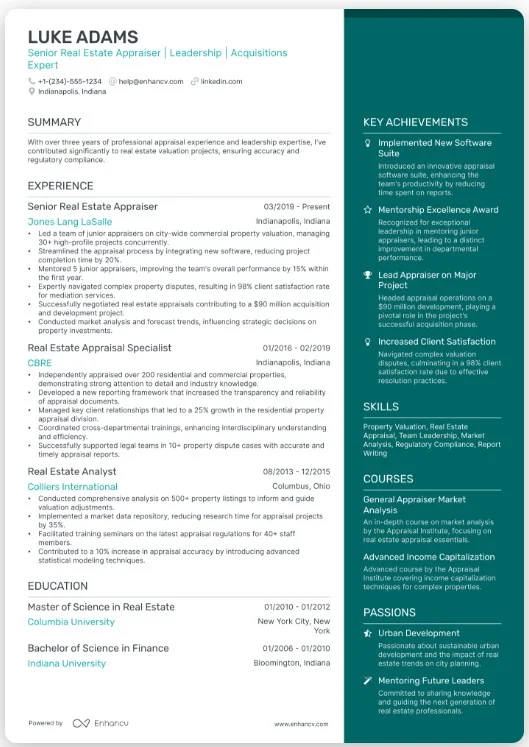
Why Enhancv works here
Using Enhancv’s template is a good option when your real estate experience is broad and layered. It gives you space to explain specialization, leadership and progression without forcing everything into long blocks of text.
The layout helps keep the complex experience readable. Even when there’s a lot to say, the resume can still fit on one page and stay easy to scan.
What to point out
- Clear senior-level summary
- Strong focus on achievements and impact
- Skills tied directly to role responsibilities
Pro tip: If you’re applying for a specialized or senior role, use the summary to clearly state your expertise and scope so expectations are set from the start.
6. ATS-focused real estate resume example (QuickCV)
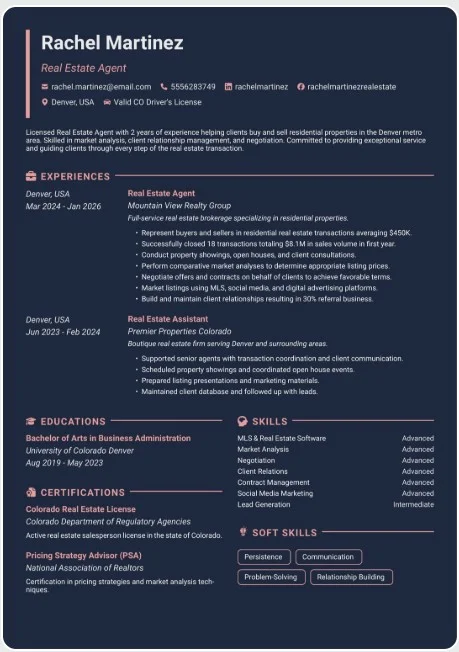
Why QuickCV works here
If you’re applying to a larger brokerage or a more structured team, your resume needs to follow clear conventions. An overly creative or cluttered layout can work against you in these environments.
QuickCV templates are designed with automated screening tools in mind. They use a clean, well-organized structure, role-specific skills and measurable achievements that are easy to scan. At the same time, the layout still highlights what real estate hiring managers care about, which helps your resume move past the first screen and reach a real person.
What to point out
- Simple layout
- Keyword-ready sections
- Focus on key skills and achievements
- Minimal design elements
Pro tip: To find the right keywords, start with the job description. Look for repeated terms related to skills, tools and responsibilities, then reflect those words naturally in your summary, skills and experience sections.
7. Tailored by AI real estate resume example (JARA Match)
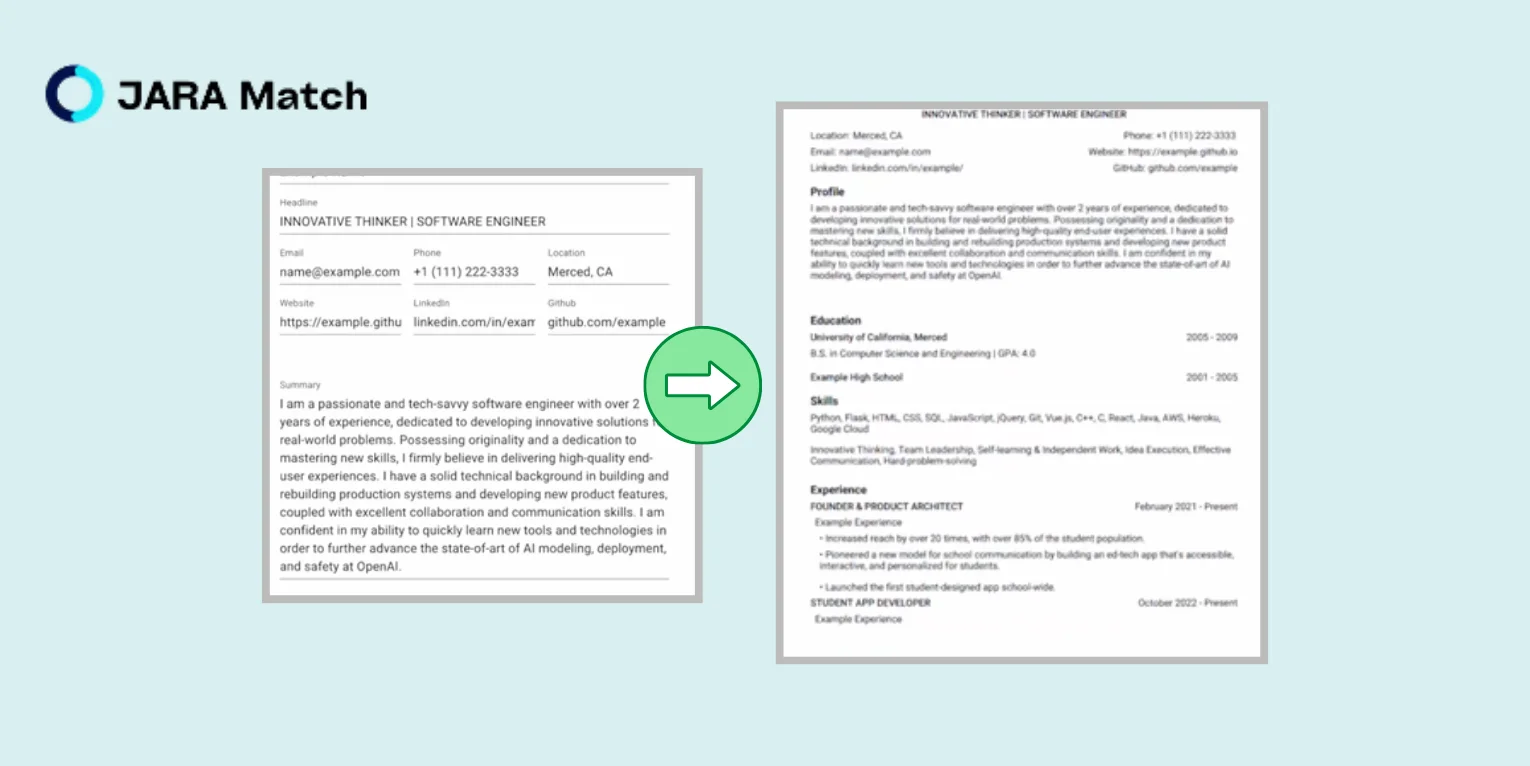
JARA Match uses generative AI to tailor your resume to a specific role. You start with one main resume, which you can upload or import from LinkedIn, then add a job description. The tool creates a personalized version that highlights the skills and experience most relevant to that position.
JARA Match is also available as a Canva app, so if you’re familiar with Canva, you can easily adjust both the content and layout in one place.
What to point out
- Job description analysis
- Keyword and phrasing suggestions
- Role-specific resume adjustments
- Integration with Canva
Pro tip: Once your resume is tailored, apply the same logic to your cover letter. Statistics show that most recruiters still read cover letters and many review them before the resume.
94%
of hiring managers say cover letters influence interview decisions, with 1 in 4 calling them “very important.”
Source: Resumegenius data from 2026)
Conclusions
A real estate resume plays an important role in building your career in real estate. It shows where you fit and what you bring to a team or brokerage.
When crafting your resume, make sure it speaks directly to your future colleagues. Keep it concise, well-formatted and tailored to the role you’re applying for. A clear structure and relevant details help decision-makers quickly see your potential.
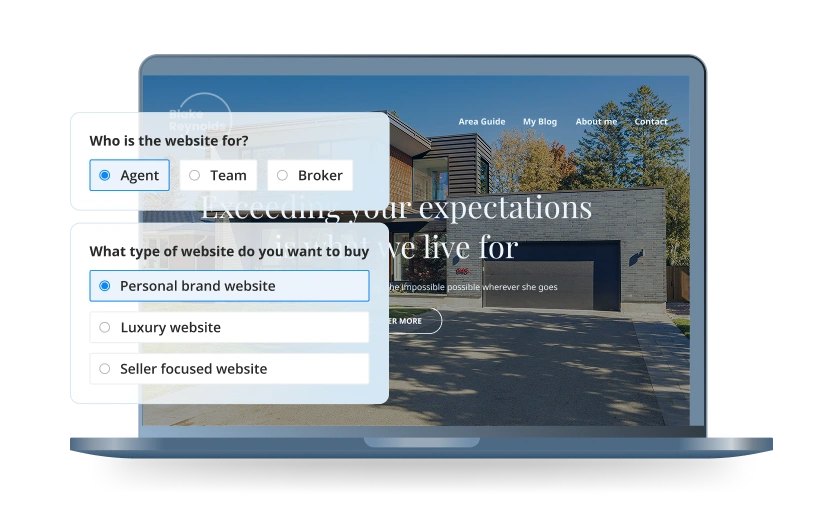
To further support you as you plan your career, Placester helps real estate professionals build a professional website without technical work. With IDX integration, customizable templates and built-in marketing tools, your website becomes a place you can point your sphere to and show how you work.
Try Placester’s AI website builder to create the first draft of your real estate website in under 5 minutes, then refine it as your business grows.
AI Websites for Real Estate
Get a custom, ready-to-edit website
in less than 4 minutes.
FAQ
How is a real estate agent resume different from a standard resume?
A real estate agent’s resume focuses more on results and hands-on experience than job titles. Transaction support, client relationships, lead handling and local real estate market exposure often matter more than a linear career path.
How to list real estate license on resume?
List your real estate license in a dedicated “Certifications & Licenses” section or at the top of the “Education” section. Include the license type, issuing state and current status. If you’re in progress or transferring your license, clearly note that as well.
How to create a real estate agent resume with no experience?
A beginner real estate resume should highlight transferable skills, customer-facing work and local involvement. Sales roles, service experience, volunteering and community groups can all show you’re a good fit for the role.
What skills should be highlighted on a real estate resume?
The most desirable real estate skills for resume include a mix of soft skills and practical skills. Soft skills like communication, negotiation, interpersonal skills, organization and relationship building are key because the role is people-driven. Practical skills such as lead generation, market analysis, CRM use, contract coordination and marketing tools show how you work day to day. The exact mix should always match the role you’re applying for.
How long should a real estate resume be?
A real estate resume should usually be one page. Two pages are acceptable for experienced real estate agents with a strong production record or leadership responsibilities.
Should I include sales numbers and performance metrics on my resume?
Yes, you include numbers whenever possible. Transactions supported, deals closed, sales volume or response times make your experience easier to remember and compare.
What is the best resume format for real estate agents?
The best format is clean, simple and easy to scan. A reverse chronological format works well for most agents, with clear sections and minimal design elements.
Should I include a cover letter with my real estate agent resume?
Yes, you should include a cover letter when applying to teams or brokerages. A tailored cover letter helps explain your fit, especially when changing roles, markets or career stage.
What are common resume mistakes to avoid in real estate?
The biggest resume mistake in real estate is not tailoring it to the role you’re applying for. Using the same document for every brokerage or team makes it harder to see fit. Other common mistakes include vague descriptions, missing numbers, cluttered layouts and turning your resume summary into a personal bio instead of a role-focused overview.
Published on
(Last updated on
)