(800) 728 8391


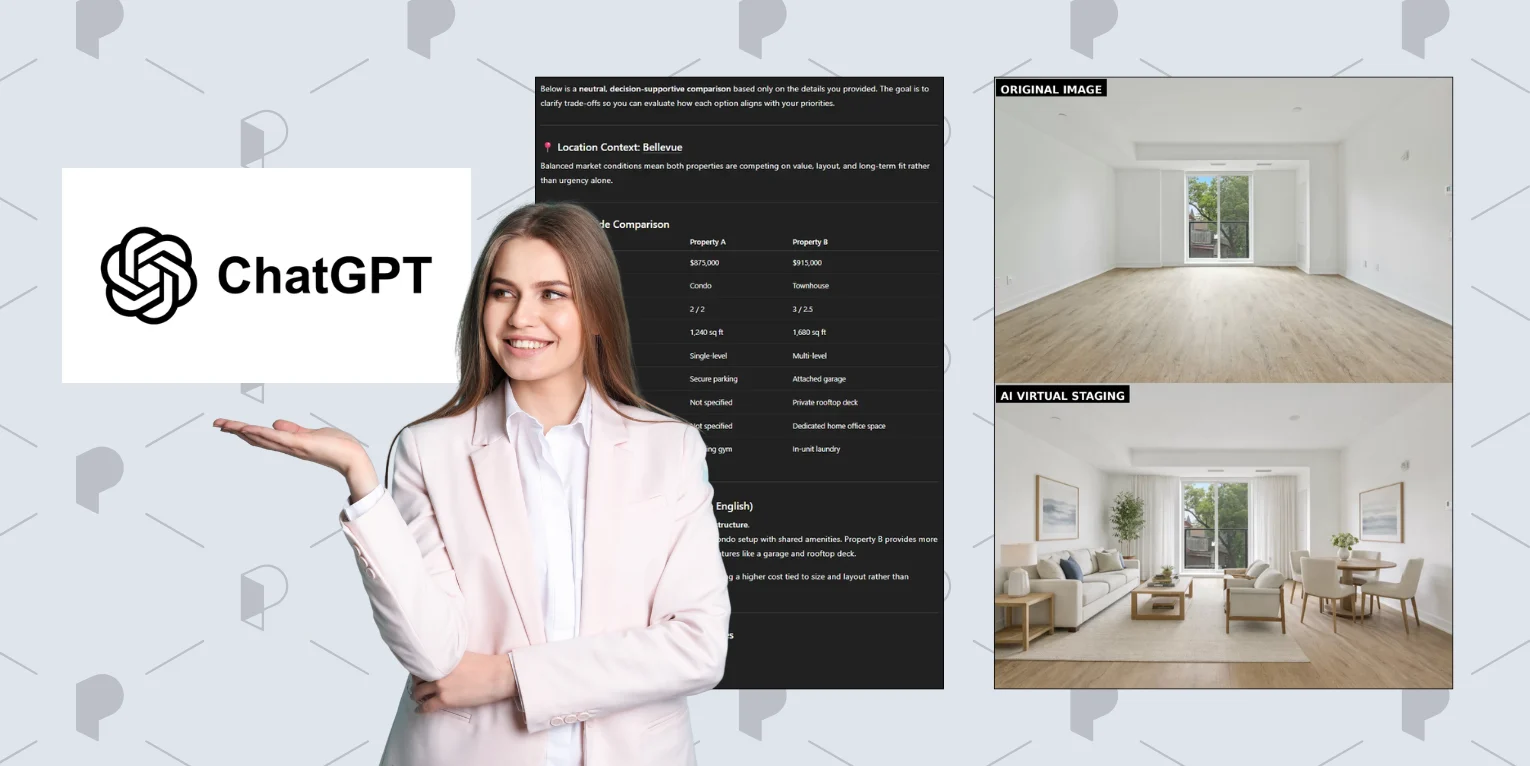
Quick summary:
- 🤖 ChatGPT works best as support, not autopilot. Use it to draft, organize, and clarify. Stay in control of decisions and the final output.
- ✍️ Strong results start with a strong prompt. Be specific, add context, and set limits. That’s how you avoid generic output.
- 🏡 ChatGPT covers core real estate tasks. Agents use it for listings, follow-ups, emails, content, and market explainers. It can save hours each week.
Artificial intelligence (AI) is already part of everyday business operations. Companies across industries are using it in everyday work, and real estate is no exception.
68%
In the U.S., about 68 % of real estate agents now use AI tools in their business.
Source: NAR’s 2025 Technology Survey
Real estate professionals reach for many kinds of AI tools, with generative AI playing the biggest role. Solutions like ChatGPT can write text, summarize information, and generate ideas quickly. How do you actually unlock this power? Through prompting—that means giving clear, specific instructions.
Below you’ll find 15 real examples of how agents can use ChatGPT right now, along with ready-to-copy prompts you can use immediately.
Understanding ChatGPT prompts in general
A prompt is the instruction you give ChatGPT or any other GenAI tool. It tells what to do, how to do it, and what the result should look like. The clearer the prompt, the better the output. Vague input leads to generic results, while specific instructions produce useful work.
ChatGPT reads your prompt and predicts the best response based on context, patterns, and examples it has learned. It does not know your goal unless you state it. That’s why details matter. To get satisfying results, pay attention to:
- Role
- Audience
- Location
- Tone
- Format
- Constraints.
Think of a prompt as a brief you would give a human assistant. The quality of the brief sets the ceiling for the outcome.
Here is an example of a basic ChatGPT prompt for real estate agents:
Act as a real estate agent in Austin, Texas.
Write a short listing description for a two-bedroom condo downtown.
Audience: first-time buyers.
Tone: clear, professional, and friendly.
Avoid hype and vague phrases.
Length: up to 120 words.
ChatGPT for real estate agents — top 15 use cases
AI isn’t just a curiosity in real estate anymore.
58%
ChatGPT is the most popular AI tool among real estate agents in the U.S. It is used by 58% of agents, followed by Google Gemini at 20%.
Source: NAR’s 2025 Technology Survey
That shows how generative AI already fits into daily workflows for many professionals. Here are the key ways real estate agents can use ChatGPT right now:
1. Listing descriptions
When you come back from a showing with messy notes, ChatGPT helps you turn them into usable copy fast. It works well for structuring details, and you still decide what matters. The AI just saves you from staring at a blank page.
👉 Get practical tips on writing real estate listing descriptions.
2. Lead follow-ups
Not every lead needs the same reply. ChatGPT lets you adjust the message based on where the lead came from and how warm it is. That matters when you want to sound responsive without typing every message yourself.
3. Email sequences for nurture
Instead of writing emails one by one, you can map the whole flow at once. ChatGPT helps you plan what to say now and what to say later. That keeps communication consistent even when you get busy.
👉 Learn more about real estate email drip campaigns in our complete step-by-step guide.
4. Market updates and summaries
Raw stats confuse most clients. ChatGPT makes it easier to explain what those numbers actually mean for someone buying or selling today. That turns data into context you can use in emails or conversations.
5. Virtual staging and visualizations
ChatGPT can help you plan and generate virtual staging for empty rooms. This makes it easier to show scale and function without changing the real features of the property.
6. Social content ideas
When posting feels forced, ChatGPT lets you find angles tied to what you already do. A price change, an open house, a client question… You stop guessing what to post and start using real moments from your work.
👉 Get expert social media advice for real estate agents.
7. Objection handling practice
You can rehearse tough conversations before they happen. ChatGPT plays the role of a hesitant buyer or a skeptical seller. That gives you a safe way to test responses and improve your wording.
8. Pricing strategy briefs
Explaining price is often harder than setting it. ChatGPT helps you lay out comps and market signals in plain language. Sellers understand the logic instead of arguing about emotion.
9. Blog articles for real estate websites
Use ChatGPT to draft helpful blog posts that answer real questions buyers and sellers ask. This works well for market explainers, neighborhood guides, and educational content tied to your local area.
👉 Explore 100+ high-converting real estate blog topics.
10. FAQ pages for listings
Buyers ask the same questions after showings. ChatGPT lets you collect and answer them once. That reduces repeat messages and saves time.
11. Comparative property briefs
When buyers choose between homes, details blur together. ChatGPT makes it easier to summarize differences in a clear way. That supports faster, more confident decisions.
12. Video script drafts
If you freeze on camera, structure helps. ChatGPT gives you a rough outline, so you know what to say before recording. You stay focused and cut retakes.
👉 Discover real estate videos every agent should watch in 2026.
13. Case studies
After a closed deal, details fade fast. ChatGPT helps you organize the story while it’s still fresh. It turns your notes, emails, and timelines into a clear case study that you can use during listing presentations.
14. Open house scripts
Before the event, you can plan how to talk to visitors. ChatGPT helps you prepare questions that feel natural and useful. After the open house, follow-ups become easier because you already know what to ask.
15. Personal branding
With ChatGPT, you can generate logo ideas, color palettes, slogans, and basic marketing assets. This helps you build a consistent visual and verbal identity.
👉 See 15 proven branding ideas for real estate agents.
When using ChatGPT by real estate agents is a bad idea
Using ChatGPT is a bad idea when legal risk, sensitive data, or hard facts are involved. In such cases, artificial intelligence can create problems instead of saving time. The examples below show where agents should slow down and step in personally instead of leaning on GenAI:
⚖️ When you need legal advice or contract language, you’ll rely on
ChatGPT can draft a starting point, but it can also miss state-specific rules or add risky wording. Don’t use it as your final source for contracts, disclosures, or legal interpretations. Treat AI text like a rough draft and run it through your broker or attorney.
🏠 When you write anything that could violate Fair Housing rules
AI can accidentally generate “preference” language in listing copy or ads. That would put you in Fair Housing trouble even if you didn’t mean it. Review every public-facing line and keep the focus on the property, not the “type of person” who should live there.
🔒 When you’re about to paste sensitive client data
Never drop SSNs, bank info, IDs, account numbers, or full financial details into a chatbot. Real estate deals carry high-value personal data, and privacy mistakes can get expensive fast. Keep prompts sanitized and use placeholders instead of real identifiers.
🧾 When you’re tempted to generate reviews or testimonials
Don’t do it. Fake reviews (including AI-written ones that claim to be real customer experiences) fall into “deceptive” territory. The Federal Trade Commission (FTC) has already penalized companies for using AI to create fake testimonials.
🖼️ When you edit listing photos in ways that change reality
Virtual staging and AI edits can help, but they can also mislead buyers if you add features or hide problems. In California, agents must clearly label digitally altered listing photos starting January 1, 2026. Even outside CA, over-editing can blow up trust.
📈 When you need hard facts, and you didn’t verify them
ChatGPT can sound confident while being wrong. Unless you verify with a primary source, don’t rely on it for:
- Interest rates
- Local inventory numbers
- Zoning details
- HOA rules
- Permits
- Tax figures.
🧑💼 When you want it to talk to clients without your review
Auto-sending AI-written messages makes mistakes public. One wrong promise or detail can cost you the relationship. Draft with AI, then edit as a human who owns the outcome.
📋 When you paste in other people’s copyrighted content
Copying MLS remarks from other agents or lifting blog sections can cause legal issues. NAR also flags copyright and transparency as key areas to handle responsibly with AI. Write original content and cite sources when needed.
🧯 When the situation is sensitive or emotional
Think: divorce, foreclosure, death in the family, job loss. AI can help you draft a respectful message, but you should choose the final words. Clients remember how you handled hard moments.
What are key elements of effective ChatGPT prompt?
You build effective ChatGPT prompts on a clear identity, relevant context, and defined boundaries. When you precisely define what you want and who the AI should act as, the output becomes useful instead of generic. The elements below show how to structure prompts so ChatGPT works like a reliable assistant:
1️⃣ Set the role
Tell ChatGPT who it should act like. This keeps tone and decisions consistent. Role-setting is a core best practice across major prompting guides.
Example:
Act as a real estate agent in Phoenix...2️⃣ Start with the task
Say what you want first. Put the job to do in the first line. This improves output quality compared to burying the ask in background details.
Example:
Write a follow-up email…3️⃣ Add context that changes the answer
Give only the details that matter for the output. Useful context for agents includes city/state, property type, goal, or channel.
Example:
Write a listing description for a two-bedroom condo in Miami, aimed at first-time buyers, for MLS...4️⃣ Put guardrails in writing
Constraints prevent “creative” mistakes. These include overpromising, made-up facts, or Fair Housing issues.
Example:
Avoid Fair Housing risk language. Don’t invent facts. Keep it under 140 words.5️⃣ Demand a clear output format
Don’t hope ChatGPT figures it out. Tell it the format.
Example:
Return a table with columns: Hook / Script / CTA.6️⃣ Use examples when you care about style
If you want your voice, show it. Paste a short sample and ask ChatGPT to match the tone. Examples reduce misinterpretation.
Example:
Here’s a short sample of my writing. Use a similar tone, language, and sentence structure in your response.7️⃣ Tell it how to handle uncertainty
For anything factual, require verification behavior.
Example:
If you’re not sure, say “Not sure” and list what I should verify.👉 Check out 13 AI tools built for real estate agents.
15 Best ChatGPT prompts for real estate agents (by use case)
In this section, we turn theory into practice. Below you’ll find ready-to-use ChatGPT prompts grouped by real estate tasks. Each of them reflects work that agents handle every week. Treat it as a swipe file. Copy a prompt, adjust the details, and put it to work right away.
1. Listing description prompt
Use ChatGPT when you already have notes from a showing and need a clean property description fast. Start by pasting raw details about the home. Focus on specific information like layout, upgrades, and location context. The goal is a clear property listing that highlights key features and speaks directly to potential buyers.
Ask ChatGPT to structure the copy, not invent facts. You review the result and adjust the tone.
Example prompt:
Act as an experienced real estate agent writing a property listing description for MLS and online portals.

Property details (use only the information provided):
– Location: [city, neighborhood, state]
– Property type: [single-family / condo / townhouse]
– Bedrooms / bathrooms: [# / #]
– Square footage: [____ sq ft]
– Lot size (if applicable): [____]
– Year built: [____]
– Key features: [upgrades, layout, finishes, parking, outdoor space, views]

Writing requirements:
– Use accurate, fact-based language only
– Do NOT exaggerate, speculate, or guarantee outcomes
– Avoid discriminatory or exclusionary language
– Follow standard MLS compliance and fair housing guidelines

Structure guidelines:

1. Strong opening sentence highlighting the home’s main appeal

2. Clear, concise description of layout and living spaces

3. Highlight standout amenities and selling points

4. Brief mention of location benefits (without overpromising)

5. Clean, professional closing sentence

Style & tone:
– Professional, neutral, and inviting
– Short, readable sentences
– Easy to scan
– No emojis, no sales hype

Length: 120–200 words

Output should be ready to publish, written in plain English, and suitable for MLS, Zillow, and Realtor.com.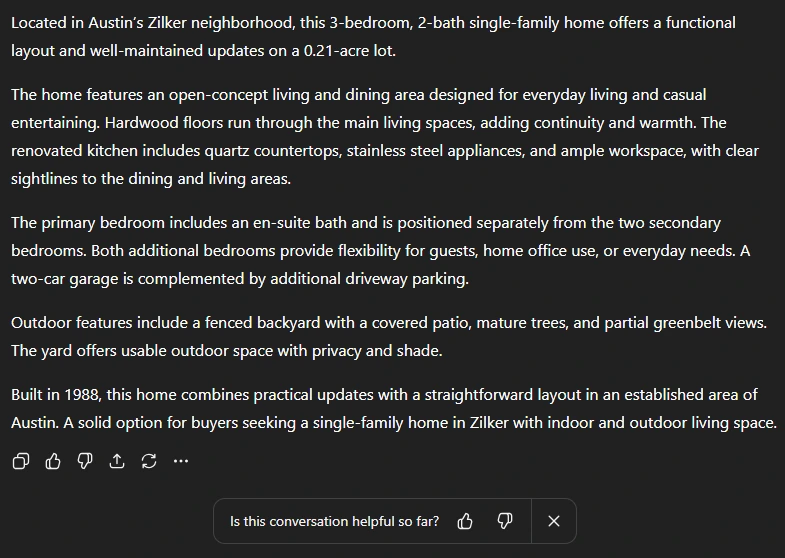
2. Lead follow-up prompt
After a form fill or an open house visit, you don’t have to guess what to say. Instead, give ChatGPT context about the lead. You get a message that fits the moment. That helps you stay responsive, even when you handle many leads at once.
This approach also supports cold calling follow-ups. You can prepare short messages for voicemail, SMS, or email before you pick up the phone. That way, every touchpoint moves the conversation closer to the next step, which makes it easier to close more deals.
Example prompt:
Act as an experienced real estate agent following up with a new lead.
Write a personalized follow-up message that builds trust and opens a conversation.

Lead context:
– Lead source: [website form / open house / Zillow / social media / referral]
– Time since first contact: [same day / 1–3 days / 1 week]
– Lead type: [buyer / seller / homeowner / investor]
– Location interest: [city / neighborhood / ZIP code]

Message goals:
– Acknowledge how the lead came in
– Show relevance to their situation
– Ask one simple, open-ended question
– Make it easy for them to respond

Writing & tone guidelines:
– Friendly, human, and conversational
– Short sentences and plain English
– No pressure, no urgency tricks
– Avoid buzzwords and scripted sales language

Format & length:
– Suitable for email or text message
– 60–120 words max
– One clear next step (reply, quick call, or question)

Trust & compliance rules:
– Do NOT promise results or timelines
– Avoid assumptions about readiness to buy or sell
– Sound like a real local agent, not automation

End the message in a low-pressure way that invites a response.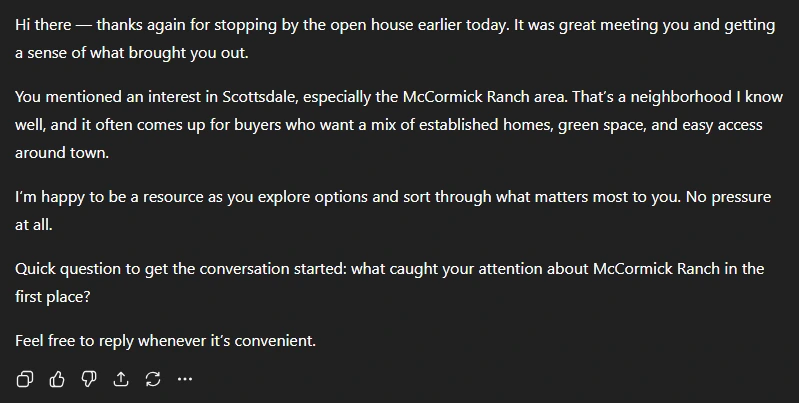
3. Email marketing prompt
Use this prompt when you want to create an email that guides buyers or sellers through the next steps. Tell ChatGPT who you’re writing to and where they are in the process. Then choose the format. A short newsletter works well for market updates. A series of emails fits onboarding, follow-ups after a showing, or warming up cold leads.
ChatGPT helps you plan the flow before you write. You can outline topics, timing, and tone in one go. Then, review the copy and add a personal touch.
Example prompt:
Act as an experienced real estate agent and email marketer.
Write a high-quality email for my real estate audience that feels personal, helpful, and trustworthy—not promotional.

Email goal: [educate / nurture leads / re-engage past clients / announce a market update / promote an open house]
Audience: [buyers / sellers / homeowners / past clients / sphere of influence]
Location focus: [city, neighborhood, or state]

Content guidelines:
– Open with a strong, relatable first line (no generic greetings)
– Share 1–2 practical insights relevant to the reader’s situation
– Keep explanations simple and jargon-free
– Write in a warm, conversational tone
– Avoid hype, pressure, or unrealistic promises

Structure requirements:
– Short paragraphs (1–3 sentences max)
– Clear flow: hook → value → takeaway
– One clear, soft call to action (reply, schedule a call, ask a question)

Compliance & trust rules:
– Do NOT guarantee outcomes or pricing results
– Avoid legal or financial advice phrasing
– Focus on education and local expertise

Length: 200–300 words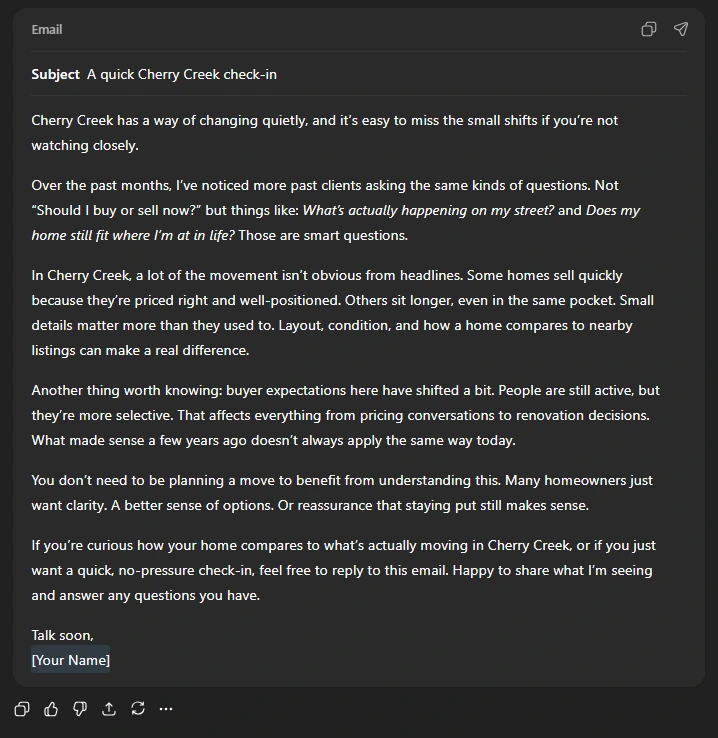
4. Market report prompt
Do you want to explain what is really happening in your local market? Instead of dumping numbers, use a smart prompt. Start by gathering fresh numbers from reliable sources like MLS, public reports, or your brokerage dashboard. ChatGPT does not fetch live data on its own, so you stay responsible for accuracy. Your role is to supply the facts. AI helps turn them into a clear market analysis that clients can understand.
This works well for emails, blog posts, or short reports you send to people thinking about whether now is the right time to buy a home.
Example prompt:
Act as an experienced real estate agent, creating a local market report. Use my own verified data.

Market area: [city / neighborhood / ZIP code, state]
Reporting period: [month / quarter / year]
Target audience: buyers / sellers / homeowners / investors

Agent-provided data (to be used exactly as supplied):
– Median home price: [$____]
– Price change vs. previous period: [+ / – % or amount]
– Number of listings analyzed: [____]
– Data source: [e.g., MLS, brokerage internal data, personal transaction records]
– Data date: [MM/YYYY]

Data handling rules (mandatory):
– Use only the numbers provided above for pricing insights
– Do NOT modify, estimate, or extrapolate missing values
– Clearly state that the pricing data comes from agent-supplied sources
– If data coverage is limited, explain this transparently
– Avoid claims that go beyond the scope of the data

Report structure:

1. Quick market snapshot based on the provided median price

2. Price trend explanation using the supplied comparison data

3. What this means for buyers in this specific market

4. What this means for sellers right now

5. Local context that does not rely on unsupported statistics

Tone & writing style:
– Professional and factual
– Clear, simple language
– No hype or predictions presented as facts
– Educational, trust-building approach

Formatting guidelines:
– Short paragraphs and bullet points
– Plain English explanations of numbers
– End with a short data transparency note

Close with a soft CTA, such as offering to review the data in more detail or provide a customized market breakdown.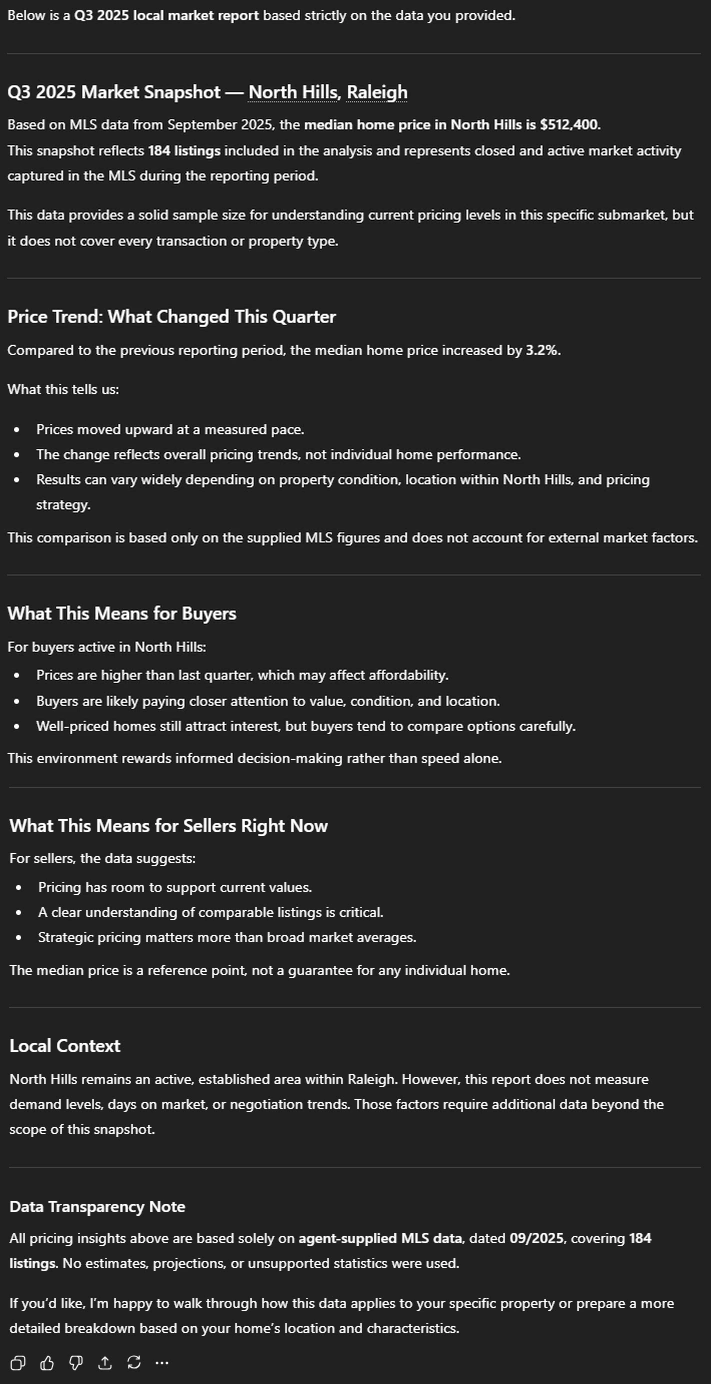
5. Virtual staging prompt
Use this prompt when you have photos of an empty property and need buyers to see how the space could look. You upload real listing photos of bare rooms. Then, you ask ChatGPT to generate realistic visualizations based on those images.
The model fills the room with furniture that fits the dimensions shown in the photo. It keeps the proportions believable. This works well for vacant listings, new builds, and flips before furniture arrives. It also helps with online listings, where buyers scroll fast and struggle to imagine empty rooms. A clear visualization often leads to more saved listings and better-quality showings.
Remember that you still carry full responsibility for accuracy. The visualization must not change the structure of the space. Furniture, rugs, lamps, and art are fine. Structural edits are not. Always mark the images as virtually staged.
Example prompt:
Generate a photorealistic virtual staging image for residential real estate.
I am providing photos of an empty property interior.
Your task is to produce a realistic, market-ready staged image that helps potential buyers understand scale, layout, and lifestyle — without misleading or over-styling the space.

Property context:
– Property type: [single-family / condo / townhouse]
– Target buyer: [first-time buyer / family / downsizer / investor / luxury buyer]
– Location style context (if relevant): [urban / suburban / coastal / modern / traditional market]

Staging goals:
– Make rooms feel livable and well-proportioned
– Help buyers visualize how the space can be realistically used
– Keep the design neutral and broadly appealing
– Highlight natural light, flow, and functionality

Design & realism guidelines:
– Add furniture and decor scaled accurately to the room size
– Match perspective, lighting, and shadows to the original photo
– Keep wall colors, floors, windows, ceilings, and structure unchanged
– Do NOT alter room dimensions or architectural features
– Avoid clutter, bold colors, or highly personalized decor

Output:
– One high-resolution, photorealistic staged image
– The result should look like a professionally staged real estate listing photo
– The space should appear clean, realistic, and move-in ready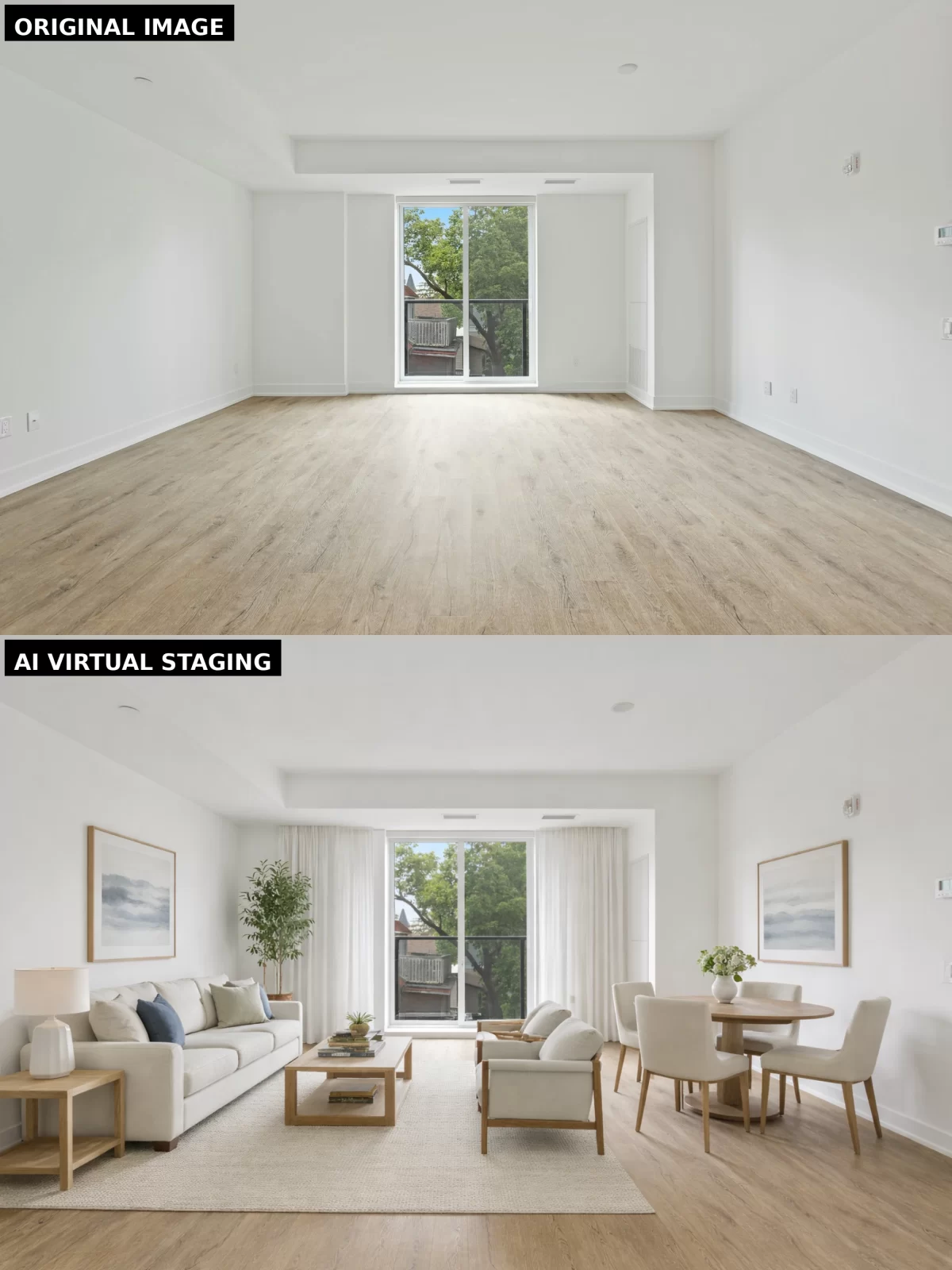
6. Social media post prompt
You use social media to stay visible and to pull people into real conversations. The problem is consistency. You know what you want to say, but turning daily market work into posts takes time. A focused ChatGPT prompt fixes that. You feed it real inputs from your day, and it helps you generate a compelling post that sounds like you.
You can use the output for short LinkedIn articles, Instagram captions, or simple Facebook updates. When done right, this supports lead generation by starting conversations in comments and DMs instead of chasing likes.
Example prompt:
Act as an experienced real estate agent and social media marketer.
Write a social media post for [platform: Instagram / Facebook / LinkedIn] aimed at [buyers / sellers / first-time buyers / investors] in [city/state].

Topic of the post: [e.g., current market conditions, buying tips, selling mistakes, interest rates, local market insight].

Tone: friendly, confident, professional, and easy to understand. Avoid jargon. Write like a real person, not a corporate brand.

Structure requirements:
– Start with a strong hook in the first sentence
– Deliver 1–2 clear, practical insights
– Keep sentences short and skimmable
– Add relevant local hashtags
– End with a soft call to action (e.g., “DM me”, “Let’s talk”, “Comment below”)

Length: 120–180 words.

Do NOT exaggerate results or make unrealistic promises. Focus on trust, expertise, and local knowledge.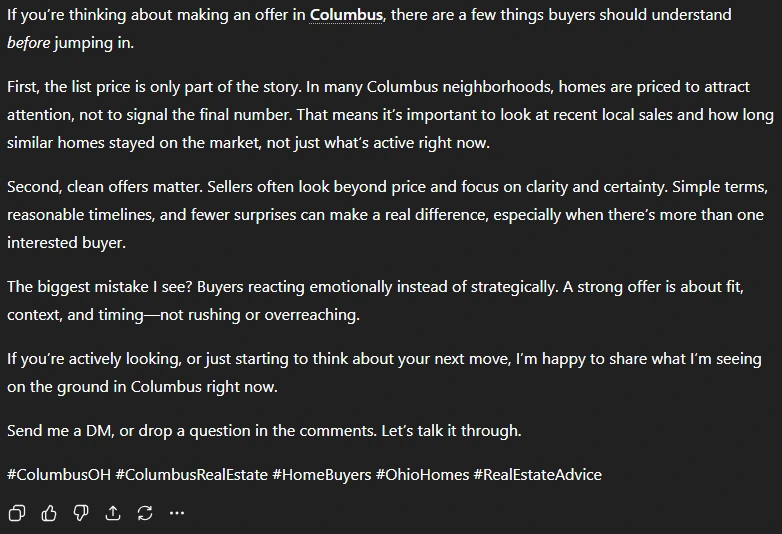
7. Objection handling role-play prompt
In the real estate business, you hear the same objections over and over. The price feels too high. The timing feels off. Someone wants to “think about it” and disappears. Each one hits the same pain point: hesitation mixed with fear of making a bad move.
You can leverage ChatGPT as a private practice partner. Feed it a real objection you heard this week. The tool helps you test different ways to respond without risking a live deal. You see which answer sounds calm and which one sounds defensive before you ever say it out loud.
Example prompt:
Act as a real estate client with genuine doubts and objections.
Your role is to realistically challenge me in a negotiation or decision-making conversation.

Client profile:
– Role: [buyer / seller]
– Experience level: [first-time / experienced / cautious / skeptical]
– Emotional state: [uncertain / anxious / analytical / frustrated]
– Location: [city/state]

Situation context:
– Scenario: [pricing discussion / offer review / timing hesitation / market uncertainty]
– Market conditions: [buyer’s market / seller’s market / balanced]

Client behavior guidelines:
– Express realistic concerns about price, risk, timing, or commitment
– Ask tough but fair questions
– Push back if answers feel vague or sales-driven
– Request clarification and concrete explanations
– Do NOT be hostile or unrealistic

Conversation rules:
– Respond only as the client
– Do NOT help me or explain strategies
– Let me lead the conversation
– Gradually evolve your objections based on my responses
– If trust increases, show cautious openness, not instant agreement

Goal of the exercise:
– Simulate a realistic client interaction
– Test my ability to listen, explain, and guide
– Help me practice calm, partner-style objection handling

Output format:
– Dialogue-style responses from the client only
– Natural spoken language
– Short, realistic replies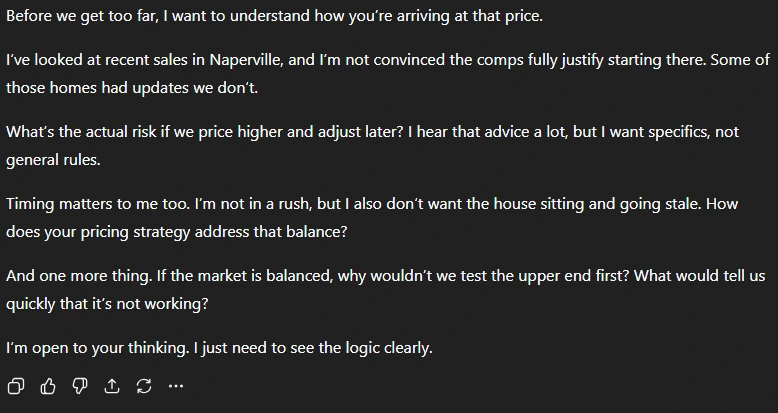
8. Pricing strategy prompt
You use a pricing strategy prompt when you need a second brain before setting or adjusting a list price. Not to replace your judgment, but to pressure-test it.
Give ChatGPT the property address, square footage, lot size, and year built. Don’t be lazy here. Then add what makes your market move. Are buyers in your area willing to pay more for a corner lot? Do they care about school districts? Does proximity to transit matter? You know this stuff. Write it down.
Next, feed it the comps. Three to five recent sales in the same neighborhood with closing price, list price, and days on market. The AI will spot patterns you might miss because you’ve been staring at too many listings. It’ll catch that the three-bedroom ranch sells $30K higher than the four-bedroom colonial when it shouldn’t, and ask why.
The prompt only works if your comps are solid. Garbage in, garbage out. And don’t use it to justify a price you already decided on. That’s just confirmation bias with extra steps.
Example prompt:
Act as an experienced real estate agent assisting with a property valuation and pricing analysis.
Your task is to help structure the pricing decision based on the provided data only, without speculation or guarantees.

Property details:
– Address (or area): [city / neighborhood / ZIP code, state]
– Property type: [single-family / condo / townhouse]
– Year built: [____]
– Bedrooms / bathrooms: [# / #]
– Interior size: [____ sq ft]
– Lot size (if applicable): [____]
– Condition: [excellent / good / average / needs work]
– Recent upgrades (with year): [____]

Comparable sales (use only these comps):
– Comp 1: price, size, distance, sale date
– Comp 2: price, size, distance, sale date
– Comp 3: price, size, distance, sale date

Market context:
– Market type: [buyer’s / seller’s / balanced]
– Inventory level: [low / moderate / high]
– Average days on market: [____]
– Seasonality factors (if any): [____]

Seller constraints & goals:
– Desired timeline: [flexible / 30–60 days / urgent]
– Risk tolerance: [low / medium / high]
– Pricing preference: [test high / market-aligned / price to sell]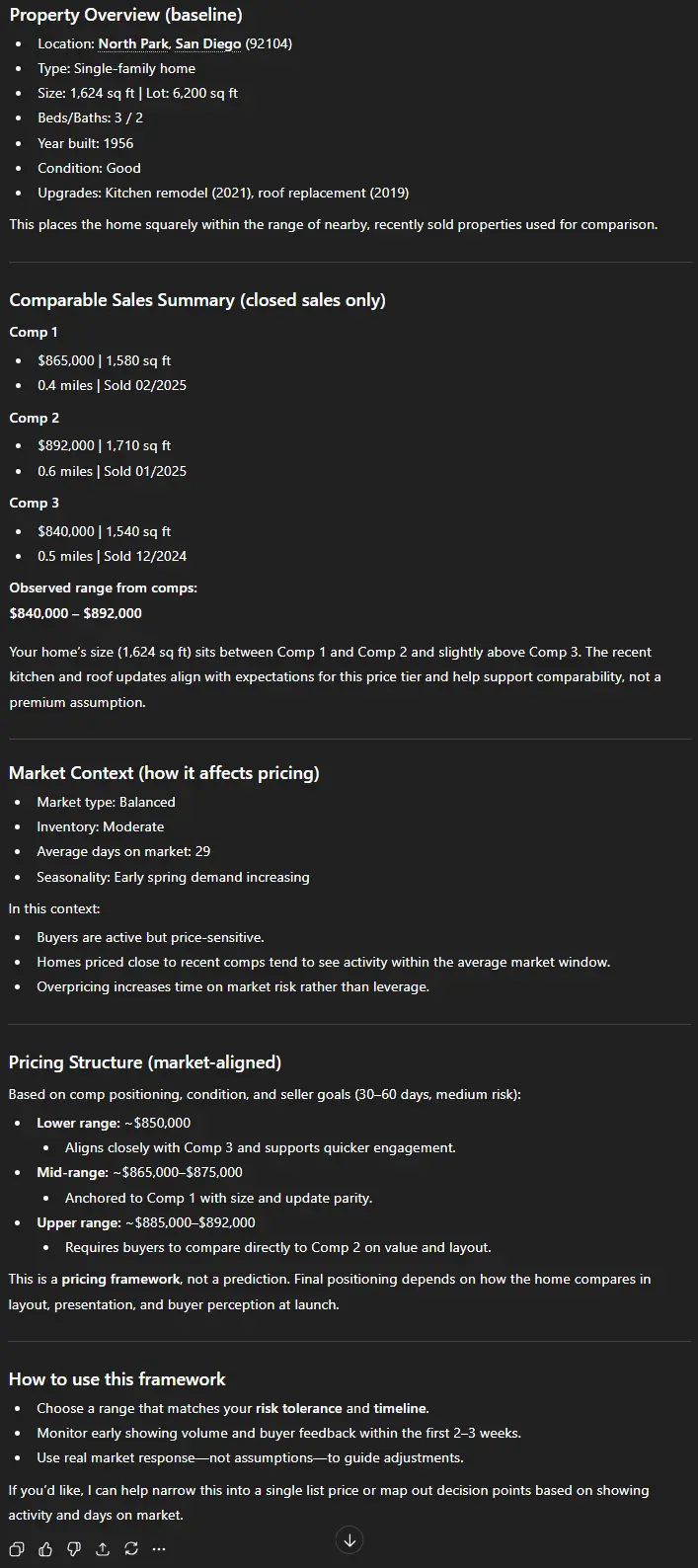
9. Content creation prompt
You don’t use ChatGPT to replace your voice. You use it to save time where time gets wasted. This prompt works when you already know what to say but don’t want to stare at a blank page.
You give the tool clear direction and let it handle the first pass. Use it with material pulled from real work. Ask for a draft that is SEO-optimized and readable enough to build on. ChatGPT also helps keep the text straightforward when the topic gets technical.
Quality control should stay with you. AI can turn rough notes into a usable structure. It cannot judge the accuracy in your market or tone for your audience. You adjust language and remove anything that feels vague.
Expert tip: To create engaging content, it’s better to write a separate prompt for each section instead of trying to generate the whole article at once.
Example prompt:
Act as an experienced real estate agent and industry educator.
Write a high-quality blog article that helps readers better understand the local real estate market and make informed decisions.

Article topic: [e.g., buying vs renting, how interest rates affect buyers, common seller mistakes, local market trends]
Target audience: [first-time buyers / sellers / homeowners / investors]
Location focus: [city / state / local market]

Content & credibility guidelines:
– Base explanations on current, widely accepted real estate practices
– Avoid speculation and guarantees
– Clearly separate facts, professional insights, and general observations
– Use examples that feel local and practical

Article structure requirements:

1. Clear introduction that answers the main reader question in the first paragraph

2. Well-structured body sections with descriptive subheadings

3. Practical explanations using plain English

4. Actionable takeaways readers can actually use

5. Short, helpful conclusion that summarizes key points

Writing style & tone:
– Professional, approachable, and educational
– Simple language, short sentences
– Natural, human tone (not corporate, not salesy)
– Write as a trusted local advisor

Formatting & length:
– 800–1,200 words
– Short paragraphs and bullet points when helpful
– No fluff, every section must add value

Trust & compliance rules:
– Do NOT give legal or financial advice
– Avoid absolute claims and fear-based language
– No exaggerated results or promises

End the article with a soft credibility-based CTA, such as offering further explanation or a personalized conversation.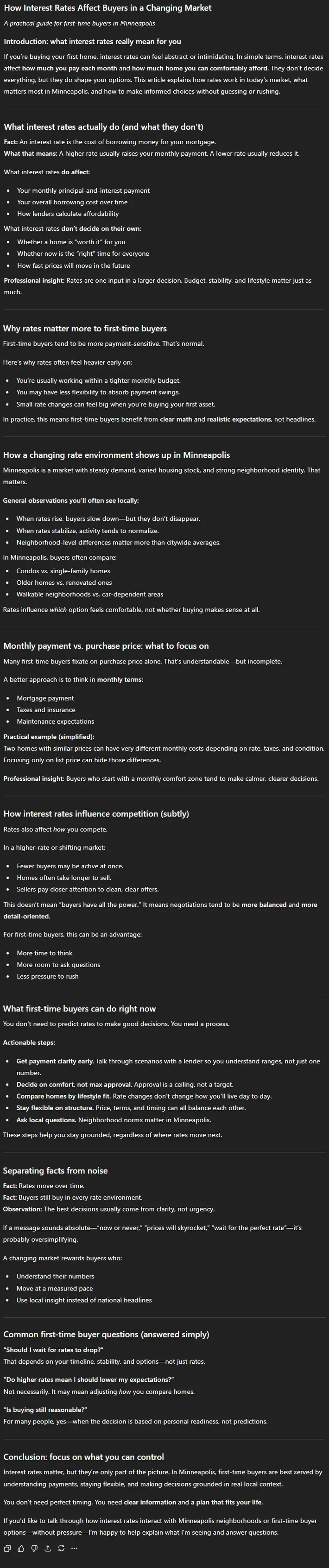
10. FAQ section prompt
This use case solves a real problem you see on listing pages. Buyers scroll, get stuck on details, and leave. An FAQ section keeps them there and answers the questions they would normally text you at 9 p.m.
If you want ChatGPT to generate a listing-specific FAQ page, feed it:
- MLS description
- Property type
- Price
- Location
- Year built
- HOA details
- Utilities
- Taxes
- Showing rules.
In the prompt, tell it to write buyer-style questions. Force short, direct answers. Each answer should remove doubt or reduce follow-up. If an answer depends on verification, instruct it to say that clearly instead of guessing.
Example prompt:
Act as an experienced real estate agent, creating a FAQ section for a listing page.
The goal is to clearly answer the most common client questions in plain English, while building trust and credibility.

FAQ context:
– Audience: [buyers / sellers / homeowners / investors / mixed]
– Location focus: [city / state / local market]
– Experience level: [first-time / experienced / mixed]

Content guidelines:
– Answer each question directly in the first sentence
– Use accurate, widely accepted real estate practices
– Avoid jargon or explain it simply when needed
– Clearly distinguish general information from advice

FAQ structure requirements:
– Create 6–10 questions clients realistically ask
– Cover topics such as pricing, timing, process, costs, and market conditions
– Keep answers concise but informative (3–6 sentences each)
– Use neutral, non-sales language

Style & tone:
– Clear, calm, and professional
– Helpful and educational
– Write like a local expert, not a marketer

Formatting:
– Use clear question-style headings
– Short paragraphs, easy to scan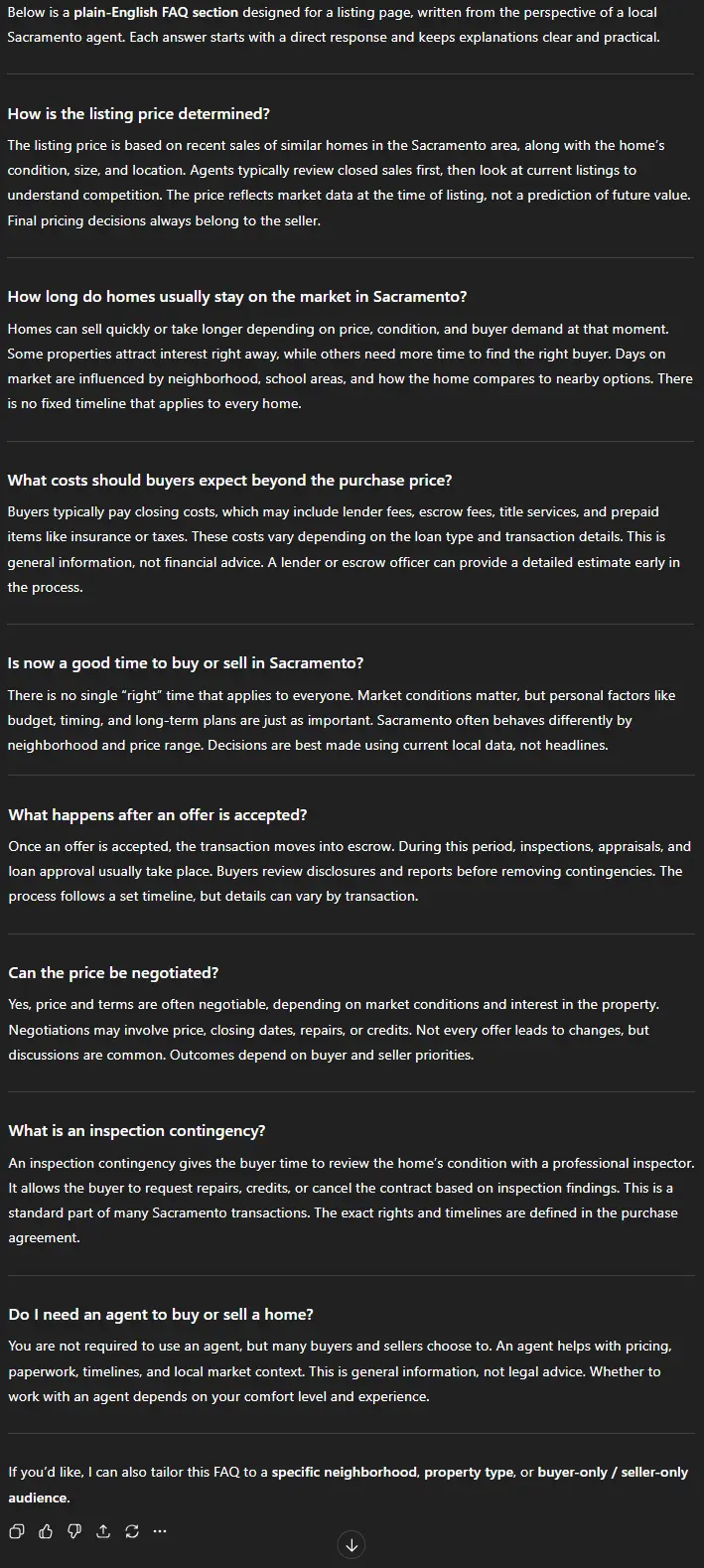
11. Property comparison prompt
This prompt helps when a buyer feels stuck between two or three properties and can’t explain why. You use ChatGPT to turn raw listing data into a clear, written comparison.
Tell the model who the buyer is and what they care about. A remote worker thinks differently than a family with kids. Without that context, the output stays shallow and generic. Ask it to surface trade-offs instead of declaring a winner. Buyers trust you more when the downsides are visible.
Example prompt:
Act as an experienced real estate agent helping a client compare multiple properties in a clear, neutral, and decision-supportive way.

Comparison context:
– Client type: [buyer / investor]
– Client priorities: [budget, location, commute, space, resale potential, lifestyle]
– Market type: [buyer’s / seller’s / balanced market]
– Location: [city / neighborhood / state]

Properties to compare (use only the provided information):
Property A
– Price: [$____]
– Type: [single-family / condo / townhouse]
– Beds / Baths: [# / #]
– Square footage: [____]
– Key features: [____]

Property B
– Price: [$____]
– Type: [single-family / condo / townhouse]
– Beds / Baths: [# / #]
– Square footage: [____]
– Key features: [____]

(Add Property C if needed)

Comparison rules:
– Stay neutral and factual
– Do NOT rank properties unless explicitly asked
– Clearly explain trade-offs between options
– Avoid assumptions about the client’s final decision
– Do NOT exaggerate or speculate

Output structure:

1. Side-by-side comparison table of key criteria

2. Short plain-English explanation of major differences

3. Pros and cons of each property based on client priorities

4. A short decision guidance section (what type of buyer each property fits best)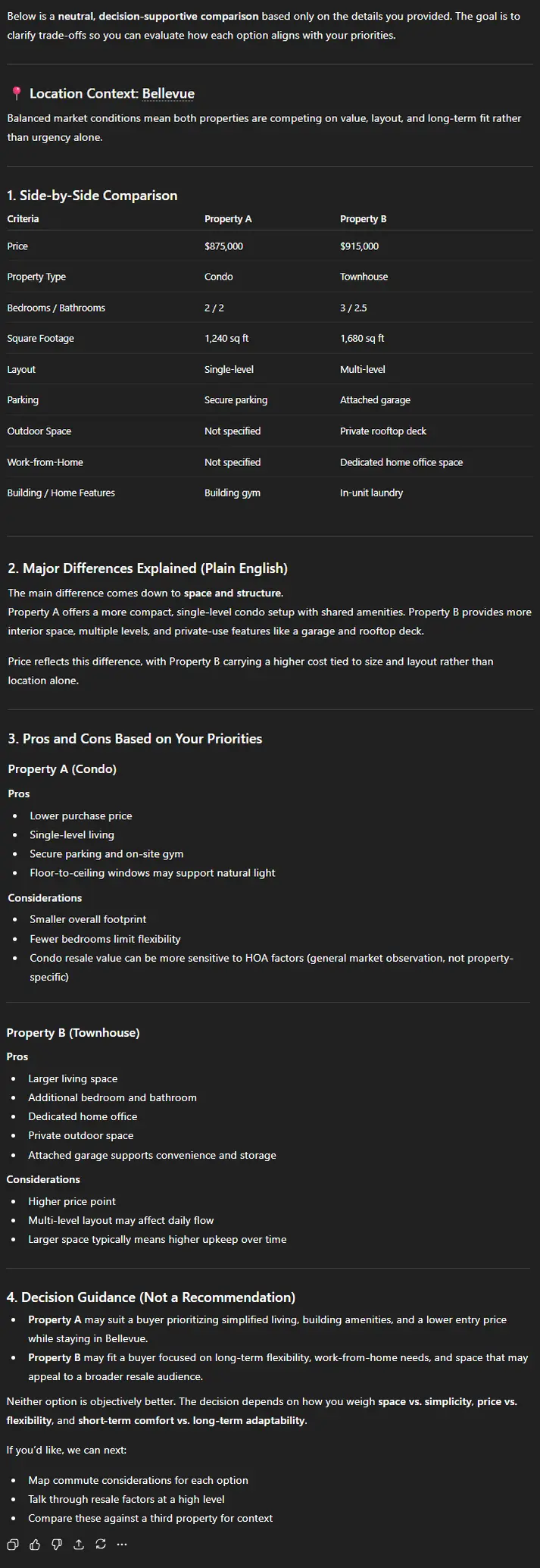
12. Video script prompt
If you need a script for a video, don’t waste your time waiting for inspiration to come. Just use a prompt that works for walk-throughs, Instagram reels, and quick YouTube clips.
Tell ChatGPT where the video will live and how people will watch it. Lock the length early, because pacing depends on it. Explain what the video needs to cover and what it should skip.
If you record a virtual tour, describe the property layout. When you work on an educational video, state the outcome you want for the viewer and name the topics you plan to touch.
Be clear about how you speak on camera. Formal scripts sound wrong when read out loud. Ask for lines that match your voice. You can also request notes on where to film, how to frame the shot, or how to cut the footage after.
Example prompt:
Act as an experienced real estate agent, creating a short-form or mid-length video script for online platforms.

Video purpose: [educate / build trust / explain the market / answer a common client question / promote an open house]
Platform: [Instagram Reels / TikTok / YouTube Shorts / YouTube]
Target audience: [buyers / sellers / homeowners / investors]
Location focus: [city / state / local market]

Script requirements:
– Start with a strong hook in the first 3 seconds
– Clearly state why this matters to the viewer
– Deliver 1–3 practical points in simple language
– Use short, spoken sentences that sound natural on camera
– Avoid jargon and sales hype

Structure guidelines:

1. Hook (attention-grabbing opening line)

2. Context (why the topic matters right now)

3. Key insight(s)

4. Clear takeaway

5. Soft call to action (comment, follow, ask a question)

Tone & delivery style:
– Friendly, confident, and conversational
– Professional but relaxed
– Speak like a local expert, not a presenter

Length guidelines:
– Short-form video: 30–60 seconds
– Mid-length video: 2–4 minutes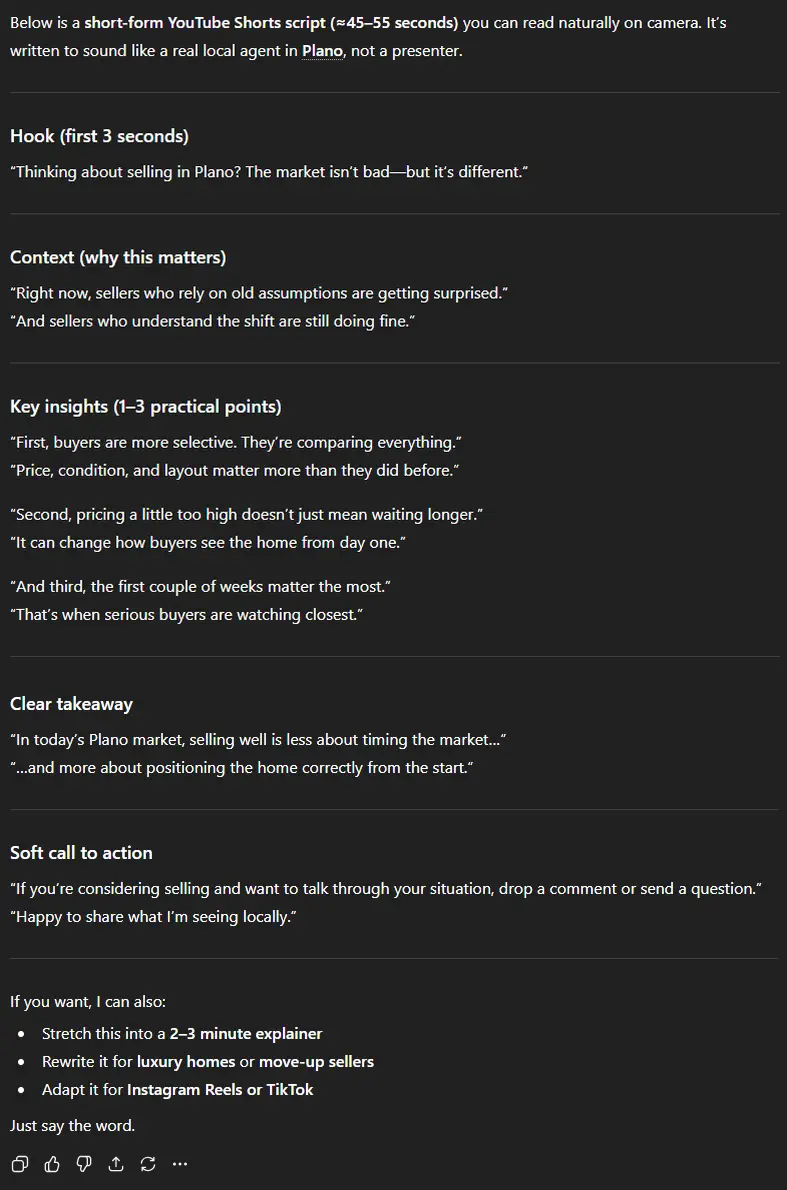
13. Case study prompt
What you’re really doing is asking the AI to help you extract the lesson. You give it the messy reality, and it organizes it in a way that shows you what you actually did. You feed it the basics of a listing you closed.
Tell ChatGPT what the case study is for. It should read like something you would explain to a client over coffee. Focus on decisions and trade-offs, not hype or emotional language. Be careful with numbers and claims, too. If a price, timeline, or result is not backed by paperwork, make sure the prompt tells the model to flag that or leave it out. Loose promises can hurt your credibility fast.
Example prompt:
Act as an experienced U.S. real estate agent creating a case study that demonstrates expertise, decision-making, and problem-solving.

Case study context:
– Client type: [buyer / seller / investor]
– Property type: [single-family / condo / townhouse]
– Location: [city / neighborhood / state]
– Market conditions at the time: [buyer’s / seller’s / balanced market]

Situation overview:
– Client’s initial goal: [e.g., sell within 60 days, buy under budget, minimize risk]
– Main challenge or concern: [pricing, competition, timing, financing, uncertainty]
– Constraints: [timeline, budget, market pressure, personal factors]

Process & strategy (use facts only):
– Key decisions made and why
– Data or signals used (comps, feedback, timing, negotiations)
– Trade-offs considered
– Adjustments made during the process (if any)

Outcome (no guarantees or exaggeration):
– Final result: [sold / purchased / negotiated terms]
– Timeline: [actual time on market or search duration]
– Key takeaway based on facts, not claims

Structure requirements:

1. Brief introduction (context and goal)

2. The challenge

3. The strategy and decision-making process

4. The outcome

5. Practical lessons for similar clients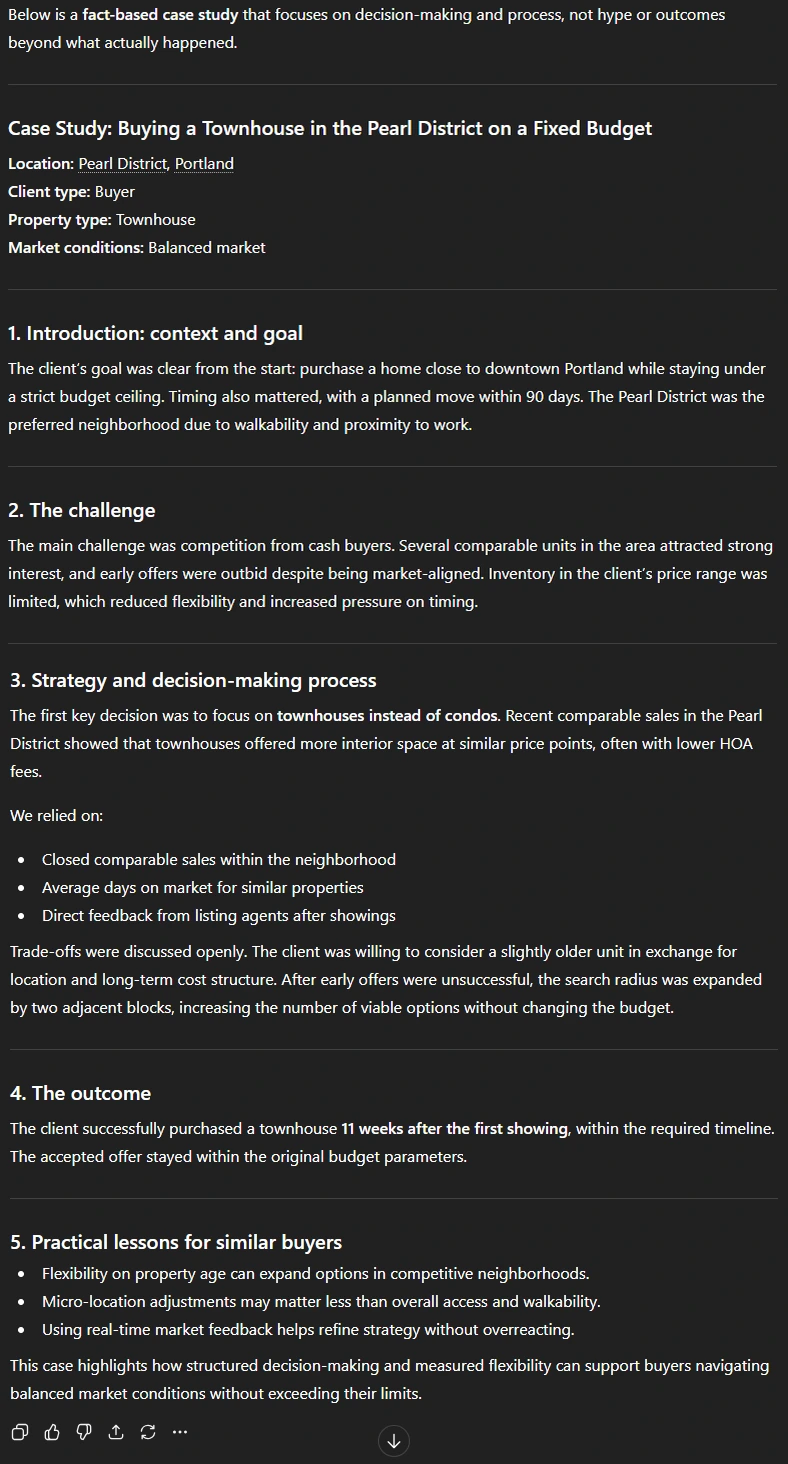
14. Open house script prompt
An open house is all about asking the right follow-up questions and spotting real interest. With ChatGPT, you can map out how to greet visitors, what to ask at each stage, and how to close the conversation without pressure. AI also helps you stay consistent, even when the event gets busy.
This works especially well when you represent the seller’s interests and need clean notes after the event. Instead of vague impressions, you walk away with usable info tied to each visitor and the property for sale. That makes follow-up faster and more relevant.
Example prompt:
Act as a top-performing real estate agent hosting an open house.
Write a complete open house conversation script that sounds natural, confident, and welcoming.

Property details:
– Location: [city, state]
– Property type: [single-family / condo / townhouse]
– Price range: [price or range]
– Key features: [beds, baths, square footage, standout features]

Audience: buyers attending an open house, including first-time homebuyers and move-up buyers.

Script requirements:

1. A friendly greeting script to welcome visitors as they walk in

2. A short property introduction (what makes this home special)

3. 3–4 open-ended questions to start a real conversation

4. Subtle ways to build trust and authority without bragging

5. A natural lead capture transition (sign-in, follow-up, or conversation)

6. A soft closing line before visitors leave

Tone & style:
– Professional, warm, and conversational
– Clear, simple language
– No pressure, no exaggerated claims
– Speak like a real local agent

Format the script in short, easy-to-read sections with sample lines an agent can say verbatim.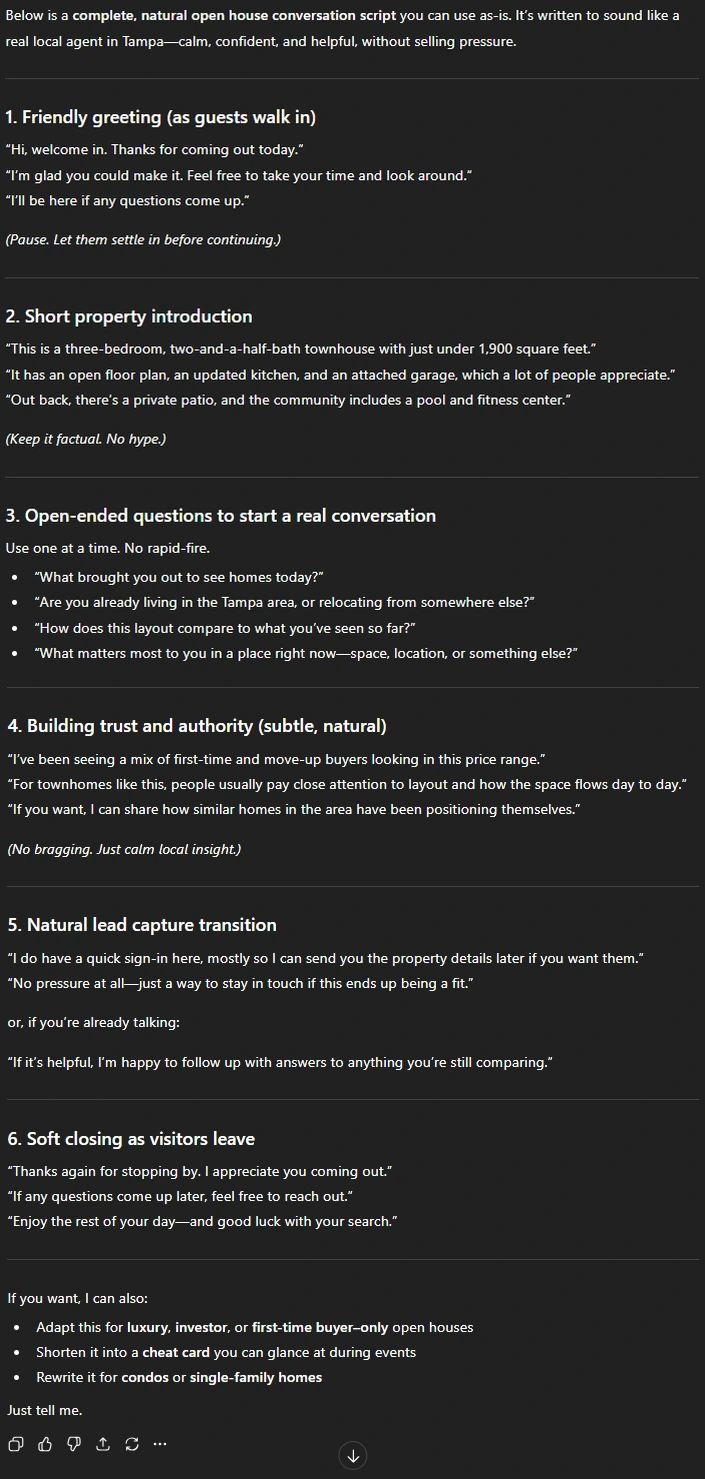
15. Personal branding assets prompt
If you know what kind of agent you are, but you struggle to explain it in a clear way, just run the prompt in ChatGPT. When you feed it your niche, mission, and vision, it can build a first version of your brand assets.
Focus on the target audience you want to reach and the emotions you want to evoke. This way, you can get a creative logo, a tailored color palette, and a smart slogan in seconds. Even if they need refinement, it’s a strong first step toward building a conscious marketing strategy for your brand.
Example prompt:
Generate a professional, market-ready logo for a real estate brand.
Act as a brand strategist and creative director specializing in personal brands for real estate agents, with the goal of producing a clean, timeless logo image suitable for real-world use.

Your task is to generate a visual logo, not a description or concept explanation.

Brand context:
– Brand type: [personal brand / team brand]
– Agent name or brand name: [name]
– Market & location: [city / state]
– Target clients: [buyers / sellers / luxury / first-time buyers / investors]
– Positioning goal: [trust, expertise, local authority, premium, approachable]

Brand personality:
– 3–5 core traits: [e.g., calm, confident, modern, knowledgeable, approachable]
– What the brand should avoid: [flashy, aggressive, overly salesy, corporate]

Requested asset: Logo (image output)

Logo direction:
– Logo style to generate: [wordmark / symbol / monogram]
– Visual themes and inspiration: [minimal, modern, classic, local references if appropriate]
– Emotional tone: [e.g., trustworthy, confident, refined, welcoming]

Output requirements (critical):
– Generate one clean, high-resolution logo image
– Logo must work on light and dark backgrounds
– Centered composition, no mockups, no backgrounds or textures
– No taglines or slogans in the logo unless explicitly requested
– The result should look suitable for website headers, social media profiles, email signatures, and signage

Guidelines & constraints:
– Avoid visual trends that age quickly
– No exaggerated symbols, no clichés (houses, roofs, keys unless highly abstract)
– Logo must feel credible to U.S. home buyers and sellers
– Focus on clarity, balance, and long-term brand use
7 tips for writing better ChatGPT prompts
Better prompts come from tighter inputs and a smarter workflow. Treat ChatGPT like a fast junior assistant. Feed it good raw material, then refine, check, and polish. OpenAI and other major model vendors consistently recommend iterating to improve results.
Use these tips to avoid wasting time on generic output:
1️⃣ Paste real raw material, not a summary
Don’t just tell ChatGPT “write a listing.” Paste your showing notes, upgrade list, HOA highlights, and any buyer-facing details you already have. The output gets sharper because the model stops guessing. Use placeholders for names and addresses.
2️⃣ Use separators so the model doesn’t mix inputs
Wrap your notes in clear blocks like “NOTES:” and “OUTPUT:” or use triple quotes. This reduces weird blending, especially when you paste long text, bullet lists, or snippets from emails.
3️⃣ Ask for the missing questions first
When the task depends on details you haven’t provided, tell ChatGPT to ask you questions before it writes anything. Keep it tight: “Ask up to 3 questions, then wait.” Reasoning guidance from OpenAI also emphasizes handling ambiguity by clarifying instead of guessing.
4️⃣ Run a two-pass workflow (draft → tighten)
First pass: generate the full draft. Second pass: ask it to cut fluff, shorten sentences, and remove vague phrases. This “review then improve” approach is a widely recommended way to raise accuracy and clarity.
5️⃣ Force contrast to avoid “samey” output
Instead of “give me 10 captions,” ask for different angles. Example: “Give 6 captions. Each must use a different hook style.” You’ll get more variety and fewer duplicates without extra prompting.
6️⃣ Use “edit mode” instead of “write mode”
If you already have a draft, don’t restart. Paste it and say: “Keep meaning. Improve flow. Reduce length by 20%. Keep my tone.” Editing prompts outperform blank-page prompts because the model has something concrete to improve.
7️⃣ Build a swipe file of prompts you reuse
Save your best prompts as templates with blanks: [CITY], [PROPERTY TYPE], [AUDIENCE], [CHANNEL], [WORD LIMIT]. Reuse them and only change the variables. You’ll get consistent quality and spend less time reinventing the same request.
👉 Discover 12 winning strategies for using AI in real estate.
Conclusions
ChatGPT can save real estate agents hours each week, but only when you use it with intent. Clear prompts, smart guardrails, and human review make the difference between helpful support and risky shortcuts. The goal is not to replace your judgment, but to move faster on the work that slows you down.
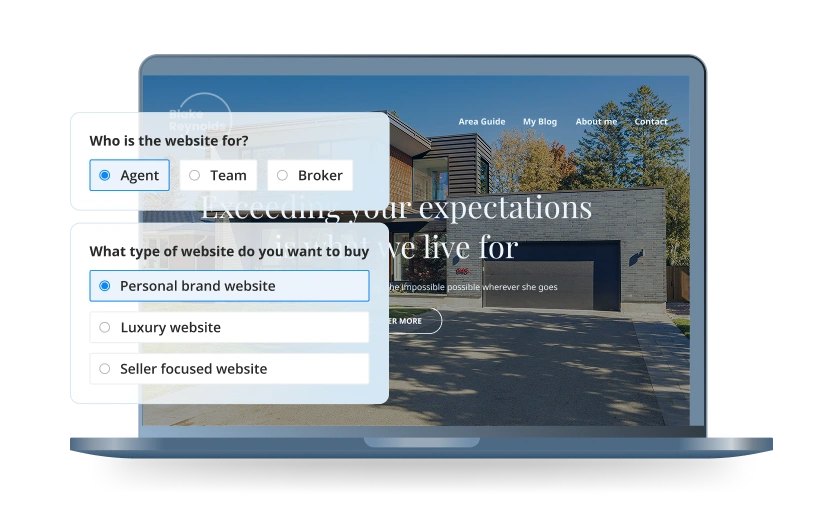
The same idea applies to your online presence. Placester also uses AI to simplify website creation. With built-in AI tools, you can launch a professional IDX website in just a few clicks, without touching code.
AI Websites for Real Estate
Get a custom, ready-to-edit website
in less than 4 minutes.
FAQ
How to use AI for real estate?
Use AI to speed up repeatable work like listing drafts, follow-ups, market explainers, and client FAQs. Keep your inputs specific. Always verify facts like rates, taxes, and HOA rules with primary sources before you send or publish.
Who has the best AI tools for real estate agents?
Based on the latest NAR tech survey, agents most often use ChatGPT by OpenAI (58%), followed by Google Gemini (20%) and Microsoft Copilot (15%). “Best” depends on your stack. Copilot suits Microsoft 365 users, while Gemini fits Google Workspace.
How to use AI for real estate marketing?
Use AI to turn one property into a full campaign. Create MLS descriptions, drip campaigns, compelling blog articles, and platform-specific social captions. You can also repurpose market stats into simple, client-friendly updates.
What are the best ChatGPT alternatives for real estate agents?
If you want a similar assistant, look at Google Gemini and Microsoft Copilot (both widely used by agents). If you need strong long-form writing and document work, you can try Claude. For quick web-backed answers, Perplexity might be the right answer.
What are current AI trends in real estate industry?
You’ll see more AI-powered search and customer support, plus virtual staging and image enhancement built into listing platforms. At the same time, the industry is getting stricter about trust, disclosures, and responsible AI use.
Published on
(Last updated on
)