(800) 728 8391


Quick summary:
- Real estate hashtags are still a relevant marketing tool in 2026. They can increase engagement (by up to 70%) and boost your brand’s social SEO.
- Most popular real estate hashtags include a mix of general, listing-focused, lifestyle, home decor, and location-specific tags.
- To use real estate hashtags with results, it’s best to adapt the marketing strategy to each social media page, mix niche and general tags, limit the number of # to less than 15, and include brand mentions.
Think hashtags are dead in 2026?
Not really.
Though they’re no longer an indispensable (albeit slightly annoying) social media staple that no millennial author could help but include in their blog posts, hashtags remain a crucial discovery tool across most key social networks.
Their main advantage is the effort-to-results ratio, as adding a few #s here and there doesn’t cost you much, but can yield great results.
Using the right hashtags can genuinely improve your visibility and engagement metrics—as long as you adapt them well to the market trends, audience’s needs, and, of course, a specific SM platform’s quirks.
How to do it?
Read on to find our list of +100 best real estate hashtags with use cases and tips for a well-rounded social media marketing strategy.
What are real estate hashtags?
Real estate hashtags are keywords and phrases used mainly on social media platforms, such as Instagram or Twitter, to categorize and promote content about properties.
Like any other type of hashtags, they’re short, catchy, and respond to the most important industry queries. Their goal is to make posts more detectable and, as a result, help real estate agents, buyers, and sellers reach a wider audience.
They do that by:
➡️ flagging the topic of the content,
➡️ targeting search and social media algorithms (SEO),
➡️ connecting posts to hot industry conversations,
➡️ reaching users who follow/search specific hashtags,
➡️ helping platforms recommend content to relevant audiences.
And it works.
According to a study titled “Effective Strategies for Using Hashtags in Online Communication,” posts with at least one hashtag get ~12.6% higher engagement than those without.
In real estate, common hashtags can look like: #CondoinNYC #DreamHouse #HouseForSale #NewConstruction #JustListed. By focusing on the audience’s search intent and market trends, they increase the likelihood that the users will stumble upon a post listing exactly the type of property they’ve been looking for.
Do hashtags still work in 2026?
Short answer—yes, hashtags are still a vital part of most social media channels.
In 2025, Fanpage Karma conducted an analysis of 2.4 million posts and found that 74% of them contained hashtags.
Their study was inspired by rather controversial words of Adam Mosseri, Instagram’s CEO himself, who claimed that hashtags no longer had a relevant impact on social media reach.
Yet, despite his prognosis and the obvious changes that IG and other platforms have gone through over the years, it seems that most users are still loyal to that little hash on their feed.
And it’s not just out of habit.
Although hashtags are not as popular as they once were, they remain an important marketing tool for engagement and online presence.
Here are the most important benefits of hashtags in 2026:
1. Hashtags increase engagement and reach 💬
- Using 9–11 hashtags can boost reach by ~79.5%.
- Posts with 11+ hashtags can increase engagement by up to 70%.
2. Hashtags boost performance ❤️
- On TikTok, posts with three to five hashtags tend to reach a broader audience.
- On Facebook, using 1 hashtag yields the highest engagement (~593 interactions/post).
- Tweets with hashtags can increase likes and impressions by ~50% on Twitter.
3. Hashtags expand discoverability 💡
- Hashtags make content visible beyond your followers via search and feeds
- Viral hashtags (e.g., challenges) can generate massive exposure and engagement spikes.
4. Hashtags improve your channel’s SEO 📈
- Hashtags act like keywords for social platforms, which is why they improve visibility in platform search and topic feeds.
- This boosts something that more and more marketing experts refer to as “social SEO,” which can lead to your social media content showing up in AI overviews or Google search.
5. Hashtags help attract high-intent real estate leads 🏡
- Hashtags get to users who are already in the problem-awareness or solution-search stage, which helps with lead generation.
- They appear in topic feeds and searches, where intent is higher than in random scrolling.
Overall, in 2026, hashtags are still well and alive—only their role has changed, and it’s now more supportive of algorithmic searches.
How to use hashtags for real estate? 7 use cases examples
Using hashtags for better visibility is actually super easy—all it takes is adjusting them to the context and message. Below, we’re listing seven examples of how they can be employed in different situations, from local targeting to authority building.
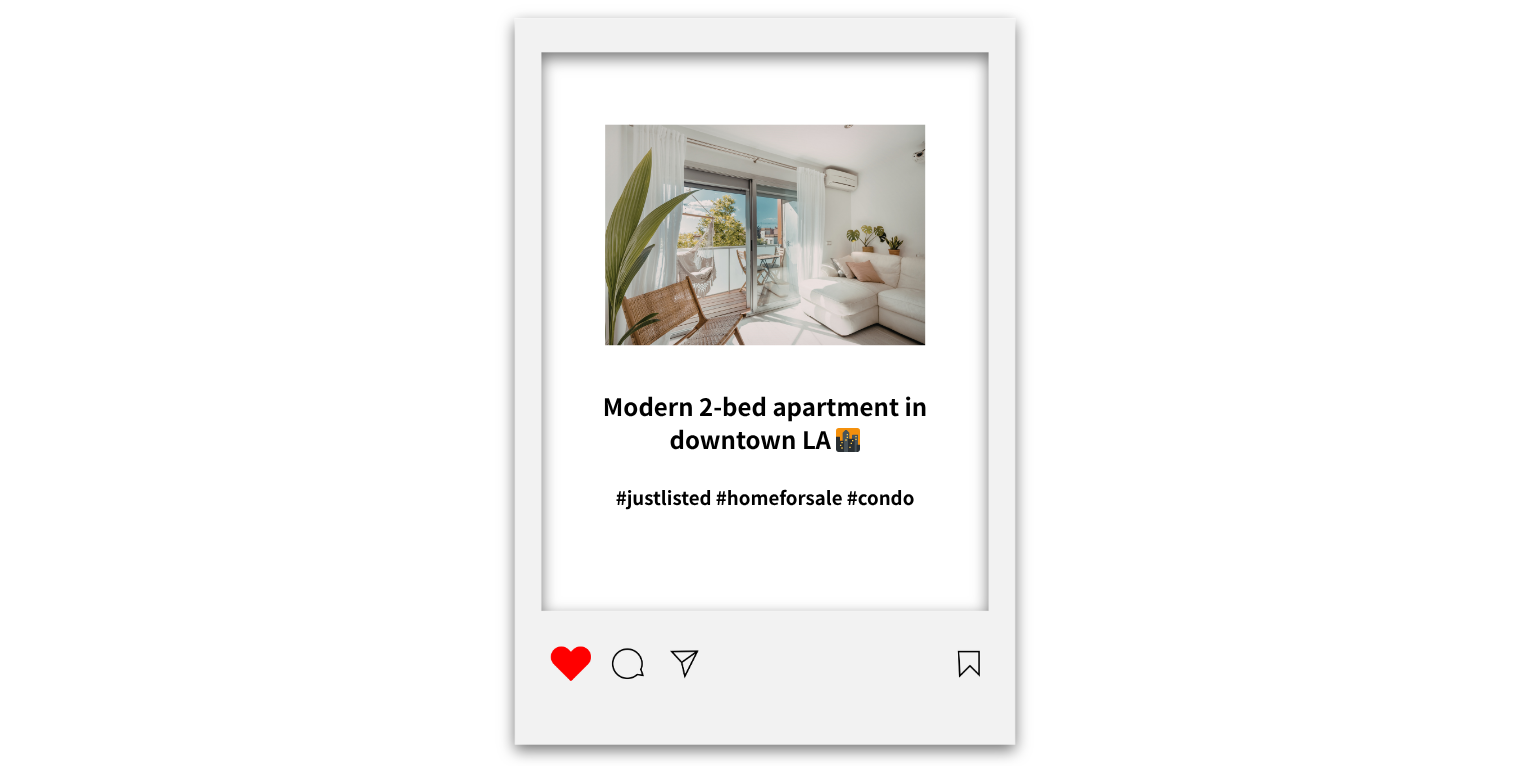
Use Case 1: Property listing promotion
Example:
Goal:
Make listings discoverable among and beyond your followers.
Why it works:
According to Zillow, 69% of sellers value an agent who promotes listings on social networking sites.
And hashtags are a good way to do that. Using tags such as #justlisted and #newlisting help expose properties to larger audiences beyond an agent’s network.
This works because hashtags function as indexing tools, which allows platforms like Instagram to surface relevant content and showcase it to users who already demonstrate intent to browse or even purchase a property.
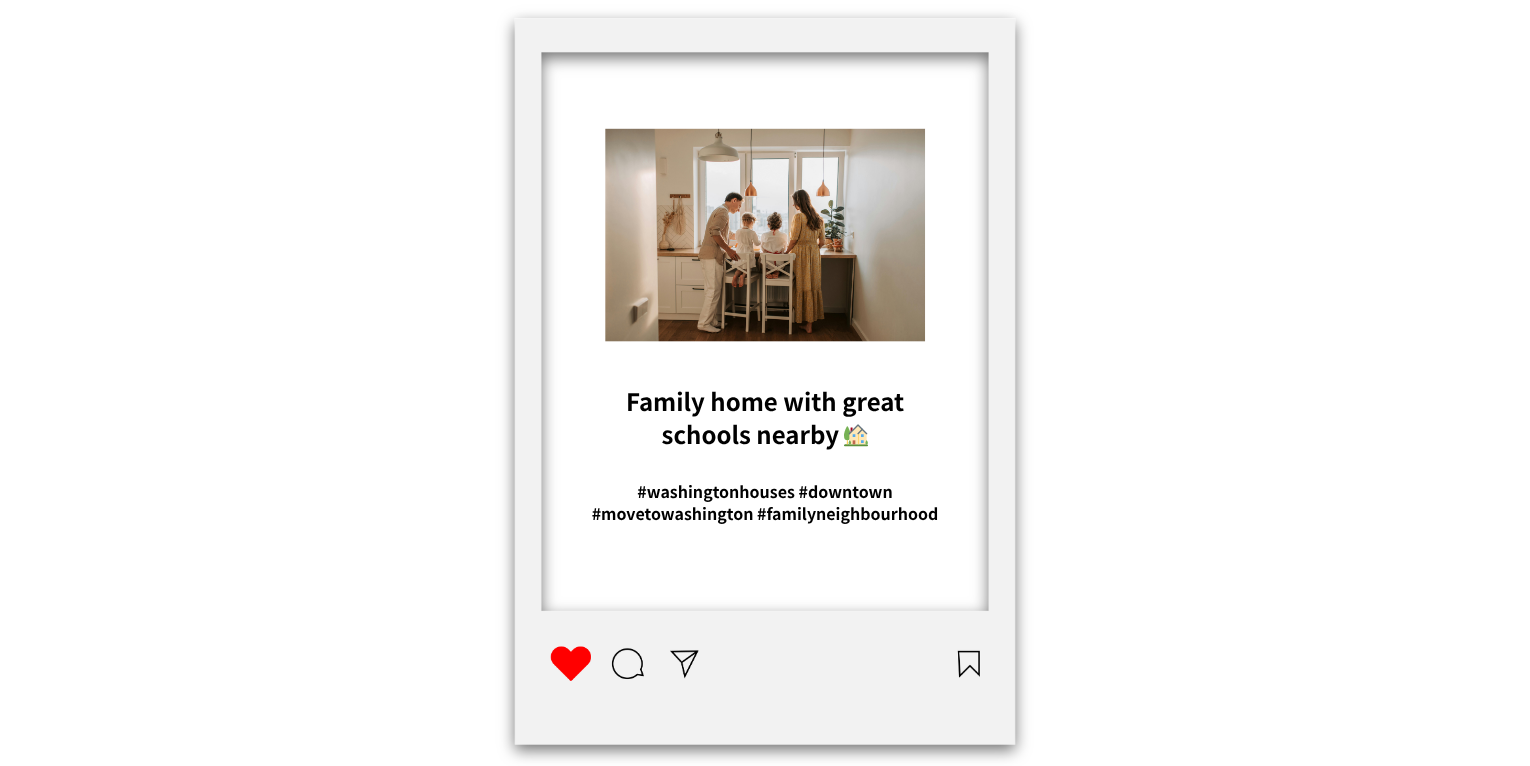
Use Case 2: Local targeting (geo-hashtags)
Example:
Goal:
Reach buyers in a specific area.
Why it works:
It’s not particularly difficult to imagine that including the name of the city you’re active in is going to raise awareness among potential customers from that city.
But if you need actual proof as to why it works, research from Market Leader suggests that local hashtags are more effective than general ones because they help target a more relevant, location-specific audience and improve the chances of reaching possible clients.
Better clients, i.e., clients who are ready for purchase.
Use Case 3: Lifestyle promotion
Example:
Goal:
Sell the lifestyle, not just the property.
Why it works:
Beyond basic property details, hashtags can communicate the lifestyle associated with a home. Instead of simply listing features, real estate agents can frame them as aspirational experiences.
This works particularly well on Instagram and Pinterest, which are famous for their inspo-like content.
It’s about selling the dream—not just a property.
Bonus? Using feature-based hashtags—like #backyardpool or #luxuryliving—can also attract niche audiences searching for very specific amenities. This strategy works because it shifts the focus from transactional selling to experiential marketing.
Use Case 4: Brand building
Example:
Goal:
Create a recognizable identity.
Why it works:
While potential clients care more about listings than your brand, it’s also important to sneak your name into the promotional materials.
Hashtags are a great way to do this because they allow for including the brand name in a subtle yet clear way.
This approach works because it creates a unique, searchable content hub tied to your identity.
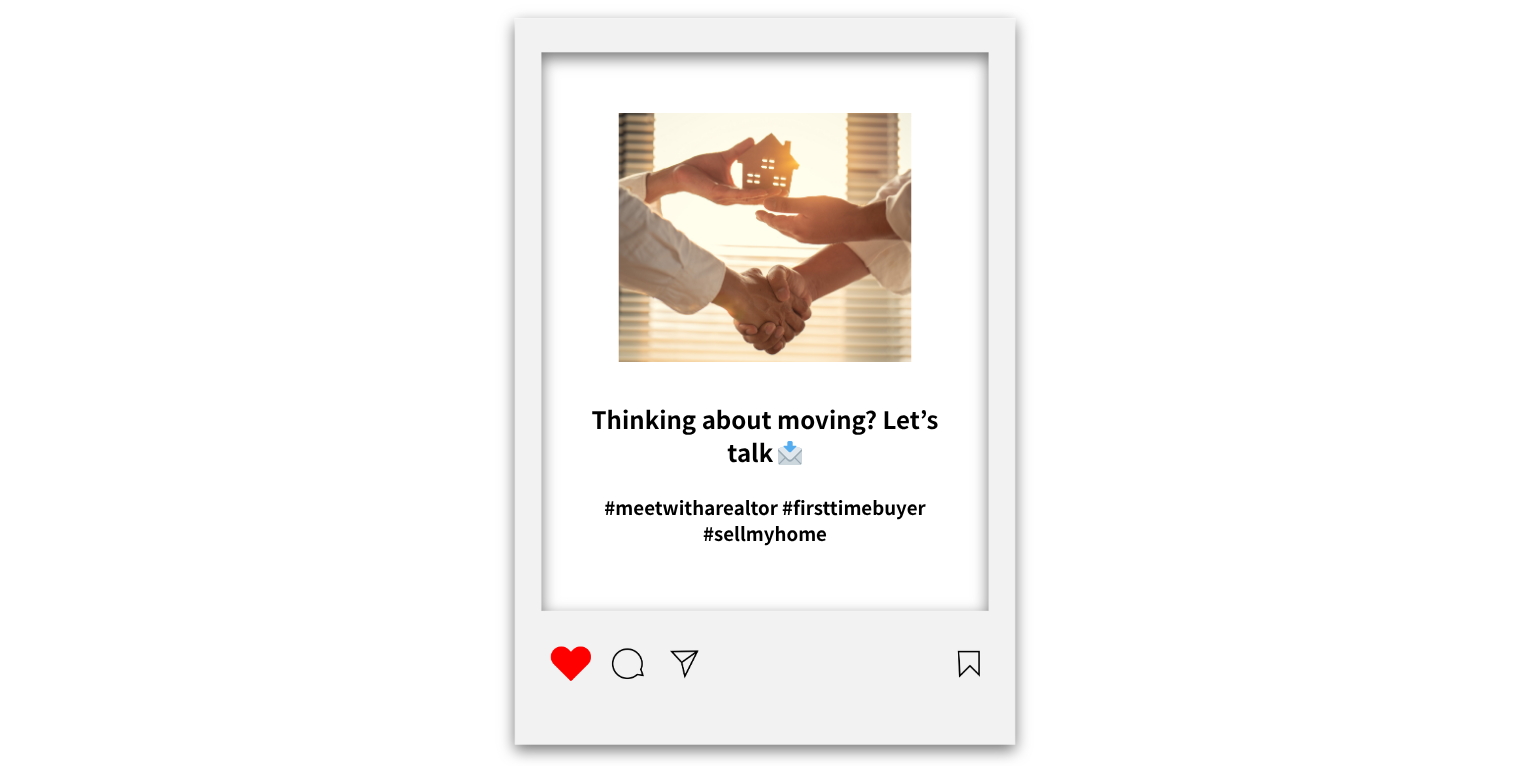
Use Case 5: Lead generation
Example:
Goal:
Attract people already considering buying and help lead generation.
Why it works:
These hashtags target users who are actively exploring real estate decisions.
It’s not about building up the idea of a dream home, it’s not about promoting a neighbourhood, it’s about straight-up business talk with people who are ready for it.
These intent-driven posts and hashtags act as a signal for people following tags like #firsttimebuyer, who often seek guidance and need a little nudge.
If they find your content (and hashtags are one of the key ways to do that), there’s a good chance they’ll accept that nudge from you.
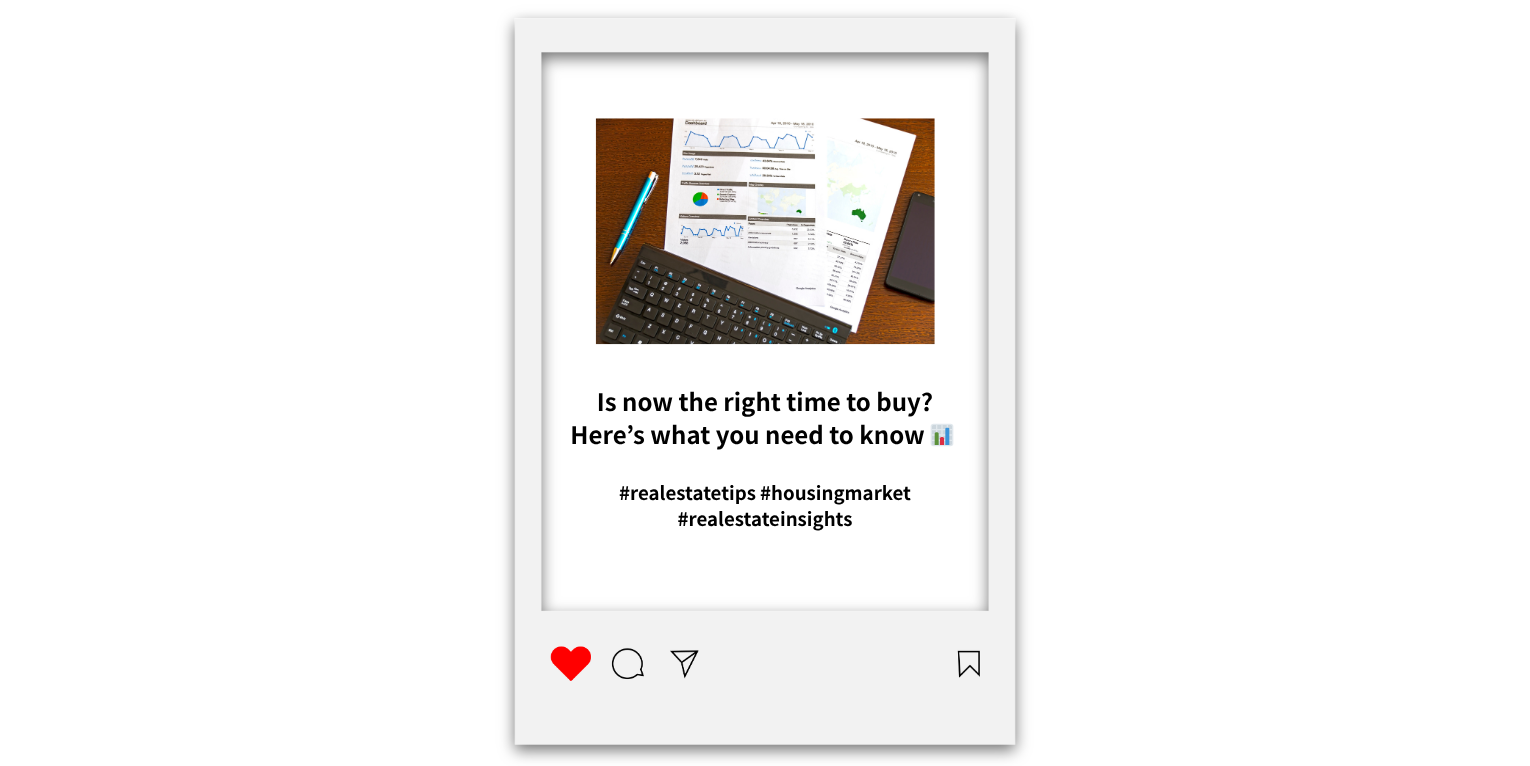
Use Case 6: Market education & authority building
Example:
Goal:
Position yourself as an expert and build authority.
Why it works:
This type of content works because it shows you know your stuff and builds a worthwhile profile without being too sales-focused.
Posts and hashtags like these are great for people who are interested in buying a property but are still in the market search stage of purchase, as well as for random lurkers who may be just curious but slowly getting to know your brand in the process.
By consistently sharing informative content, you can become their go-to resource for insights—and later for listings.
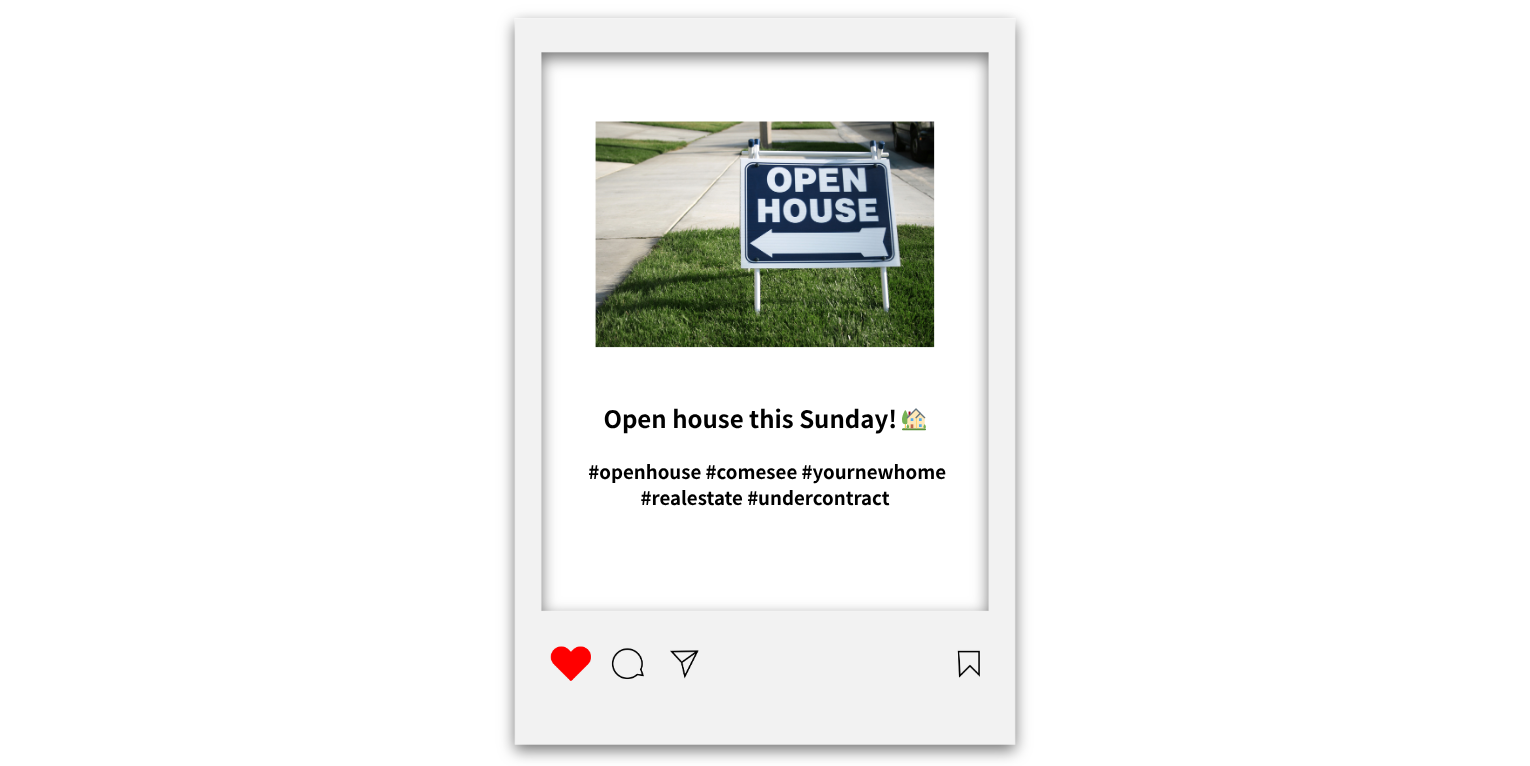
Use Case 7: Event promotion (e.g., open house)
Example:
Goal:
Drive attendance and engagement.
Why it works:
A 2024 study titled “Social media engagement of hashtag users in the context of local events” found that hashtag use significantly increases social media engagement, which in turn has a strong positive effect on users’ intention to attend events.
This works because such hashtags create urgency and demonstrate activity, which serves as social proof.
When users see consistent updates like #justsold, they are more likely to perceive the agent as successful and trustworthy, increasing the chances of future inquiries.
The best real estate hashtags for 2026 – by category
Anything can be a hashtag, but it doesn’t mean that anything should.
The key is to follow terms that people are actually putting in the search bars, whether in Google or directly in a social media platform. To help you avoid confusion, we’ve prepared a ready-to-use list of relevant hashtags for 2026.
Here are the best real estate hashtags to use depending on the context and your goal.
The most popular real estate hashtags overall
#realestate
#homeowner
#buyahouse
#property
#home
#forsale
#dreamhome
#househunting
#luxuryhomes
Top real estate buyer hashtags
#homebuyer
#firsttimehomebuyer
#homeowner
#buyahouse
#househunting
#dreamhomejourney
#dreamhome
#newhome
# property
Popular seller hashtags in real estate
#justlisted
#newlisting
#justsold
#homeforsale
#openhouse
#sellinghouse
#listing
#propertyforsale
#home sale
Trending luxury real estate hashtags
#luxuryrealestate
#luxuryhomes
#luxurylifestyle
#milliondollarlisting
#dreamhome
#modernvilla
#housewithpool
#exclusiveproperty
#luxurylisting
#premiumrealestate
#premiumhouse
Real estate hashtags for local impact
#[yourcity]realestate
#[yourcity]homes
#localrealestate
#neighborhoodname
#homesin[yourcity]
#realestate[yourcity]
#property[yourcity]
#movingto[yourcity]
#lifein[your city]
#realestateagency[yourcity]
Interior design & home styling hashtags
#interiordesign
#homedecor
#modernhome
#scandidecor
#bohodecor
#minimalistichouse
#luxuryinterior
#homeinspo
#staginghomes
Best financial hashtags in real estate
#realestateinvesting
#investmentproperty
#passiveincome
#wealthbuilding
#propertyinvestment
#roi
#cashflow
#investinrealestate
#mortgage
Other interesting hashtags for the real estate business & industry
#realestatetips
#realestateadvice
#realestatemarket
#realestatenews
#realestateinsights
#realtortips
#realestatemarketing
#virtualtour
#commercialrealestate
#realestatelife
#realestateexpert
Top real estate hashtags for 2026 by social media platform
Hitting the right intent is just as important as adjusting the hashtag to the right platform.
After all, there’s a difference between what people search for on Instagram vs. Twitter (not to mention—it’s a different kind of people as well). Your communication needs to match the audience, and hashtags are an important, even if small, part of it.
If you’re looking for some help, here’s a list of hashtags to use based on the social media page you’re trying to conquer!
Popular real estate hashtags for Instagram
#dreamhome
#homedecorideas
#luxuryrealestate
#modernliving
#househunting
#interiordesigninspo
#openhousevibes
#propertytour
#cozyhome
#realestatelifestyle
👉 Why: Instagram rewards aesthetic + aspirational content, so mixing design + lifestyle boosts engagement.
High-impact real estate hashtags for LinkedIn
#realestateinvesting
#housingmarket
#propertydevelopment
#commercialrealestate
#proptech
#investmentstrategy
#urbanplanning
#realestateinsights
#multifamilyhousing
👉 Why: LinkedIn content performs best when tied to expertise, data, and industry positioning.
Powerful Facebook hashtags for real estate
#justlisted
#openhouse
#homesweethome
#familyhome
#homeforsale
#movingtips
#newhomejourney
#renovationproject
#backyardgoals
#housegoals
👉 Why: Facebook users engage more with relatable, practical, and lifestyle-oriented posts.
Top Twitter (X) real estate hashtags
#housingmarket
#mortgagerates
#realestatenews
#propertymarket
#interestrates
#homeownership
#marketupdate
#affordablehousing
#realestateanalysis
#economictrends
👉 Why: X is driven by timely discussions + macro trends, not visuals.
Viral TikTok hashtags in real estate
#hometour
#beforeandafterhome
#dreamhome
#luxuryliving
#tinyhouse
#realestatetips
#stagingideas
#homeinspo
#fyp
#propertytok
👉 Why: TikTok rewards transformation, storytelling, and aspirational visuals.
5 tips and best practices to use hashtags in real estate
🏷️ Use a mix of broad and niche hashtags
To reach both large audiences and highly targeted buyers, combine popular tags (e.g., #RealEstate) with specific ones (e.g., #LuxuryHomesWarsaw). Research shows that using a mix helps expand reach while still attracting relevant users actively searching for that type of content.
📍 Include location-specific hashtags
Location tags like #BostonRealEstate or #BrooklynHomes help your content appear in local searches, which is crucial in real estate. Since people often search by area, localized hashtags improve lead quality and connect you with people ready to buy or rent nearby.
⚖️ Focus on quality over quantity
Using too many hashtags can reduce engagement, while a smaller set of relevant ones performs better. Studies show posts with hashtags get up to 29% more interactions, but overuse can hurt reach—so strategic selection is key.
🔁 Create and use a branded hashtag
Hashtags like #YourAgencyName help build identity and make your listings easily recognizable. They also create a searchable portfolio of your content and strengthen brand consistency across social media sites.
📊 Track and mix it up
Keep monitoring hashtags that are popular within your audience (for example, because of upcoming holidays). Make sure you’re always up to date and dynamic. Don’t bore your followers with the same set of hashtags for months on end.
5 DON’Ts of a real estate hashtag strategy
Implementing a real estate hashtag strategy is not rocket science.
Hashtags won’t sink your brand unless you get really crazy with them, so the risk-reward ratio is also pretty good. But, as with everything, there are some mistakes you should avoid. Here are the three biggest and most common ones.
What not to do when using hashtags in real estate?
❌DON’T mess up the timing
Timing matters—in life and in social media.
There are days and hours when posts are not only seen by more people but even better received.
New research suggests that the best days to publish content on social media are Tuesdays and Wednesdays, with hours varying by platform. For example, morning posts work best for Facebook, while evenings are better for TikTok. Which makes sense, as most people probably feel the need to turn their brains off and watch random short videos after work.
So before you choose your set of hashtags, make sure to publish your content in the time window when users are most likely to see them.
❌DON’T overdo it
Nobody wants to read a post stuffed with 20 keywords. It’s unnatural, difficult to read, and low-key desperate.
Especially in 2026, when a lot of people are experiencing social media fatigue, you don’t want your posts to scream at them: I’M TRYING TO SELL YOU SOMETHING.
Subtlety will probably take you further.
❌DON’T forget about intent
Since you want to be careful about the number of hashtags used, you have to be smart about your choice.
Meaning—don’t forget about the point of your post.
What’s the message behind the content? Do you want to showcase a new apartment? Do you want to share some market insights to build up authority? Do you want to introduce yourself as a new go-to real estate agent in this area?
Choose your hashtags wisely to make sure your news reaches exactly the audience that could be interested in them.
❌DON’T use hashtags that are too broad
Similar to the former point, using hashtags that are too broad makes it much harder for your content to stand out.
Tags that have already been assigned to thousands of posts can lead to your posts getting buried almost immediately after publishing.
While they can bring some visibility, they rarely attract the right audience or generate meaningful engagement. That’s why it’s more effective to combine broader tags with more specific, niche ones that better match your content and target audience.
❌DON’T choose the same hashtags for every platform
While covering the same topics will naturally require a lot of the same hashtags, it’s still best not to use a copy-paste list for every type of social media you’re on.
Why?
Because those platforms have different users with different communication styles, different expectations, and different reasons for being on social media.
This means not only a variation in the type of language used, but also the quantity of hashtags. More on that in the section below.
6 things to know about hashtags on key social media platforms
When you think of hashtags, you probably think of Instagram. They’re still huge and ever-present there, with the platform allowing each post to have as many as 30 hashtags.
Research, however, suggests that it’s best to aim for 3-10 to avoid overstuffing and making the text unpleasant to read.
🎵 TikTok
On TikTok, timing is key, and it’s all about catching the moment when a hashtag is trending.
It’s more difficult and elusive, but once you learn to master it, hashtags can play an important role in getting your content into the “For You” page, which will mean that more people will see your content.
As of 2026, TikTok allows for a maximum of 5 hashtags per post.
LinkedIn is a platform where it’s best to employ a no-nonsense approach. That’s why only 3-5 niche, industry-related hashtags will be enough to generate buzz and reach your desired audience—but not look too social-media clicky.
🐦 Twitter (X)
You may not know this, but Twitter is where it all began.
Hashtags were first introduced there in 2007 by an American blogger, Chris Messina, but didn’t really catch on until 2009. Ironically, nowadays Twitter is less big on hashtags than, let’s say, Instagram, although it doesn’t mean you should forego them altogether.
It’s best to keep it simple, with only 2-3 #s for better readability. Overly tagged posts tend to perform worse.
Bonus tip: Here’s a list of the best real estate Twitter accounts to draw inspiration from.
Facebook is where it gets tricky.
Some people say you should forget about hashtags altogether, while others claim they’re still relevant for visibility. There are no rules against using # on FB, but it’s true they’re less common there and may look out of place, like you’re trying too hard (that’s social media for you).
This isn’t to say there’s no value in including hashtags in Facebook posts. The key is just to be stingy and careful with your choice.
▶️ YouTube
If YouTube is a social platform you’re targeting (not everyone in real estate does), hashtags can be of help when it comes to building up SEO. Including them can direct the audience to your content, but it’s less important than catchy titles and thumbnails.
There are no limits to the number of hashtags on YouTube.
How many hashtags work best for key social platforms?
Quality over quantity is always the golden rule—but with hashtags, less is not always more.
While nobody likes to read posts stuffed with keywords, studies show that using a rather large number of # is a good tool to boost engagement. For example, a previously referenced research by Fanpage Karma showed that “posts with 21–25 hashtags achieved almost twice the reach of social media posts with 1–5 hashtags.”
The key, as often, is balance.
While you don’t want to overwhelm and, frankly, annoy your audience, you also don’t want to sleep on the power of hashtags. Below, you’ll find what it means for the most popular social media sites.
Recommended hashtag counts by platform (2026):
- Instagram: 3–10
- TikTok: 3–5
- LinkedIn: 2–5
- Twitter: 2-3
- YouTube: 3–5
- Facebook: 0–2
What hashtags are trending in real estate in 2026?
What works in the 2026 real estate social media game are niche, lifestyle-focused, turning-a-property-into-a-story type of posts.
It’s about portraying the real life behind the listing through the right format—such as “A day in the life of a city girl,” or “What a random Wednesday in [neighbourhood] looks like” reels.
That’s why currently popular hashtags are so content-driven, both from the POV of a potential buyer and a real estate agent.
Here are some trending hashtags that you can use as an inspo:
| #comfortliving #dailyhomeinspo #whereilive #citytocountry #homewalkthrough #listingstory | #propertyreveal #homeoftheday #nextmovehome #freshstartliving #upsizing #downsizinglife | #realtorlifevibes #agentjourney #behindthelisting #realestatestory #closingday #clientjourney |
Conclusions
From buyer and seller tags to luxury, local, and lifestyle-focused options, real estate hashtags keep on being an important part of a 2026 social media marketing strategy.
The key is to use them sparsely and in a way that’s natural to how people actually speak on different social media.
That means:
→ Using no more than 10 hashtags on Instagram, no more than 5 on TikTok, LinkedIn, YouTube, around 3 on Twitter, and 2 or none on Facebook.
→ Mixing general with niche tags.
→ Keeping an eye on market trends and using analytical tools that show currently trending hashtags.
→ Adjusting the language and type of posts: from conversational/inspirational on Instagram to insights-driven on LinkedIn.
Paired with these tips, our list of +100 most popular real estate hashtags can really help your brand become more noticeable online and reach better, more mature leads.
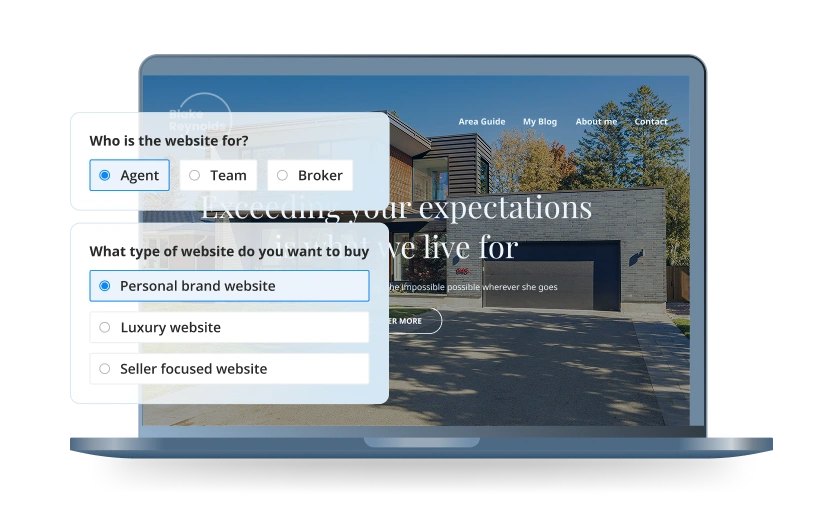
Looking for other tools to help you stay on top of things in real estate marketing? Placester’s AI Web Builder can help you create a professional page and manage your online presence with little effort and plenty of gain.
AI Websites for Real Estate
Get a custom, ready-to-edit website
in less than 4 minutes.
FAQ
When to update your hashtags?
Update your hashtags every couple of weeks or more often, especially when performance drops or there’s a clear trend emerging in your niche. Refreshing hashtags keeps your content relevant.
Is it effective to add hashtags in the first comment?
Yes, adding hashtags in the first comment can be just as effective as placing them in the caption. It also keeps your caption cleaner while still improving discoverability.
Should you use branded hashtags?
Yes, branded hashtags help build recognition and make it easier to group all your content in one searchable place. Over time, they also strengthen your brand identity and trust.
Can hashtags trigger shadowbanning?
Yes, if you use a hashtag that’s banned, spammy, or irrelevant repeatedly, you can limit your content’s visibility. It’s important to research and rotate hashtags to avoid this risk.
How to find more hashtags?
You can find hashtags by using social media search tools or tracking what your competitors do. Another options are seperate tools dedicated to finding relevant keywords that you can later use as hashtags.
Published on
(Last updated on
)