(800) 728 8391


Quick summary:
- 🎯 Marketing funnel vs sales funnel: Learn how awareness turns into leads and how those leads move toward closing.
- 📊 Improve conversion rates: When leads follow clear stages, more inquiries turn into real transactions.
- ⚙️ Build and optimize your funnel: Use CRM systems, automation, and valuable content to generate higher-quality leads and guide them to the closing table.
In the real estate industry, you generate leads through your website, ads, referrals, or listing portals. But not every inquiry turns into a transaction. In fact, most of them don’t.
0.4–1.2%
The average real estate lead conversion rate falls somewhere between 0.4% and 1.2%.
Source: Inman
A real estate sales funnel starts to make a difference here. Its purpose is simple: guide potential clients through a structured process that gradually moves them from consideration to commitment. Without that structure, leads often go cold before you even have a chance to build a relationship.
In this guide, you’ll learn what a real estate sales funnel really is and why it matters. We’ll also clarify how it differs from a marketing funnel. Let’s go through the stages of each, and explore how to build both so that more of your leads end up at the closing table.
What is a real estate sales funnel?
A real estate sales funnel is a structured process that guides potential clients from their first contact with you to a signed agreement. It moves prospects through a series of clearly defined sales steps that lead to a completed transaction. In simple terms, it maps how an initial inquiry gradually develops into a working client relationship and, ultimately, a real estate deal.
Real estate transactions rarely happen quickly. Buying or selling a home is a high-value decision that often unfolds over weeks or months. Before making a final decision, prospects may:
- Request information
- Browse listings
- Ask questions
- Schedule showings
- Or pause their search
A real estate funnel helps you track that progression and maintain consistent communication while the client moves toward readiness.
Another key function of a sales funnel is visibility. When you organize opportunities into a defined process, you can see how many leads are active, which ones are progressing, and where deals tend to stall. This makes sales performance easier to measure and improve. Teams often use CRM systems to:
- Track leads
- Automate follow-ups
- And manage the stages more efficiently
That helps reduce missed opportunities and keeps the entire sales workflow organized.
What is a marketing funnel in real estate?
A real estate marketing funnel is a framework that describes how potential clients move from first discovering your brand to developing enough interest to consider working with you. For this reason, it operates earlier in the customer journey than a sales funnel.
It maps how people who initially know nothing about you become engaged prospects who may eventually reach out about buying or selling a property. The concept comes from the broader “purchase funnel,” a marketing model that illustrates the journey consumers take from initial awareness to a purchasing decision.
In real estate, the marketing funnel focuses on visibility and engagement long before a transaction enters the picture. It covers the activities that introduce people to your services and gradually build familiarity with your expertise. A potential client might first encounter your brand through:
- Search results
- Property portals
- Social media content
- Or local advertising
Over time, repeated exposure to useful information helps establish credibility and keeps your name top of mind when the person is ready to take the next step.
The purpose of the marketing funnel is not to close deals directly. Its role is to attract the right audience and guide them toward a point where they are comfortable initiating contact. Once a potential client reaches that stage and becomes a lead, the sales funnel begins and takes over the process of turning that interest into a transaction.
Sales funnel vs marketing funnel in real estate
Understanding the difference between a marketing funnel and a sales funnel helps explain why both are necessary. A marketing funnel builds awareness and generates inquiries. The sales funnel begins later, once those inquiries turn into direct conversations with prospective buyers or sellers:
| Aspect | Marketing funnel in real estate | Sales funnel in real estate |
|---|---|---|
| Main purpose | Attract attention and build interest among prospects. | Convert existing leads into signed clients and closed deals. |
| Position in the customer journey | Earlier stage. It starts when people first discover your brand. | Later stage. It begins when a person becomes a lead and enters a direct conversation. |
| Primary focus | Visibility, education, and engagement with a broad audience. | Qualification, relationship building, and decision support for specific prospects. |
| Typical activities | Content marketing, SEO, social media, online ads, automated email campaigns, and brand visibility in property portals. | Lead qualification, follow-up calls, property showings, consultations, negotiations, and closing coordination. |
| Audience size | Large and mostly anonymous audience. Many people are still researching the market. | Smaller group of identified prospects who have already shown interest. |
| Nature of communication | One-to-many communication aimed at attracting and informing potential clients. | One-to-one communication focused on individual needs and transaction details. |
| Main success metric | Lead generation and audience engagement. | Conversion of leads into clients and completed transactions. |
| Typical tools | Websites, blog content, social media platforms, advertising tools, and marketing automation. | CRM systems, lead management tools, follow-up workflows, and transaction management software. |
| Outcome | A person becomes a lead and reaches out to an agent or brokerage. | The lead signs an agreement and the deal moves toward closing. |
Why is sales funnel important in real estate? 5 benefits
In real estate, sales funnel helps increase your conversion rate. When more leads convert into clients, you close more transactions and earn more commission. But that’s only part of the picture. Take a look at the key benefits a well-structured sales funnel can bring to your real estate business:
1️⃣ Higher lead-to-client conversion rate
You don’t rely on random outreach or risk that inquiries get overlooked. Instead, every lead enters a structured process that includes qualification, follow-up, and ongoing communication. Even small improvements in conversion can have a significant impact. For example, increasing your conversion rate from 1% to 2% doubles the number of transactions without requiring additional leads.
2️⃣ Better lead qualification and prioritization
Not every lead has the same level of intent. Some prospects are actively planning to buy or sell, while others are only researching the market. A structured funnel helps you identify which leads deserve immediate attention and which require long-term nurturing.
3️⃣ Consistent follow-up
Many agents contact a lead once or twice and then move on to the next inquiry. That approach often leaves promising opportunities unfinished rather than truly lost.
40–60%
Research based on more than 2.5 million recorded sales conversations shows that 40% to 60% of deals end in “no decision.”
Source: Harvard Business Review
A sales funnel helps prevent that outcome by defining when and how you follow up with each prospect. The result is a steady relationship with the lead instead of sporadic contact that quickly fades.
4️⃣ More predictable deal flow and revenue
When leads move through a consistent process, your business becomes easier to predict. Instead of relying on occasional lucky deals, you can estimate how many transactions might result from a given number of leads. This type of visibility allows you to confidently plan:
- Marketing budgets
- Staffing needs
- Revenue expectations
5️⃣ Faster response to new leads
The moment a new lead appears is often the moment when interest is at its highest. A sales funnel helps you react immediately by defining what happens as soon as a lead enters the system. Speed matters more than many agents realize.
x8
higher
Conversion rates are eight times higher when a lead is contacted within five minutes compared with responses that take six minutes or longer.
Source: InsideSales
4 stages of marketing funnel in real estate business
Before you can turn prospects into clients, you first need a steady flow of people who know you exist. For that reason, it makes sense to look at the marketing funnel before moving on to the sales funnel. The first one creates the conditions that allow leads to appear. Once you understand how that process works, it becomes much easier to see how those leads eventually move into the sales stage.
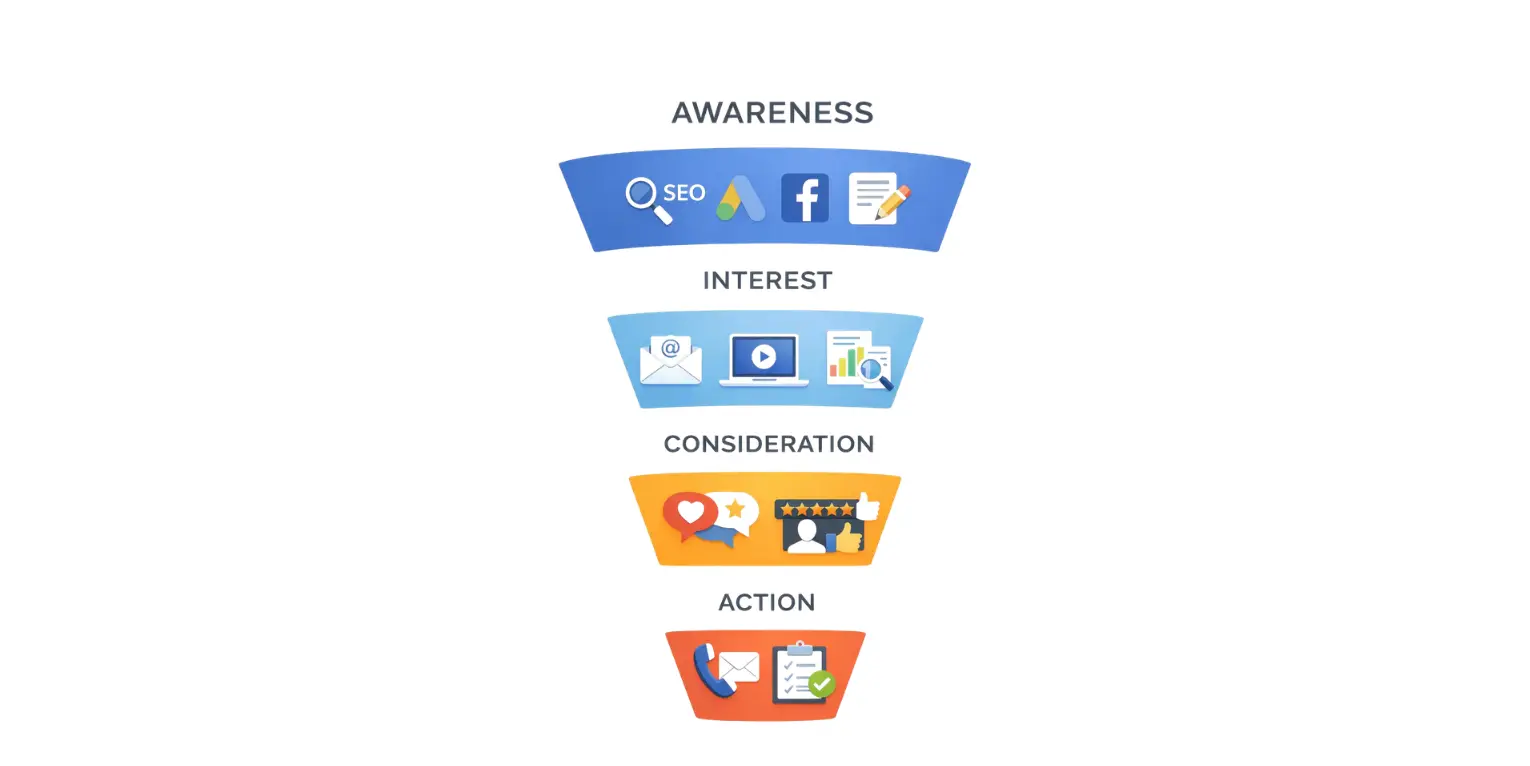
1. Awareness
The first stage of the marketing funnel begins when people become aware of your brand or real estate services. At this point, they are not actively choosing an agent yet. Many of them are simply researching the market and trying to understand the buying or selling process.
Your goal at this stage of a real estate marketing funnel is visibility. You want to appear wherever your target audience is looking for information so that they encounter your name early in their research.
43%
The internet remains the starting point for most property searches, with 43% of buyers beginning their journey online before contacting an agent.
This makes digital visibility a critical part of early-stage marketing. The awareness phase focuses on helping people discover your expertise. Instead of pushing for immediate contact, you provide useful information that positions you as a knowledgeable local professional. Over time, repeated exposure builds familiarity and trust, which increases the likelihood that the person will remember you when they are ready to take the next step.
Awareness-stage marketing for real estate agents typically includes:
- Publishing educational blog articles about buying or selling property
- Creating neighborhood guides and local market insights
- Optimizing your website for real estate SEO
- Running paid search or social media advertising
- Sharing listings and market updates on social media
- Producing video content such as property tours or market explanations
- Appearing in local media or industry publications
- Building visibility through real estate portals like Zillow or Realtor.com
2. Interest
At the second stage of the marketing funnel, prospects already know your brand exists and start paying closer attention to what you offer. At this point, people are not necessarily ready to contact an agent, but they begin actively exploring information that could help them make future real estate decisions.
This stage usually begins when someone interacts with your content more deliberately. A visitor might:
- Spend time reading several articles on your website
- Subscribe to your newsletter
- Follow your social media profile
- Or return to your website to review property listings
These signals show that the person is no longer just browsing the market in general. They are starting to engage with your expertise.
For real estate professionals, the main objective at this stage is to deepen trust and keep the prospect engaged.
59%
59% prospective buyers searched for at least six months before purchasing a home.
Source: Zillow
During that time, consistent exposure to helpful information plays a major role in shaping which agent they eventually contact. Your marketing efforts can take a shape of:
- Sending regular newsletters with market updates and new listings
- Publishing high-quality content about buying, selling, or financing property
- Creating downloadable resources such as relocation guides or homebuyer checklists
- Sharing data-driven market reports for your local area
- Posting in-depth property tours or educational videos
- Running remarketing campaigns that re-engage website visitors
- Encouraging social media interaction through comments, polls, or Q&A sessions
- Offering webinars or live sessions explaining market trends
3. Consideration
At the consideration stage, prospects move beyond general interest and begin seriously evaluating their options. They start comparing agents, services, and approaches to decide who they might want to work with.
This stage is especially important in real estate because most people work with only one agent.
88%
88% of home buyers purchase their home through a real estate agent or broker.
That means the decision about which professional to trust becomes a critical step in the process. Your goal here is to help prospects feel confident about choosing you. Instead of broad educational content, marketing becomes more focused on proof. Examples of activities that support the consideration stage include:
- Publishing client testimonials and detailed success stories
- Showcasing recently sold properties and listing case studies
- Creating pages that explain your selling or buying strategy
- Sharing before-and-after examples of property marketing campaigns
- Providing detailed neighborhood market reports
- Highlighting online reviews and ratings from past clients
- Producing videos explaining how you guide clients through transactions
- Offering downloadable seller or buyer guides that outline your process
4. Action
The last stage of the marketing funnel is the moment when a potential client turns into a lead. In other words, the person who has been learning about your services and engaging with your content finally decides to initiate direct contact.
Up to now, your goal has been to attract attention, build trust, and gradually increase interest in your services. When someone reaches the action stage, that effort results in a measurable conversion. It simply means that a visitor performs the action you want them to take. In real estate, this action usually involves sharing contact information or requesting assistance with a property-related decision. Think, for example:
- Submitting a contact form on your website
- Requesting a property showing
- Asking for a home valuation
- Scheduling a buyer or seller consultation
- Downloading a guide in exchange for contact details
- Calling or messaging you directly
- Signing up for property alerts with an email address
Once that happens, the marketing funnel has effectively completed its role, and the sales funnel begins. From here, the focus shifts from marketing activities to direct interaction.
17 real estate sales funnel steps
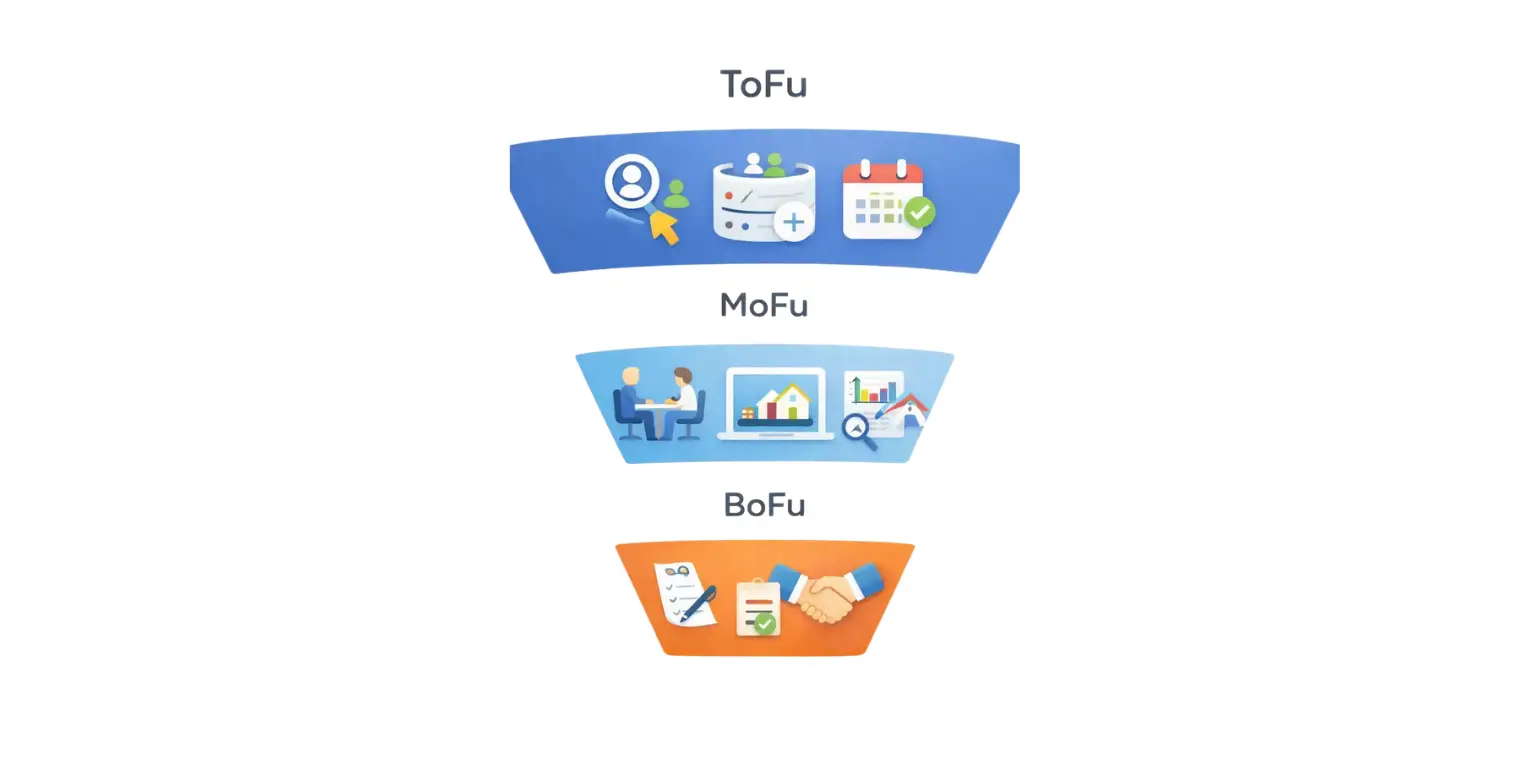
Once a lead enters your system, the real estate sales process does not happen all at once. People rarely decide to work with an agent after a single interaction. Instead, they move through several stages before they feel ready to commit. To make this process easier to manage, many teams organize their sales funnel into three broad levels:
- Top of the Funnel (ToFu)
- Middle of the Funnel (MoFu)
- Bottom of the Funnel (BoFu)
Below, you’ll see what typically happens at each level of a real estate sales funnel and what actions help move prospects closer to a signed agreement.
Top of the Funnel (ToFu)
The Top of the Funnel is the earliest stage of the process, where a newly generated lead first enters your real estate sales pipeline. At this point, the person may know your brand and has already shown initial interest—for example by filling out a form or requesting information. They are not yet ready to commit, though. Your task here is to:
- Establish contact
- Confirm that the lead is legitimate
- Begin guiding the conversation toward the next stage of the funnel.
In sales terminology, this stage is often associated with prospecting and lead qualification. That means the process of identifying potential buyers and determining whether they have a realistic chance of becoming clients.
How should you proceed with the captured leads?
1. Initial lead response
As soon as a lead appears, you reach out to acknowledge the inquiry. This first response confirms that a real person is behind the message, and opens the door for further conversation.
2. Basic lead qualification
Early questions help determine whether the prospect is a potential buyer or seller and whether their timeline and budget make sense. This step prevents you from investing time in leads that are unlikely to move forward.
3. Discovery conversations
Short calls or messages help you understand what the prospect is looking for. A buyer may explain preferred locations, property type, or budget range, while a seller might describe the property and their motivation for listing.
4. Lead segmentation and CRM entry
The lead is recorded in a CRM system and assigned to the correct category—for example, buyer, seller, investor, or long-term prospect. This ensures that the lead can be tracked and followed up properly as they move through the funnel.
5. Scheduling the next step
The conversation typically ends with a concrete action, such as:
- Scheduling a consultation
- Sending property options
- Arranging a home valuation
Setting a clear next step helps maintain momentum.
6. Early relationship building
Even at this early stage, communication should feel helpful rather than transactional. Sending personalized emails and providing relevant property suggestions helps establish trust and encourages the lead to stay engaged.
Middle of the Funnel (MoFu)
The Middle of the Funnel is the stage where a qualified lead becomes an active opportunity. You already know that the prospect has a real interest in buying or selling property. The focus shifts to deeper engagement and guidance.
Typical MoFu activities include:
7. Detailed consultation
At this stage, conversations become more structured. You discuss the client’s specific needs and concerns in detail:
- For buyers, this might include preferred neighborhoods, property types, and financing readiness.
- For sellers, it may involve the motivation for selling and expectations about price and timing.
8. Providing tailored property recommendations
Buyers often receive curated property suggestions that match their criteria. Instead of sending large lists of listings, you narrow the options and explain why specific properties may fit their needs. This helps prospects see your expertise and saves them time.
9. Scheduling and conducting property showings
For buyer leads, property tours become a central part of the process. Showings allow prospects to move from general interest to a concrete evaluation of homes on the market.
10. Preparing comparative market analysis (CMA)
For seller leads, a comparative market analysis helps estimate the realistic value of their property. This document compares similar homes that have recently sold in the area. It also forms the basis for a potential listing strategy.
11. Price negotiation guidance
You start preparing the client for the financial side of the transaction. Buyers need guidance on what a realistic offer looks like based on comparable sales in the area. Sellers often want to understand how much flexibility they may have on price once negotiations begin. Your role is to:
- Explain typical negotiation scenarios
- Discuss potential counteroffers
- Outline common concessions such as repairs, closing costs, or timeline adjustments.
12. Maintaining structured follow-up system
You should record every interaction in a CRM so that you always know the status of the relationship. After each conversation, schedule the next contact rather than waiting for the client to reach out again. Consistent follow-up ensures that the lead stays engaged and continues moving toward the next step in the selling or buying process.
Bottom of the Funnel (BoFu)
The bottom of the funnel is where all previous work comes together. Your task is to guide the client through the final steps that lead to a signed agreement. How can you close the deal?
13. Signing a representation agreement
This is the first formal step that turns a lead into a client. Buyers usually sign a representation agreement, while sellers sign a listing agreement. This document officially authorizes you to represent them in the transaction and confirms that they want to work with you as their agent.
14. Preparing and submitting an offer
For buyers, this stage often involves preparing the purchase offer. You help structure the price, contingencies, and timelines so that it aligns with market conditions and client preferences.
15. Managing negotiations with the other party
Once an offer is submitted, negotiations may begin. You should coordinate counteroffers, adjust terms, and communicate between buyer and seller until both sides reach an agreement.
16. Coordinating inspections and due diligence
After an offer is accepted, the transaction enters the due-diligence phase. As an agent, you help schedule property inspections, review reports, and negotiate repairs or credits if issues arise.
17. Preparing for closing
As the property transaction approaches completion, you review the final documentation and arrange the final walk-through. Once the closing takes place, the deal is done and your commission is secured.
How to create a real estate sales funnel in 5 simple steps
You build a real estate sales funnel by connecting various marketing channels, lead capture tools, and sales workflows into a single system. The key is to design a process where every new lead automatically enters a structured pipeline and receives the right follow-up at the right time.
You can achieve this with 5 simple steps:
1️⃣ Define your target audience
Start by deciding who the funnel is designed for. It works best when it focuses on a specific audience segment such as:
- First-time buyers
- Relocation clients
- Investors
- Homeowners planning to sell
2️⃣ Create a lead capture system
The next step is building a mechanism that turns visitors into leads. This usually happens through landing pages, forms, or gated tools that collect contact details. Real estate lead generation strategies often rely on digital marketing channels such as:
- SEO
- Social media
- Google Ads and Facebook Ads
3️⃣ Connect everything to a CRM
A funnel only works if you track every lead. This is why most real estate teams rely on a Customer Relationship Management (CRM) systems. Such software allows you to:
- Store lead information
- Track interactions
- Assign leads to stages in the pipeline
- Schedule follow-ups automatically
4️⃣ Automate lead nurturing
When a lead enters your funnel, you need a way to maintain contact until they are ready to act. To achieve this, rely on automation. AI-powered tools offer, among other things:
- Automated email marketing sequences
- Property alert notifications
- SMS updates
- Personalized listing recommendations
5️⃣ Track performance and optimize
Finally, you need to measure how well your funnel works. The most useful metrics include:
- Visitor-to-lead conversion rate
- Lead-to-appointment rate
- Appointment-to-client conversion
- Number of closed transactions
Tracking these numbers helps you optimize the real estate lead funnel and increase the final conversion rate.
What are common sales funnel mistakes?
The most common sales funnel mistakes are usually linked to poor execution, such as weak lead capture or inconsistent follow-up. When these elements are missing, leads quickly lose interest and the funnel stops working as intended. Take a look at some typical sales funnel mistakes and the approaches that help avoid them:
| Common mistake | How to fix it |
|---|---|
| Weak lead capture | Use clear calls to action, simple forms, and focused landing pages to make it easy for visitors to take the next step. |
| Inconsistent follow-up | Implement scheduled follow-ups through a CRM or automated reminders so that every lead receives timely communication. |
| No defined sales process | Create a clear pipeline with stages such as qualification, consultation, negotiation, and closing. |
| Treating all leads the same | Segment leads based on intent, timeline, or property type so communication stays relevant. |
| Relying only on manual outreach | Combine personal communication with automation tools such as email sequences and alerts. |
| No performance tracking | Monitor funnel metrics such as lead volume, conversion rate, and closed deals to easily identify bottlenecks. |
Conclusions
A well-designed sales funnel for real estate agents helps you move prospects step by step toward a completed transaction. When your strategy is supported by the right tools, you attract higher quality leads and boost your real estate business with more consistent deal flow.
It usually begins with a strong online presence. Your website acts as the foundation of the marketing funnel, where visitors discover your services, explore listings, and decide whether to reach out. Build it with Placester to capture and nurture leads from the very first interaction.
Thanks to Placester’s AI-powered features, you can also quickly produce valuable content tailored to your audience. It’s a simple way to attract visitors and keep them engaged as they move through the funnel. Try Placester today!
AI Websites for Real Estate
Get a custom, ready-to-edit website
in less than 4 minutes.
FAQ
What are the 5 stages of the sales funnel?
The five stages often cited in industry literature are awareness, interest, desire, action, and loyalty. However, this model originally describes the customer’s psychological journey rather than the operational stages of a sales process. In real estate, these stages therefore fit the marketing funnel more closely, while the sales funnel focuses on practical activities such as lead qualification, consultations, negotiations, follow-up, and closing the deal.
How to build a simple sales funnel?
Building a simple sales funnel starts with a lead capture system, automation, and a CRM to manage prospects. Together, these tools create an environment where every lead can move from the first inquiry to a closed transaction through a defined process.
What tools help with sales funnels?
You can manage your sales funnel with CRM tools such as HubSpot, Salesforce, or Follow Up Boss, which track leads and deal stages. To capture those leads in the first place, platforms like ClickFunnels, Leadpages, or Unbounce help you create landing pages and lead forms. Once the contact information is collected, automated follow-ups can be handled through Mailchimp, ActiveCampaign, or HubSpot Marketing Hub.
What are some real estate sales funnel examples?
Examples may include home valuation, property showings, and open house funnels. These illustrate that there are many different types of sales funnels, each designed around a specific goal. Instead of building one universal system, agents often start with a funnel template tailored to a particular objective and then adjust it to their local market and lead sources.
Published on
(Last updated on
)