(800) 728 8391


Quick summary:
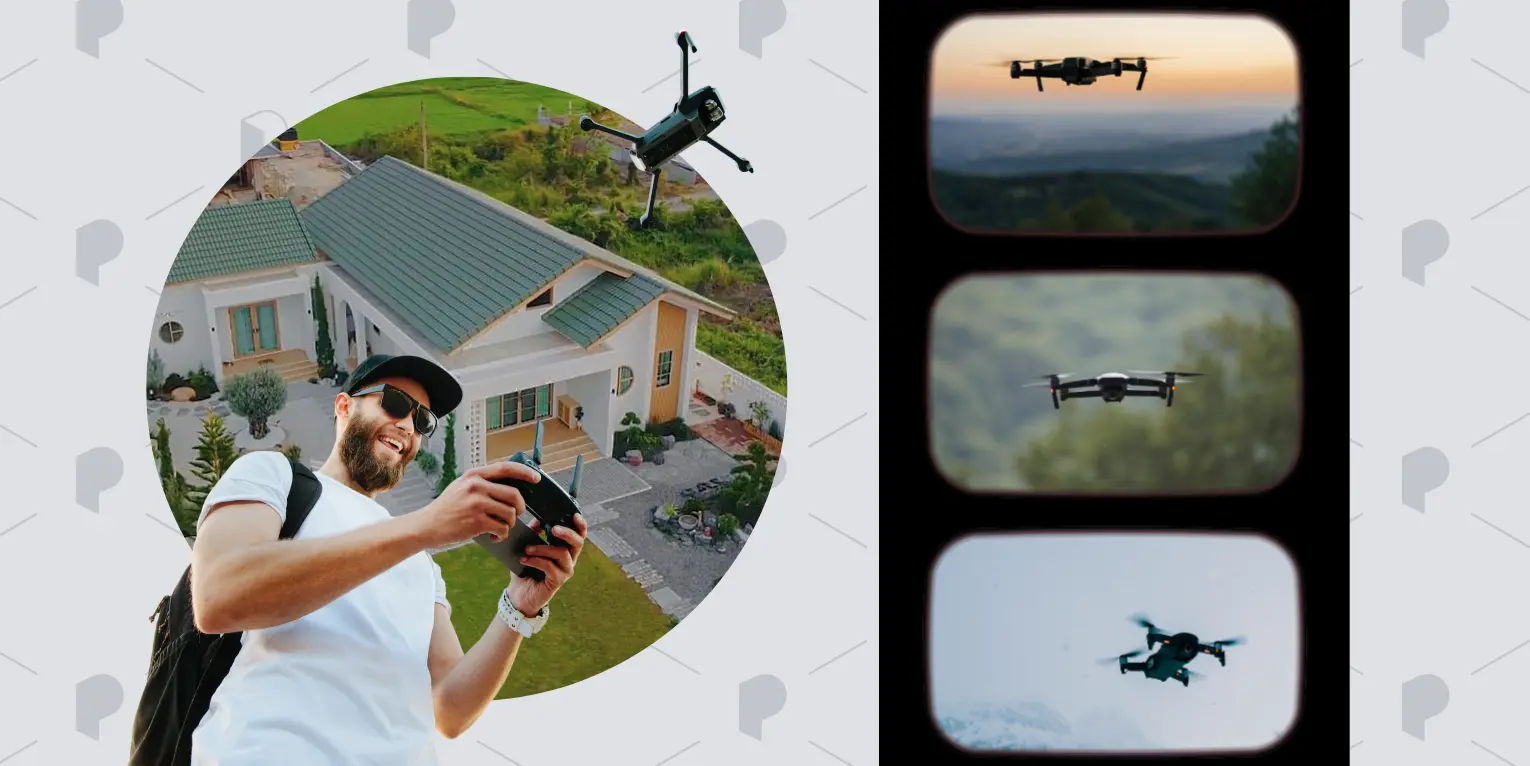
- 🚁 Different drones for different jobs: Compact drones work best for quick exterior shots, while larger models deliver better image quality for high-end listings.
- 📸 Key features matter in the field: Look for strong cameras, long flight time, stable transmission, and safety tools like obstacle sensing or propeller guards.
- 🏡 Popular real estate picks: The DJI Mini 4 Pro or Mini 5 Pro work well for fast shoots, while the DJI Air 3 and Inspire 3 cover advanced needs.
Drones have changed real estate marketing. They give buyers a view they can’t get from the ground. One flight can explain location, lot size, and neighborhood value faster than a long and boring description.
18%
In total, 18% of real estate agents have direct access to a drone in their office.
Source: 2024 NAR Member Profile
Some fly it themselves (6%), and others work with an in-house team member who operates it (12%). Most agents choose to outsource drone work to licensed professionals (46%).
That means nearly one in five agents may be wondering which drone to choose. The answer depends on how you work. Not every UAV (unmanned aerial vehicle) fits every job. That’s why this guide breaks down the best drones for real estate in 2026. Check which model makes sense for your work.
Best Drones for Real Estate Photography & Videography in 2026
Real estate photography and videography place different demands on a drone. Photo-focused work requires sharp sensors and consistent image quality. Video projects rely on stable flight and smooth motion. Other scenarios—such as indoor shoots or large commercial properties—introduce their own technical limits.
DJI leads the global consumer drone market, with its compact and cinematic models used across hobby, commercial, and professional workflows.
~83%
In a 2025 dataset, DJI drones accounted for 83.48% of all detected drone activity.
Source: dedrone.com
This section breaks down the best drones for real estate photography and videography in 2026 by specific use case.
| Model | Best for | Base price (USD) |
|---|---|---|
| DJI Air 3 | Overall real estate | $1,099 |
| DJI Mavic 3 Pro | Real estate photography | $2,199 |
| DJI Mavic 3 Cine | Real estate filming | $4,799 |
| DJI Matrice 350 RTK + Zenmuse L2 | LiDAR videography | $10,500 + $12,430 |
| DJI Mini 4 Pro | Beginner photography | $759 |
| DJI Mini 4K | Budget photography | $299 |
| DJI Avata 2 | Indoor videos & photos | $999 |
| DJI Inspire 3 | Commercial marketing | $16,499 |
| DJI Mini 5 Pro | Compact shoots | $899 |
The best real estate drone overall: DJI Air 3
If you want one drone that fits almost every real estate job, this is a strong choice. Air 3 balances image quality, flight performance, and ease of use better than most models in its class.
Air 3 stands out with a dual-camera system. It pairs a wide-angle lens with a 3× medium telephoto lens. Both cameras use 48 MP, 1/1.3″ CMOS sensors. That gives you sharp photos and detailed video from multiple focal lengths without changing lenses. This flexibility is great for varied property types—large estates and smaller lots alike.
For real estate work, Air 3’s 4K HDR video at up to 60 fps means smooth, professional footage. You can capture walkthroughs, sweeping flyovers, and neighborhood context in rich detail. The dual system also lets you switch perspectives without stopping your shoot.
Battery life matters in the field, and Air 3 delivers. It offers up to 46 minutes of flight time on a single charge. That’s more than enough to map an entire property, try various angles, and redo shots without rushing.
The drone has omnidirectional obstacle sensing for safer flights around trees and buildings. Transmission and control are also solid. Air 3 uses DJI’s latest systems for long-range video feed and a steady connection between the drone and controller.
I’m so in love with the ability to shoot in 2 focal lengths, I don’t mind the smaller sensor. The quality out of both lens is amazing. Also, the Color science must have been improved a bit.
👉 Read our complete guide to real estate drone photography in 2026.
The best drone for real estate photography: DJI Mavic 3 Pro
At its core is a triple-camera array on a foldable frame. The main camera uses a 4/3″ Hasselblad sensor, known for excellent dynamic range and clean detail—even in challenging light. Two additional lenses cover medium and long focal lengths. This gives you more flexibility to frame shots from different distances without losing sharpness.
The Mavic 3 Pro can capture photos in high resolution and RAW format, allowing more control in post-processing. RAW files save more image data, which helps when you’re editing exposure or color for listing galleries.
Flight stability and smart features also support better photography. The drone handles wind well, and its obstacle avoidance helps when flying close to structures. Intelligent flight modes let you repeat shots consistently rather than winging every angle manually.
The 3x on the other hand… holy hell that thing is sharp and the colours are beautiful SOOC. I actually think its my favourite camera on the M3P. Even in low-ish light it has a dual native iso (100 & 800) so can hold its own against the 4/3” camera.
The best camera drone for real estate filming: DJI Mavic 3 Cine
This drone is essentially the Mavic 3 imaging platform tuned for more professional footage. Many filmmakers in the drone community point to it as a great choice when quality matters most.
What sets this version apart is not the flight hardware, but the video workflow built into the drone. Unlike the standard or Pro models, the Cine edition includes a large internal SSD and Apple ProRes encoding. ProRes gives you higher-quality footage that stands up to editing and color grading.
The core imaging system here uses the same high-quality Four Thirds Hasselblad sensor that made the Mavic line so respected. That sensor captures rich detail and good dynamic range, which is vital when filming exteriors in bright sunlight or interiors with mixed light.
The Cine variant records in industry-friendly codecs and has the space to store larger files without you juggling microSD cards mid-shoot. That makes footage easier to work with in post-production.
In practical terms, this model works well for listing videos with motion ramps, sweeping reveals, and neighborhood flyovers. The ProRes capture means those clips hold up much better when you color-grade or stabilize them in editing software. That’s a big deal for agents and creators who want content that doesn’t look “phone-shot.”
ProRes 422 and the inbuilt SSD more than explain this difference [editor’s note: between the Pro and Cine versions]. Its professional-level base video recording as opposed to the lossy, highly compressed H.265 used on consumer models.
👉 Get inspired by the 21 best real estate videos for agents in 2026.
The best LiDAR drone for real estate videography: DJI Matrice 350 RTK + Zenmuse L2
LiDAR is a laser-based way to measure distance. The sensor sends out light pulses and records how long they take to bounce back. That data becomes a point cloud, which you can turn into accurate 2D and 3D models.
In real estate, LiDAR shows up when you need more than pretty footage. It helps teams capture true measurements, build floor plans, and create as-built models. You can use it for site inspection or commercial planning.
For that kind of job, the most practical setup is the DJI Matrice 350 RTK airframe paired with the Zenmuse L2 LiDAR payload from DJI:
- The Matrice 350 RTK delivers enterprise-grade endurance and stability, with up to 55 minutes of maximum flight time and an IP55 protection rating.
- The Zenmuse L2 handles the LiDAR capture. It carries an IP54 rating, supports a maximum detection range of 500 meters, and mounts directly on the Matrice platform.
Note that this setup is expensive because it’s built for professionals. A complete Matrice 350 RTK and Zenmuse L2 LiDAR system typically runs between $30,000 and $40,000 USD, depending on accessories and software.
Expert tip: If you only need smooth flyovers for Instagram and MLS, LiDAR is the wrong spend.
I still prefer running my L2 data through LP360 before doing any ground classification, point cloud cleanup. All my clients have been very happy with the output and were even surprised that I got good data out of this sensor compared to the other systems on the market.
The best beginner drone for real estate photography: DJI Mini 4 Pro
You don’t need a $2,000 drone to start offering aerial photos to clients. The DJI Mini 4 Pro gives you real listing-ready results at a much friendlier price.
DJI lists it at $759 for the base kit in the U.S. store. That’s a big gap versus the popular DJI Air 3 ($1,099) or DJI Mavic 3 Pro ($2,199). For a first drone with a camera, that price difference matters. You can learn fast, make money, and upgrade later if your workflow outgrows it.
Mini 4 Pro also feels beginner-safe in a way cheaper drones don’t. It has omnidirectional obstacle sensing, so it can help you avoid trees, walls, and rooflines when you’re lining up a clean exterior angle.
For real estate photos, the specs are more than enough to deliver a solid aerial set. Mini 4 Pro uses a 1/1.3-inch sensor and supports 48MP photos. It also shoots 4K/60 HDR and supports True Vertical Shooting, which is perfect when you want vertical clips for Reels, Shorts, or TikTok without awkward cropping.
In the field, the Mini 4 Pro keeps the process simple. It hovers steadily, gives you a clean live feed, and doesn’t demand a complex setup. DJI rates it at up to 34 minutes of max flight time. That should be enough for first takes.
Expert tip: The Mini 4 Pro weighs under 250 grams (0.55 lb). While you’re still learning and flying recreationally, that can mean no registration. It’s only required once you use a drone for commercial purposes.
These drones fly themselves. My three year old daughter could fly if I’d let her.
The best budget drone for real estate photography: DJI Mini 4K
The DJI Mini 4K can be the best cheap real estate drone for beginners. The base kit typically sells for $299, while the Fly More Combo is $449. Compare that to DJI’s step-up models: Mini 4 Pro starts at $759, and Air 3 at $1,099.
The key features to consider with a budget drone like this include camera basics, flight time, and how easy it is to get repeatable shots. Mini 4K checks the core boxes with:
- 4K/30fps video
- A 1/2.3-inch CMOS camera
- 31 minutes of max flight time
- One-tap takeoff/landing
- Return to Home feature
- Stable hovering
Thanks to its compact size, the drone is easy to carry and quick to deploy. It works well for basic exterior shots and simple indoor spaces.
Be realistic about its limits, though. Mini 4K is an entry-level model, so it won’t match higher-end drones like the DJI Mavic 4 Pro in low-light conditions.
It’s brilliant, it was my first drone. The lack of obstacle avoidance might be a good thing, as it will train you to have spatial awareness and not rely on OA while you are learning […] For the same budget, there really wasn’t anything else like it, but for a starter drone, it won’t disappoint.
👉 Find out how real estate agents can save with tax deductions in 2026.
The best drone for indoor real estate videos & photos: DJI Avata 2
Indoor work has one problem: tight spaces. The DJI Avata 2 was built for this exact scenario. Its cinewhoop design uses built-in propeller guards, which makes it a safer option for indoor drone shots than open-prop models.
From a real estate perspective, Avata 2 shines when you want a smooth fly-through feel. Imagine entering through the front door, floating past a kitchen island, then revealing the backyard in one take. The camera supports 4K/60 HDR and uses a 1/1.3-inch sensor with a 155° ultra-wide field of view. That means you can capture more of the room without constantly backing up.
It also helps that DJI designed Avata 2 around intuitive controls. Many people fly it with DJI’s motion controller setup. It lowers the barrier if you’re not an FPV pilot but still want dynamic indoor video that looks high-end.
Avata 2 has a max flight time of up to 23 minutes per battery. It also comes with 46 GB of internal storage, which is handy when you’re moving fast and don’t want to juggle cards between properties.
This type of drone is hard to replace for indoor walk-throughs. It lets you move smoothly from room to room, which works especially well in smaller apartments. Instead of static cuts, you get a natural sense of how the home feels to live in. When you need excellent image quality and attractive cinematic footage, this approach helps you turn tight interiors into inviting spaces.
Ran both the Avata 2 and the DJI NEO through a full indoor low-light flight inside an abandoned house — tight hallways, pitch-black rooms, no GPS, and lots of real obstacles […] The Avata 2 did great in terms of stability and control.
The best drone for commercial real estate marketing: DJI Inspire 3
In real estate marketing, aerial content needs to communicate scale and flow at a glance. Buyers want visuals that feel convincing and easy to understand. That means excellent camera quality and smooth footage on every platform.
Not every drone can do that. High-end commercial work demands crisp details, wide dynamic range, and footage that holds up on big screens. You also need reliability and enough spare batteries to cover long site tours.
The DJI Inspire 3 is often the right drone for real estate teams with serious marketing needs. It’s built for filmmakers and content pros. The camera system is stellar. Inspire 3 carries a full-frame 4/3 sensor capable of stunning 5.2K video and rich stills. That sensor size gives you clean highlights and deep shadows. It’s ideal when shooting across bright skies and shaded buildings in the same frame.
What really sets Inspire 3 apart is how it handles motion and control. The drone supports dual-operator workflows, so one person flies while another frames shots. That matters when you’re capturing a choreographed walkaround of a campus or sweeping reveals of waterfront property. It also handles high frame rates and professional codecs, which makes your footage easier to edit in high-end software.
Another practical benefit is the drone’s interchangeable lenses. That adds flexibility for creative angles and different shooting distances. You can use a wide lens for large exteriors or switch to a tighter lens for detail shots.
Honestly, I know this has been out for over a year now, but I recently watched the product video from DJI about the Inspire 3, and I can’t get over how cool this technology is. It made me wonder about the endless possibilities on a film set with access to tools like this.
👉 Discover 18 real estate marketing trends to follow in 2026.
The best compact drone for real estate shoots: DJI Mini 5 Pro
If you want “small bag, big results,” Mini 5 Pro stands out in 2026 coverage as a top pick: It measures:
- Folded: 157 × 95 × 68 mm (6.2 × 3.7 × 2.7 in)
- Unfolded: 304 × 380 × 91 mm (12.0 × 15.0 × 3.6 in)
It packs easier than, for example, the Air 3, which folds to 207 × 100.5 × 91.1 mm and weighs a lot more.
What makes the Mini 5 Pro real estate–ready is the drone’s camera. DJI pairs a 1-inch 50MP sensor with an f/1.8 aperture. According to users, this model performs noticeably better in tough lighting than older Mini models, while still staying portable.
The new DJI Mini 5 Pro keeps things simple, also on the weight side. It comes in just under 250 g (about 0.55 lb), which means you don’t have to register it. The low weight means the Mini 5 Pro will make it easy to record an in-depth virtual open house. Remember that it only works until you don’t use the drone for paid real estate work.
Ended up getting the Mini 5 Pro, as its size is great for traveling, it has less restrictions due to C0 label around western world and it has rotating gimbal for cool shots over Air 3S.
How to choose real estate drone? 7 tips
To choose a good drone for real estate photography, focus on camera quality, flight performance, and safety. The tips below break down what matters in the field and help you select a drone that fits your workflow. Before buying gear, it helps to define your overall marketing plan so equipment spend matches your strategy.
1. Start with your use case
Before you look at specs, think about the jobs you do as a real estate agent:
- A suburban home listing usually needs clean exterior photos and a few aerial angles for context. In that case, a lightweight model like the DJI Mini 4 Pro is often enough.
- If you shoot higher-end homes or want stronger visuals for marketing videos, drones like the DJI Air 3S or Mavic 3 Pro make sense. They give you more camera flexibility and cleaner results when the light isn’t perfect.
- Indoor content demands a safer design and better control. A cinewhoop-style drone like the DJI Avata 2 lets you move through rooms smoothly without stressing about props or walls.
The point is simple. Don’t buy a drone for everything you might do someday. Buy one for what you shoot now.
2. Decide if you need photo, video, or both
Many agents rely on aerial stills to sell listings. If that’s your focus, a photo-oriented drone like the DJI Air 2S makes sense. It’s cheaper and lighter than the DJI Mavic 3 Pro, so it can be a great mid-range option for real estate professionals.
If video is your priority, you want a drone that flies predictably and records clean clips without extra effort. Models like the DJI Air 3 work well here. They balance image quality and ease of use, which is ideal when you shoot multiple properties in one day.
Some agents need both. You might deliver a photo gallery for MLS and a short video for marketing. In that case, look for a hybrid option. Drones such as the Air 3 or Mini 5 Pro handle stills and video well enough without forcing you to specialize too early.
3. Pay attention to specs that affect your shots
When you compare drones for real estate, use this checklist to filter out the noise. Focus on what improves photos and video:
- Photo resolution: Look for at least 12 MP for basic listings. 20 MP gives you more flexibility for cropping and MLS galleries.
- Video resolution: 4K is the baseline today. 6K makes sense if you deliver high-end marketing videos.
- Adjustable aperture: It helps you control exposure settings and reduce motion blur in bright light without pushing shutter speed too far.
- Transmission system: DJI’s OcuSync is the standard here. A better transmission means a stable live feed, fewer dropouts, and more confidence when framing shots around buildings and trees.
- GPS positioning: It improves hovering accuracy and shot repeatability. That helps when you need consistent angles across various takes.
- Stabilization and gimbal quality: A solid 3-axis gimbal is non-negotiable. It keeps footage smooth and usable straight out of the camera.
4. Check flight time and battery workflow
For real estate, a range of 30–45 minutes per flight tends to be a practical sweet spot. Which models can deliver that in the field?
- DJI Mavic 2 Pro typically gets around 28–31 minutes per battery in real flying conditions. That’s usable for one full exterior photo set or a short walk-through video session.
- On the lighter end, the DJI Mini 3 can fly up to 38 minutes on a single charge with its standard battery. That’s a solid chunk of time for residential shoots, and it’s often enough for one or two exterior angles plus neighborhood context.
- Newer models push this further. Drones like the DJI Mini 5 Pro can reach up to about 36 minutes with the standard battery and around 52 minutes with the Plus battery.
5. Think about size and portability
Big drones take up space and slow you down between listings. A compact aircraft fits in a backpack or even a camera bag. That means you can move fast from one house to the next without hauling a bulky case.
Weight also affects your clearance to fly. In the U.S., drones under 250 g (about 0.55 lb) come with less paperwork while you’re flying recreationally. Registration is only required once you fly commercially.
The newest models in this group include:
- The DJI Mini 4 Pro: 5.8 × 3.7 × 2.5 in folded and 11.7 × 14.7 × 4.0 in unfolded
- The DJI Mini 5 Pro: 6.2 × 3.7 × 2.7 in folded and 12.0 × 15.0 × 3.6 in unfolded
6. Consider safety features
Safety tech matters most during indoor or close-range walk-through style shots. When you fly near walls, door frames, light fixtures, and furniture, one mistake can end the flight.
That’s why you should look for the obstacle avoidance feature. Models like the DJI Mini 4 Pro or the DJI Air 3 use an omnidirectional vision system designed to detect obstacles around the aircraft. It won’t make you crash-proof, but it gives you a safety net when you’re working fast.
For indoor work, a different feature matters even more: propeller protection. The DJI Avata 2 has a built-in propeller guard that wraps the props into the body. If you bump a doorway or brush a wall, you’re less likely to shred props or damage the room.
7. Match the drone to your experience level
If you’re new to drones, simplicity matters more than specs. You want a drone that takes off fast, hovers steadily, and doesn’t punish small mistakes. Focus on features like:
- Automatic takeoff and landing
- Clear on-screen guidance
- Reliable GPS
- Obstacle sensing
- Return-to-home
- Stable flight modes
Models such as the DJI Mini series are popular with beginners because they feel predictable and forgiving right out of the box.
As your experience grows, your priorities change. Advanced users often want more control, not more help. In that case, look for:
- Manual exposure
- Adjustable aperture
- Higher bitrate video
- Better transmission systems
- Longer flight times
- Dual-operator support
- Interchangeable lenses
- Advanced color profiles
Start with a drone that helps you learn, then upgrade as your skills grow. As your skills and client base grow, so should your certifications and designations.
Everything you need to know about using drones for real estate
Choosing the right drone is about matching your gear to the way you work. The right model helps you capture stronger visuals that make your listings stand out.
Great footage only works if people see it. To get real value from aerial content, you need a place to showcase your listings and your brand. A professional website built with Placester makes that easy. It gives you a clean, agent-focused space to highlight drone photos and videos.
AI Websites for Real Estate
Get a custom, ready-to-edit website
in less than 4 minutes.
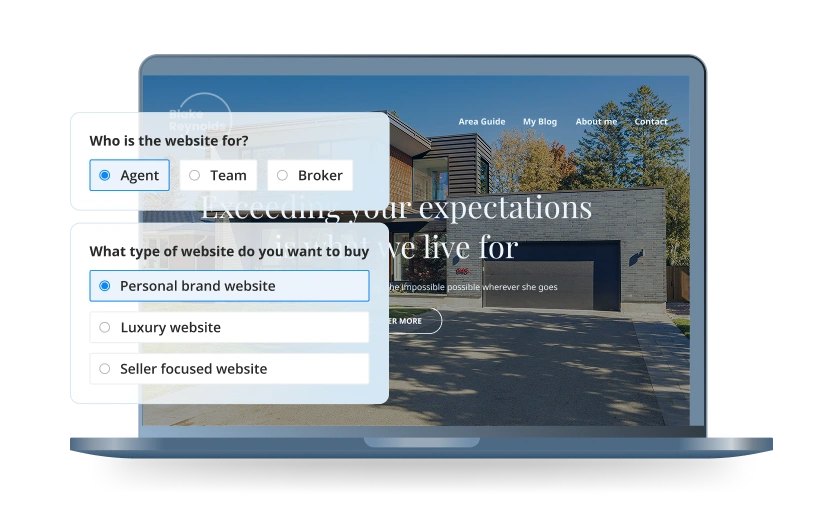
Choose a drone that fits your strategy, and pair it with a website designed for long-term marketing success.
FAQ
What type of drones are used in real estate?
Real estate agents use camera drones that balance image quality, stability, and ease of flight. Most listings rely on compact consumer drones for exterior shots and short videos. Indoor walk-throughs often use ducted drones with propeller guards for safety in tight spaces.
What is the best drone for real estate photography?
The DJI Mavic 3 Pro is widely regarded as the best drone for real estate photos. Users praise its large sensor, strong dynamic range, and flexible lens options that produce crisp, detailed stills. If you want alternatives, the DJI Air 3 delivers a solid mix of image quality and value. The Mini 5 Pro, on the other hand, is a great lightweight choice that still captures excellent photos for listings.
What is the best DJI drone for real estate photography in 2026?
In 2026, the DJI Mavic 3 Pro stands out for photo-focused work thanks to its strong sensor performance and lens options. It handles bright skies and deep shadows well, which is common in property shoots. For lighter workflows, newer Mini-series models also deliver solid results at a lower cost.
How to get into real estate drone photography?
Start by learning basic flight skills and local rules before offering drone photography services for real estate. Practice on personal projects and build a small portfolio with exterior shots and simple videos. Once you’re confident, register and certify as required, then pitch drone add-ons to agents or brokers.
How much do drone pilots charge for real estate photography?
Rates vary by market, but many pilots charge between $100 and $300 for basic aerial photos. Video packages cost more, often $200 to $500 or higher. Pricing depends on property size, deliverables, and how polished the final content needs to be.
What is ideal weather for drone real estate photography?
Light wind, clear skies, and soft light produce the best results. Early morning or late afternoon works well because shadows look cleaner and highlights stay under control. Avoid strong wind, rain, or harsh midday sun when possible.
Will the FAA know when I fly my drone?
The Federal Aviation Administration does not monitor every individual flight in real time. However, commercial flights require registration and proper certification. If something goes wrong or a complaint is filed, your flight history and registration can matter.
Published on
(Last updated on
)