(800) 728 8391



Key Takeaways:
- SMS is read far more reliably than email: open rates are estimated at 90-98% across major platforms, compared to a measured 43.46% average for email in 2025 (MailerLite 2025 Email Marketing Benchmarks).
- Real estate text message marketing is legal with documented consent, but the FCC’s April 2025 revocation-of-consent rule changed how fast you have to honor an opt-out.
- A2P 10DLC registration, required by carriers since 2021, determines whether your texts get delivered or filtered as spam before compliance even enters the picture.
- Speed matters more than polish: companies that respond within 5 minutes close at roughly 2.6 times the rate of those that wait a full day (Optifai, 2026), a pattern that also held up in a foundational 2007 MIT/InsideSales.com study.
- Segment templates by funnel stage (new lead, showing, past client) instead of sending the same generic message to everyone on your list.
Companies that respond to a new lead within 5 minutes close deals at roughly 2.6 times the rate of companies that wait a full day, 32% versus 12%, according to Optifai’s benchmark of 939 companies tracked from Q2 2025 through Q1 2026 (Optifai, 2026).
Text message marketing closes that speed gap better than almost any other channel, because a text gets read within minutes, while an email can sit in an inbox for hours or days. It’s one of the few marketing methods that reaches your target audience wherever they already are, glued to their mobile devices, whether they’re active leads or potential clients you haven’t heard from in months.
The catch is that texting a lead isn’t the same as calling or emailing one. The Telephone Consumer Protection Act (TCPA) covers marketing texts, carriers require business senders to register under a system called A2P 10DLC, and the rules changed again in 2025. Most guides to real estate SMS marketing skip past this part with a one-line warning. This one doesn’t.
Below: what’s actually legal, how to get compliant before your first send, real estate text messaging templates by use case, what to look for in a texting platform, and how to measure whether any of it is working.
What is real estate text message marketing?
Real estate text message marketing is opt-in, consent-based SMS or MMS outreach to leads, active clients, and past clients, sent to keep a conversation going after the first phone call or web form fill. It’s different from cold outreach like circle prospecting or cold calling: texting works best as a warm follow-up channel for someone who has already shown interest, not as the first touch with a total stranger.
Benefits of using text messages in real estate marketing
The reason texting outperforms other marketing channels on attention is simple: people carry their phones everywhere, and a text notification gets checked almost immediately. SMS open rates are commonly cited in the 90-98% range across major messaging platforms.
That figure is worth a caveat competitors rarely include: it’s a cross-platform benchmark estimate built from delivery and engagement data (Klaviyo, Attentive, Postscript, Validity), not a single controlled study. Unlike email, SMS messages rarely get buried under a pile of other messages waiting in an inbox, which is exactly why more agents use text messaging as a first response instead of a fallback.
Email has a much lower open rate. In MailerLite’s 2025 benchmark analysis, real estate emails averaged a 40.37% open rate, a little under the overall benchmark average of 43.46%.
However, both of those measured figures are likely inflated somewhat by Apple’s Mail Privacy Protection, which counts an open automatically on iOS whether or not a person actually reads the message. SMS still wins clearly on attention, just not by quite as wide a published margin as some competing guides suggest.

Texting also fits naturally into specific moments in a real estate business: a new lead who just requested more information, a buyer confirming a showing, a past client who might be ready to sell again. Call it SMS marketing for real estate, text marketing for real estate, or just marketing for realtors, the fundamentals don’t change: get consent, nurture leads with real information, time it well, and make the message worth reading.
Is real estate text message marketing legal? TCPA and A2P 10DLC rules
Yes, real estate text message marketing is legal, as long as you have documented consent from the recipient and you’ve registered as a business sender. This is the part most competing guides gloss over with a vague warning to “stay compliant,” so here’s the actual regulatory picture instead.
The TCPA requires written consent before you send marketing texts to a cell phone. In April 2025, the FCC added a rule on revoking that consent. Businesses must now honor a consumer’s opt-out request, using any reasonable method including a reply of STOP, QUIT, REVOKE, OPT OUT, CANCEL, UNSUBSCRIBE, or END, within 10 business days.
A second part of the rule, requiring revocation on one channel to apply across every other channel a business uses to contact that person, has been delayed twice since then, most recently to January 31, 2027, under an FCC Second Extension Order.
That narrower provision is worth watching rather than treating as settled, since the FCC has pushed it back more than once already. Either way, the base requirement to honor a plain STOP reply within 10 business days is already in effect and isn’t affected by that delay.
The penalties for getting this wrong are real. TCPA violations run $500 per text, rising to $1,500 for willful violations, and the FCC’s TRACED Act allows penalties up to $10,000 per message for intentional violations (47 U.S.C. § 227). The FTC separately publishes inflation-adjusted maximums for Telemarketing Sales Rule violations that run into the tens of thousands of dollars per violation.
Separately from TCPA, US carriers (AT&T, Verizon, T-Mobile) have required businesses to register under Application-to-Person 10-Digit Long Code, or A2P 10DLC, since 2021. Unregistered business numbers get filtered as spam, which means your texts simply won’t arrive, registered or not, compliant or not.
How to get compliant before you send your first text
Before any marketing text goes out, three things need to be in place:
- documented consent,
- A2P 10DLC registration,
- and a working opt-out process.
Get consent in writing, not just verbally. Add a checkbox or short disclosure to every lead capture form, something like: “By checking this box, I agree to receive text messages from [Brokerage Name] about listings and services. Message and data rates may apply. Reply STOP to unsubscribe.” Keep a timestamped record of every opt-in, separate from your general marketing consent, since a text-specific complaint or audit will ask for text-specific proof.
Register for A2P 10DLC. Most real estate texting services and CRM platforms handle this registration for you as part of onboarding, but you or your brokerage still have to supply business details and get verified before high-volume sending is unlocked. Budget a few business days for registration and verification to clear.
Build your list with a keyword and short code, not by importing contacts. One of the cleanest ways to build a compliant SMS marketing list is a keyword campaign: put “Text HOMES to 59925 for instant photos and pricing” on a yard sign, flyer, or sign-in sheet at open houses as an easy way to sign up for a text update, and anyone who texts that keyword to your short code has just given you a timestamped, documented opt-in. It also solves a real estate-specific problem: turning foot traffic at open houses into a list you can nurture via text message, instead of a stack of sign-in sheets nobody follows up on.
Honor opt-outs immediately and scrub your list regularly. Whatever platform you use should handle opt-in and opt-out the same way, automatically, without you having to lift a finger. Do a periodic check against the National Do-Not-Call Registry too. A number being publicly listed, on a for-sale sign or in an MLS record, doesn’t override someone’s right to opt out or their Do-Not-Call status. Getting compliance and privacy right up front is what lets you send with confidence instead of hoping nobody complains.
Choosing the right texting platform for your brokerage
If you’re ready to get started with SMS marketing but haven’t picked a tool yet, the right texting platform depends less on feature count than on three things: how well it integrates with your CRM (customer relationship management system), whether it handles A2P 10DLC registration and compliance automation for you, and how its pricing scales with your lead volume, the same evaluation criteria that apply across the real estate industry no matter which platform you’re comparing.
CRM integration matters more than a long feature list. A standalone SMS marketing service can look impressive in a demo, but if it doesn’t sync with your real estate CRM software, every text conversation becomes one more disconnected inbox to check. Look for two-way texting that logs directly to the same contact record as your calls, emails, and showing history, so a lead’s history doesn’t depend on which app you happen to open first. That’s also what streamlines follow-up once your list gets past a few dozen active leads, which is why most brokerages use real estate-specific CRM platforms instead of a bolted-on SMS tool.
Compliance automation should be built in. Ask any platform directly whether it handles A2P 10DLC registration, opt-out processing, and consent record-keeping automatically. If the answer is vague, that’s a sign you’d be managing compliance manually on top of everything else.
Pricing models vary more than they look. Some platforms charge a flat monthly rate with a message allotment; others charge per message or per text once you’re over a plan’s included volume. For an independent real estate agent sending a moderate volume, a per-message plan can end up cheaper than a team-sized flat rate built for a full brokerage. Whether you’re running one-off SMS campaigns around a single listing or an always-on drip sequence, the pricing math changes with volume, and for a team running SMS marketing campaigns at scale, a flat rate is usually the better deal.
Before signing up for any texting service, ask about these specific features for real estate: 10DLC support included in onboarding, keyword and short code campaigns, list segmentation by lead source or funnel stage, and reporting you can actually read without exporting a spreadsheet.
Real estate text message templates by use case
Templates work better when they’re written for a specific moment in the relationship, not as one generic script sent to everyone on your list. Whether someone’s actively house-hunting or still months from being ready to buy, the message should match where they are. Here are six templates organized by use case.
New lead follow-up. Send this within minutes of a lead submitting a form, calling, or texting a keyword campaign, before they’ve moved on to the next agent’s website. This works well for interested leads who’ve already raised their hand, not for a cold list. Keep the tone conversational and give them an easy choice of how to continue the conversation, since some leads would rather text back and forth than get on the phone with a stranger.

“Hi [Name], this is [Agent] with [Brokerage]. Thanks for reaching out about [listing/area]. I’d love to answer any questions, when’s a good time for a quick call, or should I just text over the details?”
Showing confirmation. Send this the morning of or the evening before a scheduled showing, not just once when the appointment is first booked. Most texting platforms can automatically send this once the showing is on your calendar. A short confirmation cuts down on no-shows and gives the client a low-friction way to reschedule by text instead of having to call you.
“Confirming your showing at [address] tomorrow at [time]. I’ll meet you there. Reply if anything changes!”
New listing alert. Send this as soon as a property hits the market that matches something a lead already told you they wanted: price range, bedrooms, or a specific neighborhood. Real estate moves fast, and being the first person to flag a matching listing beats a lead finding it on Zillow an hour later and losing track of who to call.
“Just listed in [neighborhood]: [beds/baths], [price]. This one’s a good fit for what you described to me, want me to send photos or set up a showing?”
Open house reminder. Send open house reminders a day or two ahead of an upcoming open house, with an optional same-day nudge for people who are local. Keep the ask low-pressure; “no appointment needed” removes the one bit of friction that stops casual lookers from showing up, and asking them to bring a friend turns one invite into two potential leads for free.
“Open house this Saturday, 1-3pm at [address]. Stop by, no appointment needed. Bring a friend who’s house-hunting!”
Past-client check-in. Send this periodically, not only when you want something from the relationship; around the anniversary of their closing date or a few times a year is a reasonable cadence. It matters more than it looks: 43% of 2025 home buyers found their agent through a referral, and 66% of sellers either got a referral or rehired an agent they’d already worked with (NAR, 2025 Profile of Home Buyers and Sellers), and a past client is the easiest source of both. A quick check-in like this costs nothing and keeps you top of mind the next time they, or someone they know, are buying a home.
“Hi [Name], it’s been a while since we closed on [address]! Just checking in, how’s the house treating you? Happy to run a free market update if you’re curious what it’s worth now.”
Referral ask. Send this right after a successful closing, while satisfaction is highest and the transaction is still fresh in their mind, rather than waiting months and having to reintroduce yourself. A direct ask paired with a genuine thank-you tends to outperform a vague “let me know if you hear of anyone.”
“Glad we found you the right place, [Name]! If you know anyone else buying or selling, I’d love an introduction. Referrals are how I keep my business going.”
The through-line across all six: each one asks for a specific, small next step and gives the contact a reason to stay in touch, instead of trying to sell something in the first message. Staying in touch this consistently, with buyers and sellers alike, is what builds trust over time. Segmenting your list this way (new leads, active buyers and sellers, past clients) makes it much easier to personalize messages at scale. It also stops the same generic blast from landing on potential buyers who are actually at a completely different stage.
Response time and follow-up best practices
Text a new lead within minutes of their first contact, not hours. None of the research on response speed is SMS-specific, but it’s remarkably consistent: a 939-company benchmark spanning Q2 2025 through Q1 2026 found a 2.6x close-rate gap between 5-minute and full-day responders (Optifai, 2026), and a foundational 2007 study found the same shape of gap even earlier.
Leads contacted within 5 minutes are roughly 21 times more likely to qualify than leads contacted after 30 minutes (MIT/InsideSales.com, 2007). Yet the average firm, across roughly 2,241 US companies studied, took 42 hours to respond to a web lead at all (Harvard Business Review, 2011).
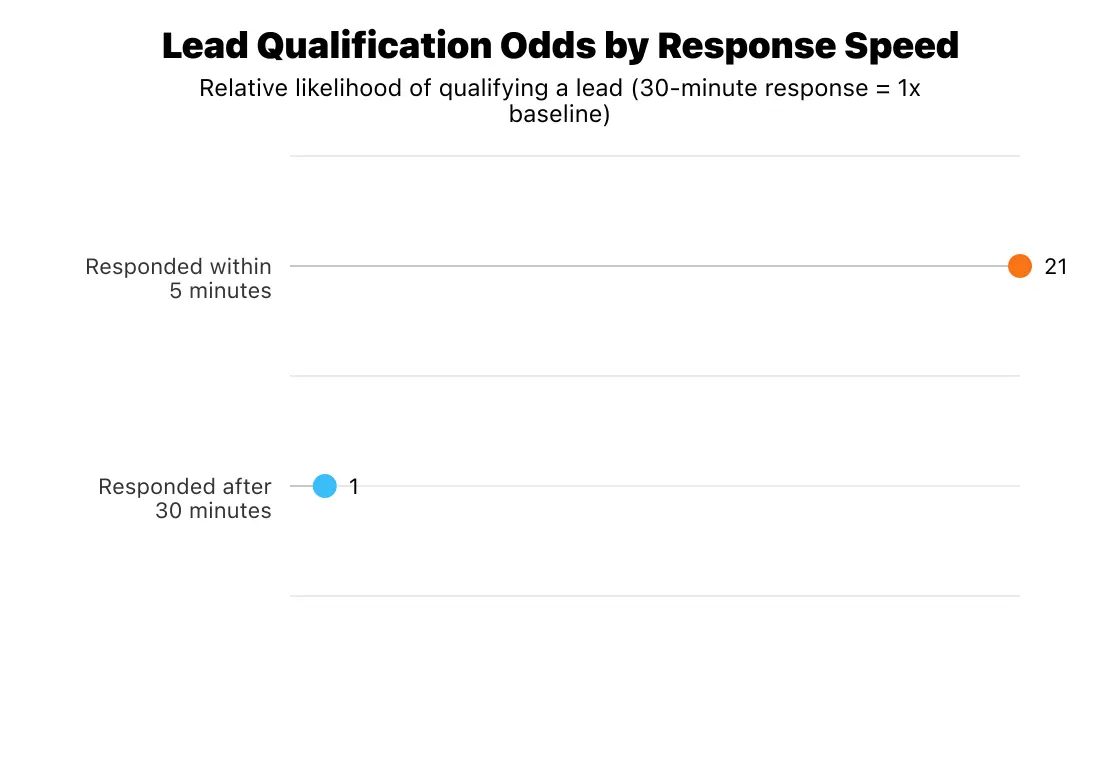
Those are older studies, not new SMS-specific research, but the underlying behavior they describe (interest cools fast) hasn’t changed, and texting is simply the fastest channel available for closing that window. A missed call goes to voicemail a lead may never check. A text shows up on the lock screen.
For follow-up cadence after that first response, a few rules keep a text sequence from turning into spam: space marketing texts (not transactional ones like showing confirmations) at least a few days apart, cap how many touches you send before a lead responds at all, and escalate to a phone call once a conversation gets detailed enough that texting back and forth becomes clunky. Texting and calling aren’t competing channels; they’re sequential ones: text to get a response, call to actually close.
How to measure results from your texting program
Track opt-in rate, response rate, and appointment or showing conversion, not just how many messages you sent as part of your broader marketing efforts. Message volume alone tells you nothing about whether the program is generating real estate leads or whether your messaging campaigns are actually working.

The broader trend is worth knowing as context: consumer willingness to receive business texts is climbing, not shrinking. 84% of US consumers were opted in to receive texts from businesses in 2025, up from 79% in 2024. Businesses using SMS marketing were also about 5.89 times more likely to report overall digital marketing success than businesses that don’t (98% versus 80%), according to SimpleTexting’s original 2025 survey of 1,000 consumers and 400 business owners and marketers (SimpleTexting, 2025).

To connect a specific closed deal back to a text thread, your CRM needs to log texts on the same contact record as calls, showings, and offers- the same integration point worth checking before you pick a platform. These are the metrics real estate agents should track if you’re setting up broader lead-source and cost-per-lead analytics alongside your texting program.
The bottom line
Text message marketing is a tried-and-true method of communication and lead nurturing in real estate, and it works because it matches the moment: a fast reply to a new lead, a reminder before a showing, a check-in with a past client who’s overdue for one.
None of that requires guesswork once it’s built around the three things this guide covered: consent and A2P 10DLC registration first, templates matched to where the contact actually is, and a CRM that logs every text next to the calls and emails around it.
Do that, and you’ll have a direct line of contact that’s proven to be more responsive than almost any other channel. It’s not a guarantee of conversion, but few other ways of maintaining a relationship with a prospect return this much for the effort.
Skip the first of those three things and the other two stop mattering. A perfectly written template sent without documented consent, or from a number that was never registered for A2P 10DLC, either draws a complaint or just never arrives.
If you’re not compliant, alienating a potential contact will be the least of your worries: the fines are real money, and they get worse for repeat offenders.
Texting also doesn’t work in isolation. It’s a response to interest someone already showed you, which means they had to find you first and have somewhere to say yes to hearing from you again. Building your social media presence covers the first half of that: it’s how a lead notices you exist in the first place.
But without a website, it’s a dead end. There’s nowhere to put the opt-in checkbox that makes any of this legal, and no lead capture form to turn that social media follower into a contact your CRM can actually track.
The thing is, you don’t need to be a developer (or hire one) to close that gap. With Placester’s AI website builder, that lead capture form, opt-in language included, comes built into a site that’s live in minutes, not months, so the next person who finds you on social media or a Google search has somewhere real to say yes.
AI Websites for Real Estate
Get a custom, ready-to-edit website
in less than 4 minutes.
Frequently asked questions
Is text message marketing legal for real estate agents?
Yes, with documented consent and A2P 10DLC registration. The FCC’s 2025 revocation-of-consent rule also requires honoring an opt-out request within 10 business days, so your platform’s opt-out handling needs to be current, not just your original consent language.
What is A2P 10DLC and do real estate agents need to register?
A2P 10DLC (Application-to-Person 10-Digit Long Code) is a carrier requirement, in place since 2021, for any business sending marketing texts from a standard 10-digit number. AT&T, Verizon, and T-Mobile filter unregistered business traffic as spam, so registration determines whether your texts get delivered at all, not just whether they’re compliant.
What’s the best way to get texting opt-in consent from real estate leads?
A checkbox or short disclosure on your lead capture form is the baseline. A keyword and short code campaign, like “Text HOMES to [number]” on a yard sign or open house flyer, is a stronger option for real estate specifically, since it produces a timestamped, documented opt-in from someone actively raising their hand.
What should a real estate text message say?
It depends on where the contact is in the relationship. See the template section above for six examples by use case, but the short version: keep it specific to that person’s stage (new lead, showing, past client) and ask for one small next step instead of trying to close a sale in the first message.
What’s the best texting software for realtors?
The best option depends more on your CRM setup and lead volume than any single feature. Prioritize CRM integration, built-in A2P 10DLC compliance handling, and pricing that fits your volume, in that order, before comparing feature lists.
How fast should a real estate agent respond to a lead by text?
Within minutes where possible. Lead qualification odds drop sharply once response time passes the 30-minute mark, based on foundational lead-response research that still holds up as the clearest evidence available on this question.
Sources:
47 U.S.C. § 227 (Telephone Consumer Protection Act), retrieved 2026-09-10, https://www.law.cornell.edu/uscode/text/47/227
Optifai, Lead Response Time Benchmark (939 companies, Q2 2025-Q1 2026), retrieved 2026-09-13, https://optif.ai/learn/questions/lead-response-time-benchmark/
MIT/InsideSales.com, Lead Response Management study (Oldroyd), retrieved 2026-09-10, https://www.leadresponsemanagement.org/lrm_study/
Harvard Business Review, “The Short Life of Online Sales Leads” (Oldroyd, McElheran, Elkington), 2011, retrieved 2026-09-10, https://hbr.org/2011/03/the-short-life-of-online-sales-leads
MailerLite, 2025 Email Marketing Benchmarks, retrieved 2026-09-10, https://www.mailerlite.com/blog/compare-your-email-performance-metrics-industry-benchmarks
Federal Communications Commission, Order DA-25-312 (TCPA revocation-of-consent rule), as summarized by Carlton Fields, 2025, retrieved 2026-09-10, https://www.carltonfields.com/insights/publications/2025/fcc-delays-effective-date-of-tcpa-revocation-of-consent-rules
Federal Trade Commission, “FTC Publishes Inflation-Adjusted Civil Penalty Amounts for 2025,” retrieved 2026-09-10, https://www.ftc.gov/news-events/news/press-releases/2025/02/ftc-publishes-inflation-adjusted-civil-penalty-amounts-2025
SimpleTexting, 2025 SMS Marketing Statistics Report, retrieved 2026-09-10, https://simpletexting.com/blog/2025-texting-and-sms-marketing-statistics/
Published on