(800) 728 8391



Quick summary:
- Real estate buyer presentation is a tool that helps agents build trust, explain their value, and guide buyers through the home-buying process.
- The most important elements of a buyer presentation include agent introduction, market insights, financing information, legal explanations, and sample listings.
- Buyers respond better to presentations that simplify complicated topics like mortgages, contracts, HOA fees, and the NAR agreement.
Did you know that visuals are processed up to 60,000 times faster than text?
In real estate, that can be the difference between a buyer feeling confused—or completely confident in your expertise.
That’s why buyer presentations can be such a powerful tool.
Especially in today’s digital world, where showing is so much more convincing than telling, crafting a presentation that truly highlights your strong suits and breaks down all the financial mumbo-jumbo that feels so intimidating into a simple guide can be your huge advantage.
A great buyer presentation does much more than explain how to buy a property.
It makes clients understand the market, visualize their future home, trust your guidance, and feel prepared to make one of the biggest financial decisions of their lives.
But how do you do it?
Read on to learn all there is to know about a successful real estate buyer presentation!
| Step | What it includes |
| 1️⃣ Start with a strong introduction | Introduce yourself, your experience, and what makes you different as an agent. |
| 2️⃣ Explain the home-buying process clearly | Break down the buying journey into simple, easy-to-follow steps. |
| 3️⃣ Include current market insights | Share relevant market trends and explain how they affect buyers. |
| 4️⃣ Prepare realistic home samples | Show example properties that match the buyer’s budget and goals. |
| 5️⃣ Showcase your communication style | Explain how you stay responsive and support clients throughout the process. |
| 6️⃣ Use testimonials and social proof | Add reviews and success stories to build trust and credibility. |
| 7️⃣ Add neighborhood and lifestyle insights | Highlight local amenities, lifestyle benefits, and community features. |
| 8️⃣ Explain financing and legal matters in a simple way | Simplify mortgage terms, costs, and budgeting expectations. |
| 9️⃣ Make the presentation interactive | Ask questions and involve buyers to keep them engaged. |
| 🔟 End with a clear next step/call-to-action | Finish with a tailored action plan and explain what happens next. |
What is a buyer presentation in real estate?
A buyer presentation is a document, usually prepared in the form of a slideshow or a digital deck, that explains how a real estate professional can help a potential client purchase a new property.
Kind of like a digital business card or, better yet, a pitch.
Presentations like this usually serve as a second point of contact between the agent and a client, after the client has already learnt about the agent’s services and becomes interested in discovering more. These documents are often showcased at the first buyer consultation.
Agents use them to introduce themselves, explain the buying process, highlight the current market conditions, demonstrate available estates, and prove their experience in helping others acquire them.
The goal of a home buyer presentation is:
- to showcase the agent’s expertise,
- to educate the buyer about the market,
- to show the buyer sample properties,
- to inform the buyer about the legal and financial implications of a property purchase,
- to make clients feel more confident about committing to a big purchase.
In short, it’s all about convincing the customer that you are someone they should entrust with finding their dream home.
And it can work better than you may think.
According to a study titled “The Impact Of Product Presentation On Decision-Making And Purchasing,” a higher number of product presentation features DOES lead to stronger positive visual, cognitive, and emotional responses from consumers—especially among younger groups (in their 20s and 30s).
In our digital-obsessed world, people respond to visuals, which is why presentations are an important tool for agents to attract and retain clients.
Real estate buyer presentation example
A good presentation is a mix of info about you as an agent—your credentials, experience, knowledge—and the market—insights, legal & financial aspects, and, of course, available properties.
Here’s an example of a real estate presentation that concludes them all:
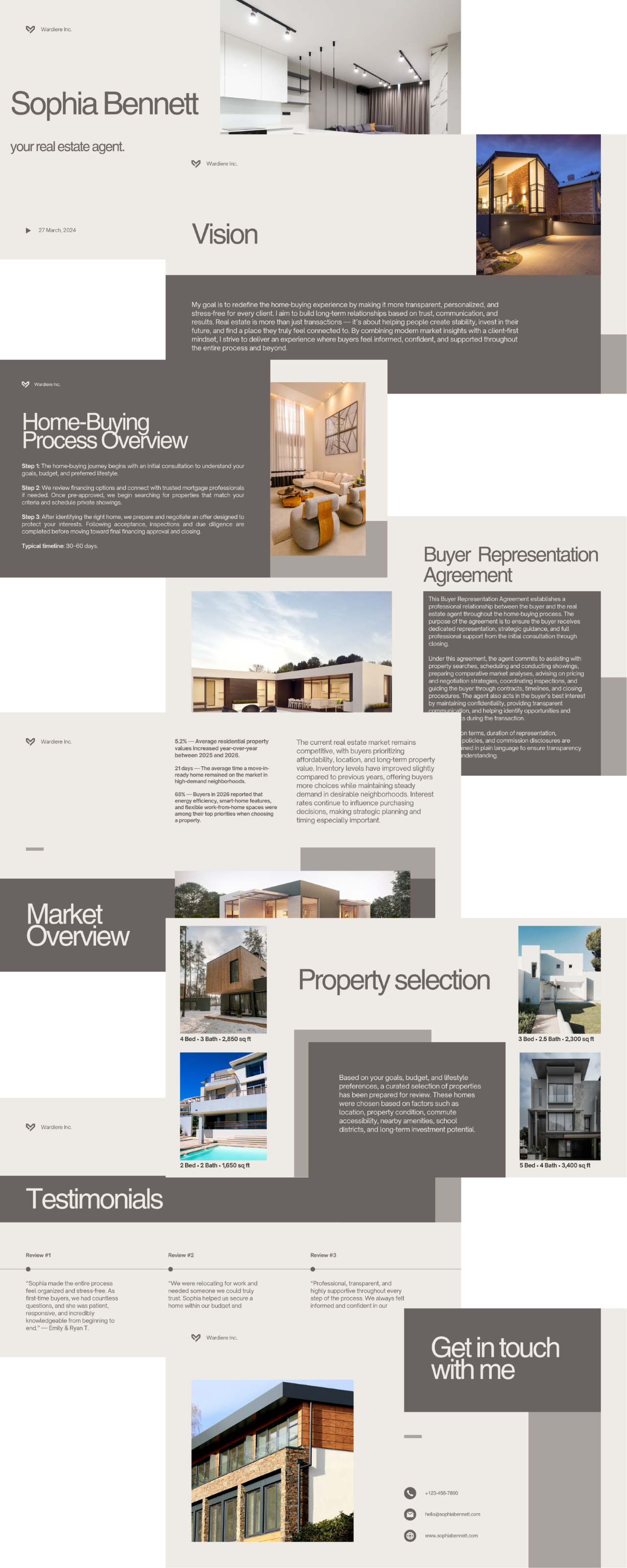
Key elements of a buyer presentation in real estate
From basics, like introducing who you are, to sample listings—here are the absolute must-haves that a good presentation needs to include. If you feel like it and have a strong vision for your deck, you can always get a little more creative and add more out-of-the-box elements, but these are the essentials that your presentation cannot miss.
👤 Agent introduction
The presentation should begin with a short introduction about the agent, including their experience, local market knowledge, and communication style. This helps buyers understand who they will be working with and why the agent is qualified.
🗺️ Overview of the buying process
Many buyers, especially first time home buyers, are unfamiliar with the steps involved in purchasing a home. A clear timeline explaining property searches, financing, inspections, negotiations, and closing reduces confusion and builds confidence.
📈 Market analysis
A presentation should reflect the current real estate market trends, such as average home prices, mortgage rates, and inventory levels. This gives buyers realistic expectations about competition and pricing in their target area.
💰 Financing options and budget guidance
One of the key reasons why people reach out to agents is that they don’t understand all the financial implications that come with buying a home.
You’re the one who has the knowledge on the importance of mortgage pre-approval, estimated monthly payments, or closing costs, and presentation is the perfect time and space to explain that.
🏡 Listing presentation
Including sample listings helps buyers understand what is realistically available within their budget and preferred location.
These examples should reflect the client’s needs, lifestyle, and priorities, such as property size, neighborhood, amenities, or commute time. Visual examples also make the presentation more engaging and help buyers set realistic expectations early in the process.
📑 Legal aspects
A buyer presentation should also briefly explain important legal and contractual aspects of the entire process.
This may include buyer representation agreements, offer contracts, contingencies, disclosure requirements, inspection periods, and the closing process.
Buyers often feel intimidated by legal terminology, so presenting these topics in a simple and clear way helps them know what to expect.
⭐ Success stories
Client reviews and success stories create trust and credibility. They show that behind every sale, there’s a satisfied, real-life person living in their new dream home—and your new client could become one soon, too.
That’s why including examples of past transactions or past clients’ reviews shows buyers that the agent has experience delivering positive results.
How to create a presentation: 10 steps for real estate agents
With all the elements ready, let’s get into the making of a real estate buyer presentation. Below, you’ll find a step-by-step guide with insights and pro-tips to use in your own deck!
1. Start with a strong introduction
The beginning of your presentation sets the tone for the entire relationship.
Buyers want to know who they are working with, why they should trust you, and what makes you different from other agents. That’s why it’s necessary to include a professional photo, your experience, local market expertise, certifications, and a few short achievements or success statistics.
Instead of making the presentation feel like a resume, focus on how your experience benefits the client.
The question always is—why would they need YOU?
A deck like this can be a great opportunity to mention your ability to find off-market opportunities or experience helping first-time buyers navigate complicated transactions.
Research shows that first impressions strongly influence decision-making. A good one can really make or break the sale, as 66% of consumers claim they will not give a second chance after a poor initial experience with a salesperson.
💡Pro tip: Read this guide with the best real estate branding ideas!
2. Explain the buying process clearly
Many potential buyers, especially first-time home buyers, feel overwhelmed by the complexity of purchasing a home.
That’s why one of the most important parts of a presentation is simplifying the process into clear, manageable steps.
Explain the stages of buying a home, including pre-approval, property search, showings, making offers, inspections, negotiations, and closing. Use visuals, timelines, or icons instead of large blocks of text. Buyers often remember structure more than detailed explanations.
A well-organized process helps reduce anxiety and creates trust because clients feel guided rather than confused.
💡Pro tip: Include a slide called “Common buyer surprises” where you explain hidden costs, competitive bidding situations, or realistic timelines. Buyers appreciate honesty more than perfection.
3. Include current market insights
A strong buyer presentation should educate buyers about the current market conditions. Include information such as average prices, inventory levels, mortgage rates, and how competitive the market currently is.
The key is making the information relevant rather than overwhelming. Buyers do not need every market statistic available — they need insights that help them make better decisions.
According to the National Association of Realtors, 88% of buyers purchase homes through an agent or broker, showing that professional guidance remains highly valuable during uncertain or competitive markets.
💡Pro tip: After every statistic, explain what it means in practical terms. Instead of only showing “low inventory,” explain how it may affect negotiations, speed, or pricing.
4. Prepare realistic home samples
Now we’re getting down to the brass tacks.
The whole reason why buyers seek you out is to get a new property. Showing them realistic home samples, including houses that match their budget, preferred neighborhoods, and lifestyle needs, is key to engagement during the presentation.
It’s all about making your clients understand what they can realistically expect in the current market. It also prevents disappointment later in the process when they begin viewing homes in person.
A good idea is to use a mix of listings: one ideal option, one “stretch budget” property, and one more affordable option with compromises. Comparing different homes helps buyers identify their real priorities faster.
💡Pro tip: If you’re looking for inspiration, read our article on how to find off-market properties!
5. Showcase your communication style
Many agents focus too heavily on sales achievements while forgetting that buyers mainly want responsiveness, reliability, and transparency. Use your presentation to explain how you communicate throughout the process.
Tell buyers how quickly you respond to messages, how property updates are shared, and how often you check in during negotiations or escrow periods. This creates confidence before the working relationship even begins.
Communication is one of the strongest drivers of client satisfaction in real estate. Studies from Engel & Völkers highlight that communication quality directly affects trust and client relationships.
💡Pro tip: Include a short “What working with me feels like” slide that focuses on the buyer experience rather than only your services.
6. Use testimonials and social proof
Buyers trust other clients more than marketing claims.
Including testimonials, reviews, and success stories helps reduce uncertainty and increases credibility.
Focus on reviews that describe emotions and experiences, not just outcomes. A review saying “Our agent made us feel calm during a stressful process” is often more persuasive than one focused only on price negotiations.
According to NAR, 91% of buyers said they would use their agent again or recommend them to others.
💡Pro tip: Use screenshots of Google reviews or short client quotes with photos for a more authentic feel.
7. Add neighborhood and lifestyle insights
Many buyer presentations focus entirely on the property itself while ignoring lifestyle factors.
However, buyers are often purchasing a lifestyle just as much as a home.
Include information about neighborhoods, local cafes, schools, parks, gyms, nightlife, transportation, or commute times. This makes the presentation feel personalized and helps buyers emotionally connect with different areas.
This approach is especially effective for relocation buyers or younger buyers who care strongly about community and convenience.
💡Pro tip: Create a “day in the life” section showing what a typical weekend or commute might look like in a certain neighborhood.
8. Explain financing and legal matters in a simple way
Financing is one of the most intimidating parts of buying a home.
Your presentation should simplify mortgage terminology, pre-approval requirements, estimated monthly costs, and closing expenses.
Many buyers underestimate costs beyond the down payment, including inspections, insurance, taxes, maintenance, and closing fees. Clear financial explanations help buyers feel more prepared and realistic.
Visual breakdowns work especially well here.
Charts comparing monthly payments, rent vs. buy scenarios, or loan options are easier to understand than text-heavy explanations.
Same thing goes for the legal matters.
Your potential clients obviously have no idea about the NAR agreement or HOA rules and fees, so it’s your job to explain all the nitty-gritty to them.
💡Pro tip: Include a sample monthly budget example to help buyers visualize the real financial commitment of homeownership.
9. Make the presentation interactive
One of the most overlooked strategies is involving buyers directly in the presentation.
Instead of talking the entire time, ask questions and encourage participation. Interactive presentations feel more collaborative and memorable. Ask buyers to rank priorities, identify must-have features, or choose between different property scenarios.
💡Pro tip: Include a “dream home checklist” slide where buyers select their top priorities. This keeps them engaged while giving you valuable insight into their motivations.
10. End with a clear next step/call-to-action
Many presentations lose momentum because they end too passively.
Instead of finishing with “Let me know if you have questions,” guide buyers toward a clear action.
Explain exactly what happens next—whether it is mortgage pre-approval, scheduling home tours, signing a buyer representation agreement, or setting up listing alerts.
A confident ending makes buyers feel supported and organized. It also reduces hesitation because buyers understand the process moving forward.
💡Pro tip: End the presentation with a simple action-focused question like “What would you like your next step to be?” This creates a smoother transition into working together and encourages buyers to commit to the process.
Real estate home buyer presentation template
Need help building a good strategy? Here are a couple of presentation templates you can use to gain new clients!



Legal consideration for buyer presentation
A presentation is more than just a fun marketing tool—especially since August 17, 2024, when the National Association of Realtors (NAR) settlement came to life.
“Inspired” by a $400 million class action lawsuit, this settlement introduced many changes related to broker commissions and is directly affecting how agents need to present their services.
Instead of assuming buyers already understand the role of a buyer’s agent, presentations now have to clearly show the value an agent provides, including negotiation support, market knowledge, property research, contract guidance, and transaction management.
Key changes from the NAR settlement include:
- Written buyer agreements are required: Agents must have a signed agreement with buyers before touring homes. This explains the working relationship and services provided.
- Compensation must be clearly explained: Agents need to discuss how they are paid upfront to avoid confusion or hidden fees.
- MLS compensation offers were removed: Buyer agent compensation can no longer be displayed on the MLS, which means compensation discussions may happen separately during negotiations.
- Transparency is more important: Buyer presentations should clearly explain the agent’s role, negotiation skills, market expertise, and overall value to the client.
This inherently affects a buyer’s deck, requiring each and every one to be more detailed and strategic than ever before.
Key takeaways
The power of presentation is real—and the real estate market is no exception.
A good presentation can build trust, help clients understand the market, and—of course—get you that sale.
The key is to portray yourself as someone who knows the industry, has experience, understands what a buyer needs, and goes the extra mile to find the hidden gems of properties that could just turn into their dream home.
The most essential elements of a buyer presentation are:
→ introduction
→ value proposition
→ listing samples
→ financial & legal overview
→ market insights
→ credentials
→ next steps & clear plan.
A presentation is your time to shine—and you know that people today have an attention span of a fly, so you really can’t afford to lose them with boring or unimportant info.
Speaking of which…
How’s your website doing? Maybe it needs a little tweak to capture that elusive user attention?
If you’re looking for help, check out PLACESTER—a #1 AI website builder for real estate agents to create visually stunning, modern websites designed to capture attention, impress clients, and keep visitors engaged from the very first click.
What information do buyers expect to see in a presentation?
Buyers usually expect information about the buying process, market conditions, financing, negotiation strategies, and the agent’s experience. They also want clear timelines and examples of how the agent will help them find a home.
How do you showcase your value as an agent in a buyer presentation?
Agents can showcase their value by highlighting their market knowledge, communication skills, negotiation experience, and past success stories. Testimonials, sales statistics, and examples of solved client problems can also build trust and credibility.
What tools can be used to create a professional buyer presentation?
Popular tools for creating real estate presentations include Canva, Microsoft PowerPoint, Google Slides, and Keynote. Many agents also use real estate CRM platforms that include presentation templates and branding tools.
What are the most common mistakes agents make during a buyer presentation?
One of the biggest mistakes is including too much text or focusing too much on the agent instead of the buyer’s needs. Poor organization, outdated market data, and a lack of visual design can also make presentations less effective.
What is the best way to end a real estate buyer presentation and move to the next step?
The best way to end a buyer presentation is with a clear next step and/or call to action, such as scheduling property tours or signing a buyer representation agreement.
Where do I find the best templates for a real estate buyer presentation?
Many real estate professionals use templates from Canva, Envato Elements, Slidesgo, and Template.net. Real estate brokerages and CRM platforms also often provide branded presentation templates for agents.