(800) 728 8391


Quick summary:
- 📝 Words sell the showing: A clear, specific listing description helps buyers picture the home and decide faster whether it’s worth a visit.
- 🎯 Details beat fluff: Strong listings focus on real features, benefits, and honest information instead of vague phrases or agent jargon.
- 🚀 Structure drives action: Scannable formatting, a strong opening, and a clear CTA guide buyers to act.
When you scan property ads online, the photos catch your eye—but the text is what seals the deal. Good word choices and vivid details can actually push a property’s sale price up.
29%
Homes with smart listing descriptions sell for up to 29% above the expected price.
Source: Zillow
That’s real money and a real reason to care about how you write.
Property descriptions do more than stuff in square footage or number of bedrooms. They tell a story and help buyers imagine life in that space. In this guide, you’ll learn how to write listing copy that goes beyond facts. Ready to give your next home its own voice? Let’s jump in.
What are real estate listing descriptions?
Real estate listing descriptions are written summaries that present a property to potential buyers. They highlight key features such as:
- location,
- size,
- amenities,
- layout,
- and unique selling points to attract interest.
A strong listing description not only informs but also persuades, helping buyers imagine living in the property.
Why are listing descriptions important?
Listing descriptions matter because buyers skip offers that don’t give them the information they need right away. Think about the last time you almost clicked “add to cart” but didn’t. What stopped you? Probably a vague description that left you guessing. Or maybe one so boring it felt like reading a manual.
90%
Nearly 90% of consumers rate product content as extremely or very important when deciding to buy.
Source: axite.io
That’s not only “somewhat important” or “nice to have.” That’s make-or-break territory. And the cost of getting it wrong?
83%
Over 83% of consumers are ready to go elsewhere if they can’t find enough information about a product.
Source: syndigo.com
The same applies to the real estate industry. Get it wrong, and buyers move on. Get it right, and you’re selling for more.
Your listing descriptions matter because they do three jobs at once:
❓ They answer the questions buyers haven’t asked yet. What’s the neighborhood like? Will my furniture fit? Is this place actually move-in ready? Get ahead of their doubts before they scroll past.
👀 They paint a picture clients can’t see. Potential buyers can’t walk through your home from their couch. Your words have to do that work. Make them feel what it’s like to live there.
⭐ They separate you from the noise. There are hundreds of other listings competing for attention. A flat, boring overview that just lists specs? That’s forgettable. A description that tells a story and highlights what makes this home different? That’s what gets the showing.
What is an example of a real estate description?
A strong description can make your home sale faster and bring in more money. Let’s look at three real examples and why they work. Each one shows a different approach to appealing to buyers:
1. Modern comfort & move-in ready

This description immediately emphasizes comfort, style, and convenience. It balances technical details with lifestyle benefits. You learn about appliances, privacy on an end lot, and proximity to downtown. The flow moves naturally from interior features to exterior perks, then to location. This creates a full picture that encourages buyers to act.
2. Historic Tudor charm
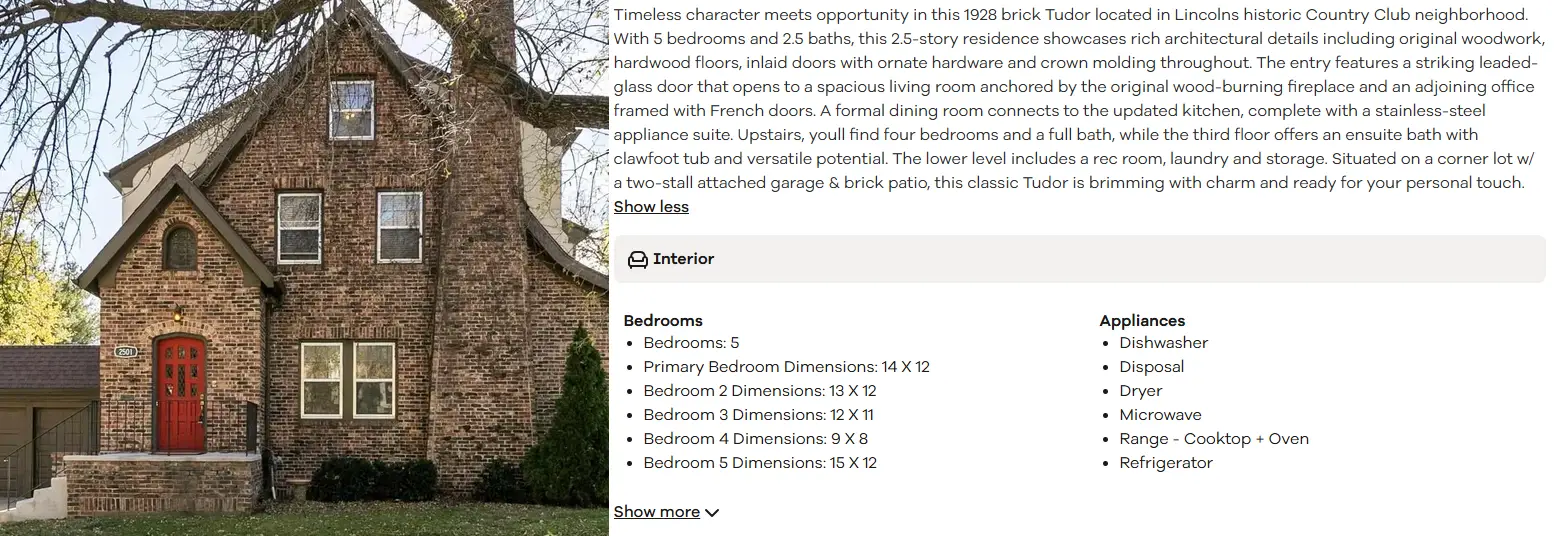
Here, the focus is on the property’s unique selling point (USP). Original architectural details, hardwood floors, leaded-glass doors, and a brick patio give the home personality. It stands out among competing listings. The description balances character with practical features like the updated kitchen and garage. Highlighting the Tudor style immediately appeals to buyers looking for a home with a soul.
3. Renovated home with stunning views
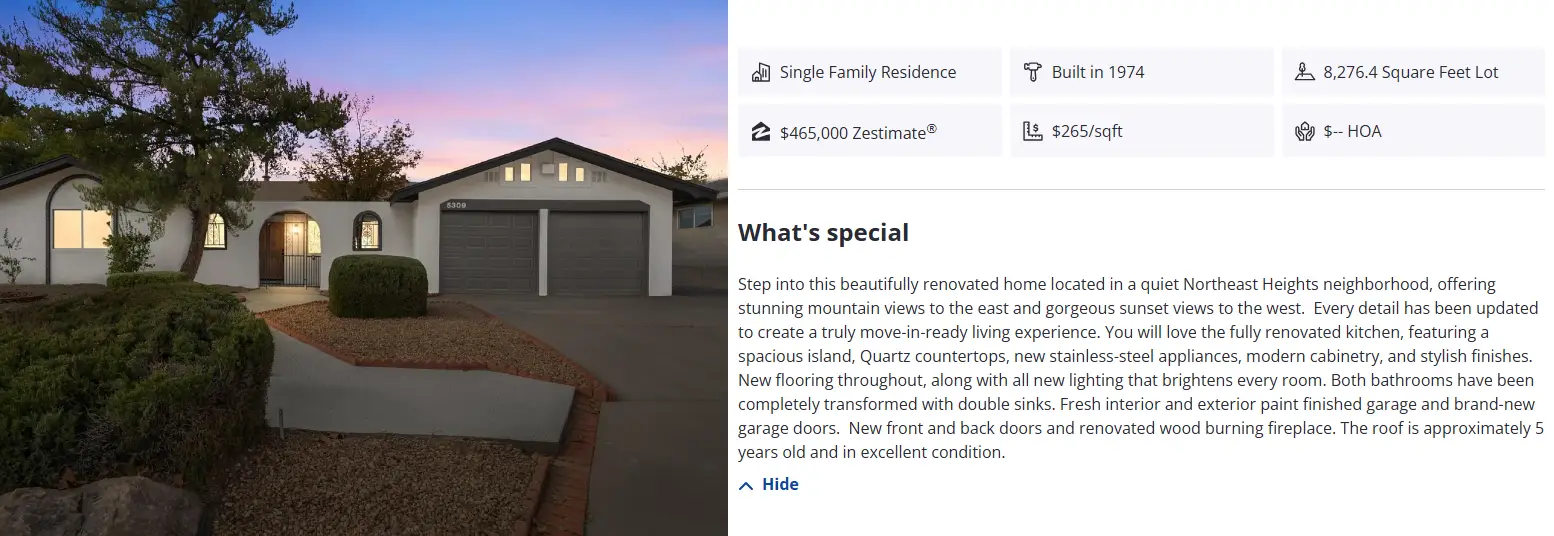
This description succeeds by combining technical updates with emotional appeal. Buyers see recent renovations while imagining themselves enjoying mountain and sunset views. It’s move-in ready, but still tells a story about lifestyle. The home feels inviting and shows how it enhances daily living.
What makes a good listing description?
A good property listing description is clear, specific, and honest. It doesn’t try to be everything. It only has one job: make someone want to see the house in person. Here’s what sets well-written listings apart:
1️⃣ Leads with the strongest feature. The best thing about the house comes first, not buried halfway down.
2️⃣ Shows the lifestyle, not just the specs. It helps buyers picture themselves living there instead of listing measurements they have already seen.
3️⃣ Gets specific with details. “Kitchen remodeled in 2023” beats “updated kitchen” every time.
4️⃣ Includes the practical stuff. Roof age, HVAC, parking, storage—the unsexy details that actually matter.
5️⃣ Uses words that work. Some phrases drive higher offers. Others tank interest. Authors of good descriptions know which is which.
6️⃣ Skips the fluff. No “rare opportunity” or “won’t last long.” Just real information about the actual house.
7️⃣ Reads like a conversation. Written for humans making a life decision, not for algorithms.
8️⃣ Stays honest. Doesn’t oversell or hide quirks. The right buyer won’t care, and the wrong buyer wasn’t buying anyway.
9️⃣ Easy to scan. Short paragraphs, shorter sentences. The important stuff jumps out when someone’s comparing five listings at once.
🔟 Ends with action. Tells buyers exactly what to do next instead of just stopping.
Killer real estate listing descriptions feel effortless. Clear, specific, and written for real people who are trying to decide where to live.
How to write effective real estate listing descriptions? 15 tips to follow
If you want to write listing descriptions that get attention, focus on clear structure and buyer intent. Some agents overthink it. They spend hours trying to sound clever and end up stiff and forgettable. Others rush through it in five minutes and wonder why no one’s calling.
Writing a strong listing description isn’t guesswork. It’s a skill you can learn and repeat. Below, you’ll find the best practices to grab attention and get showings booked.
1. Keep your description tight and concise
Buyers don’t want a wall of text. They need clear, useful details that help them decide if the home is worth seeing. “Zillow Talk” found that longer descriptions tend to support higher sale prices, but only up to a point.
250
words
The sweet spot sits around 250 words. After that, you stop adding value and start repeating yourself.
So, keep your writing lean. Pick details that matter and cut anything that doesn’t help a buyer understand the home.
Short, focused descriptions also make your strongest features easier to spot. Most buyers skim. If your best selling points hide under soft language or long sentences, they never land. Tight writing keeps attention on the features that push someone to book a showing.
Example:
❌ Instead of writing:
This beautiful and spacious living room offers an inviting atmosphere perfect for entertaining family and friends, featuring plenty of natural light that floods the space throughout the day thanks to the large windows that look out over the backyard. It’s a great place for gatherings, cozy nights in, or simply enjoying the peaceful surroundings of the neighborhood.
✅ Simply use:
Sun pours into the living room through wide backyard windows. You get a bright space where you can host friends or unwind on a quiet night.
2. Start with an attention-grabbing headline
Your headline is the gatekeeper. If it doesn’t grab attention, nothing else matters. Decades ago, David Ogilvy pointed out that most people only read the headline, not the rest of the copy. His point still hits today.

On the average, five times as many people read the headline as read the body copy. When you have written your headline, you have spent eighty cents out of your dollar.
~David Ogilvy
Most agents ignore that reality. They fall back on safe, empty lines like “Beautiful Home in Great Location” or “3BR/2BA House for Sale.” These phrases tell buyers nothing and disappear into the scroll.
A strong headline does the opposite. It shows the feature that makes this home worth a closer look, and gives buyers a clear reason to click.
Example:
❌ Weak Headline: Charming Family Home for Sale
✅ Strong Headline: Renovated 4BR in Top School District—Move-In Ready
3. Build an opening statement
Your opening sentence sets the tone for everything that follows. Make it count.
This is where most agents lose buyers. They open with something like “Welcome to this lovely home.” Generic. Forgettable. The kind of sentence that makes eyes glaze over.
The best openings drop buyers right into the experience of living there. They highlight the single strongest selling point and make it feel real.
Expert tip: Start with the benefit, not the feature. Don’t just list a double garage, renovated kitchen, or private backyard. Focus on what they give the buyer: convenience, comfort, lifestyle, etc.
Example:
❌ Don’t say: This home has a south-facing backyard.
✅ Say: Imagine summer evenings on your private patio, soaking up sunlight until 8 PM.
Same backyard, completely different impact. People buy feelings, not square footage.
4. Use power words that spark emotion
The words you choose can directly impact how much buyers are willing to pay. Research from “Zillow Talk” shows that carefully picked phrases can push a home’s sale price above expectations.
8.2%
Describing an affordable home as “luxurious” added an average of 8.2% to its expected value. Calling a high-end property “captivating” lifted it by 6.5%.
Source: Zillow Talk: The New Rules of Real Estate
These words work because they trigger something in buyers. They create a feeling before the showing even happens.
Example:
✅ According to “Zillow Talk”, the valuable words include:
- Luxurious
- Captivating
- Stainless
- Granite
- Basketball (as in a court)
- Landscaped
- Pergola
- Remodel
- Tile
- Upgraded
- Updated
- Impeccable
- Beautiful
- Gentle.
5. Cut high-risk phrases
Just as some words can boost a home’s value, others may actually hurt it and lower buyer interest. If you’re trying to sell a property for top dollar, certain phrases work against you. They signal problems, scare off potential buyers, or make your listing sound desperate. Even if you don’t mean it that way, that’s how buyers read it.
Zillow analyzed 24,000 home listings and found that certain words consistently tanked sale prices.
11.1%
Homes described as a “fixer” sold for 11.1% less than expected. “Potential” costs sellers 4.3%. Even “opportunity” knocked 2% off the sale price.
Source: Zillow
Useless fluff also drags down your description. Phrases like “must-see” or repeating stats already shown elsewhere in the listing don’t add value. Every word should either inform, excite, or help the buyer picture life in the home.
Example:
❌ Avoid using:
- Fixer
- TLC (as in Tender Loving Care needed)
- Cosmetic (as in cosmetic updates needed)
- Investment
- Investor
- Potential
- Bargain
- Opportunity
- Nice (too vague and subjective)
- Must-see (empty fluff that says nothing).
6. Be honest and transparent
Avoiding certain words doesn’t mean hiding the truth. It means framing it better. If you’re selling a fixer-upper or a flip project, own it. The worst thing you can do is pretend or lie. Buyers will figure it out at the showing, and then you’ve blown your credibility before negotiations even start.
Note that you can be honest without killing interest. Instead of leading with “fixer,” describe what the home actually offers. Try “blank canvas ready for your vision”. See the difference? You’re not lying. You’re just not leading with the negatives.
Expert tip: Be upfront about the condition. Acknowledge all the drawbacks. The right buyer won’t care—they’re looking for exactly that. The wrong buyer was never going to make an offer anyway.
Don’t waste people’s time. Potential buyers are busy. They’re comparing dozens of listings and trying to narrow down which ones are worth seeing in person. If your description oversells a home that clearly needs work, you’re wasting their time and yours.
Example:
✅ If you’re selling a true investment property, admit it. Write “priced for renovation and resale” instead of “opportunity” or “investor special.”
7. Highlight unique features
Every listing needs a clear USP—a unique selling point. It’s the one detail that makes your property stand out in a crowded feed. A strong USP helps buyers remember your home and gives them a reason to click.
A USP doesn’t have to be dramatic. It should just matter to the right buyer. A small perk, like a dedicated workspace or a low-maintenance yard, can be a big deal for someone who values those things.
The USP is the nucleus around which you build your success, fame, and wealth. So you’d better be able to state it. If you can’t state it, your prospects won’t see it.
~Jay Abraham
Even quirks can work in your favor. A compact lot turns to “easy upkeep”. A dated basement becomes “ready for your vision”. The key is to frame the feature in a way that answers a buyer’s “Why should I care?”
Example:
✅ Strong USPs include:
- A sunroom that works as a year-round home office
- A garage with built-in storage for bikes and tools
- A private entrance ideal for guests or long-term stays
- A garden designed for low-water landscaping
- A top-floor unit with no neighbors above.
8. Describe the property in details
Buyers don’t skim listings hoping to be surprised. They look for specific features of the property: square footage, lot size, layout, storage, and recent upgrades. These are the details that help them decide if your home is even worth a tour. When you cover the technical facts and the functional benefits, you make the decision easier and attract the right people faster.
13.4%
Zillow found that listings mentioning “barn doors” sold 13.4% above expectations and 57 days faster.
Source: Zillow
Go beyond a bare list of specs. Show what those features do for the buyer. A large mudroom becomes a place to keep gear organized. A deep pantry means fewer grocery runs. A south-facing yard gives them warm light all afternoon. Create a picture of the lifestyle the property offers.
Example:
✅ Think about other details people actively hunt for:
- Walk-in pantry
- Oversized garage or workshop space
- EV charging outlet
- Smart thermostats or smart locks
- New roof or updated HVAC
- Hardwood floors in good condition
- Fiber-optic internet availability
- Laundry on the main level
- Outdoor features like raised garden beds or a covered patio.
9. Mention trusted brands
When you name-drop trusted brands in your listing, you show that this home offers quality. It may concern the kitchen, appliances, windows, or smart home systems. For many buyers, brand-name finishes work like a badge of reliability. They know what “Sub-Zero fridge” or “Bosch dishwasher” means.
The impactful products are almost exclusively appliances because they have the identifiable ‘wow’ that consumers relate to.
~Charlie Wills, First Weber
Adding brand names matters most in areas such as kitchens, bathrooms, windows, heating, or smart-home features. If you have high-end appliances or premium finishes—name them. Those property features differentiate your listing from the others.
Example:
✅ Popular brands mentioned in great listings include:
- Sub-Zero
- Andersen Windows
- Thermador
- Jenn-Aire
- Viking
- Wolf
- Kohler
- Pella
- Marvin Windows.
10. Ditch industry jargon
Your online listing should speak to real people, not other real estate agents. Abbreviations and insider terms often confuse buyers. They slow down reading and kill interest. Skip the jargon. Use plain English.
56%
More than 56% of people failed a quiz on common real estate terms—things like “mortgage rates” and “down payments.”
Source: Moneywise
These aren’t obscure technical phrases. These are basic concepts that agents assume everyone understands. And if buyers are confused by the fundamentals, imagine how lost they feel when your listing is full of jargon.
If you want a positive first impression, avoid using:
- SF (as in square feet)
- CAC (as in central air conditioning)
- 3/2 (as in 3 bedrooms, 2 bathrooms)
- FT CTR (as in fitness center)
- NGS (as in natural gas).
👉 If you want to understand what different real estate terms mean, read our full guide here.
Example:
❌ Instead of writing: 2 BR / 1 BA apt w/ W/D hookups. Open LR/DR combo. Fin bsmt offers rec room or add’l storage. Great bones.
✅ Go for: Cozy two-bedroom, one-bath apartment. Laundry hookups inside. Living and dining area flow together. Finished basement gives extra space—ideal for a lounge or storage.
11. Call out incentives and promotions
Home buyers and their agents move faster when they see real value, and incentives will do that for you. In the real estate business, even a small perk can make your listing stand out. Add it high in your copy so it works as part of your description that attracts.
Expert tip: Place the incentive in the first two lines. Mobile readers skim fast, so early placement boosts engagement. Add one short benefit statement to make the perk feel real.
When the offer feels attractive and risk-free, you create a sense of urgency that pushes buyers to act quickly. These extras lower buyers’ stress and help you sell without adding much cost on your side.
You can highlight a one-year warranty, a credit that reduces upfront expenses, or a flexible closing date. These perks remove friction and make your home feel easier to say yes to.
Example:
✅ You can write: Seller includes a one-year home warranty for the buyer. You avoid early repair bills and get peace of mind from day one.
12. Stay within Fair Housing rules
While selling properties, you must stay within the rules. Some of them concern even your MLS listing. Showcasing your property in its best light doesn’t give you the right to use language that excludes or favors certain types of buyers.
The Fair Housing Act prohibits any suggestion of preference, limitation, or discrimination based on:
- Race
- Color
- Religion
- Sex
- National origin
- Disability
- Familial status.
Mistake to avoid: Even ambiguous phrases can break the rules. Terms like “family-friendly neighborhood,” “perfect for singles,” or “ideal for retirees” can trigger violations.
Want to be safe? Describe the property, not the buyer.
Example:
❌ No-go phrases include:
- Perfect for young families.
- Quiet, safe neighborhood for professionals only.
- No children. Senior community.
- Ideal for singles or couples.
13. End with a clear call to action
All the creative real estate listing descriptions need a final push. A clear call to action (CTA) is a line that tells buyers exactly what to do next. It turns casual interest into real inquiries and closes the loop.
A strong CTA takes your buyer by the hand. It doesn’t make them guess what to do next or scroll around for info. It gives direction and keeps them engaged with your listing. When taking action feels simple, people are far more likely to do it.
A CTA can invite a phone call, a tour, or an open house registration. It can prompt an email inquiry or even a request for a detailed inspection report. The goal is the same: guide the buyer to take the next step immediately.
Expert tip: Remember to place your CTA at the end of the listing and make it stand out.
Example:
✅ Use strong CTAs like:
- Schedule a private tour today—call 555‑1234 or click to book online.
- Open house this Saturday at 2 PM. Reserve your spot now!
- Want a full inspection report? Request it before noon and receive it the same day.
14. Use clean formatting
The way you write can make or break your listing. Buyers want quick clarity, not a wall of text. Clean formatting helps them scan your description in seconds, catch the key details, and decide if they want to learn more. Aim for 250 words or fewer, keep ideas organized, and follow a simple structure you can reuse as a template.
Timeless NNG research backs this up.
124%
A study showed that concise copy boosted usability by 58%, scannable formatting improved it by 47%, and objective writing increased it by 27%. When all three elements were combined, overall usability jumped by 124%.
Source: Nielsen Norman Group
Here are the basics:
- Break long ideas into short paragraphs.
- Use bullet points to highlight features buyers want.
- Keep sentences tight and direct.
- Lead each section with the most important detail.
- Avoid filler transitions—move straight to the point.
- Use white space to help the eye rest.
- Stick to one clear voice throughout.
A clean layout shows your ability to write with readers in mind.
Example:
❌ Instead of creating a wall of text:
This home has updated features including a remodeled kitchen and a large deck and is near transit. It also includes new windows and a newer roof and buyers will love the open floor plan. The location is great and the yard is big…
✅ Use bullet points:
What you’ll love:
- Remodeled kitchen with quartz counters
- New windows and upgraded roof
- Large deck for outdoor dining
- Short walk to transit
- Open floor plan with plenty of light.
15. Ask for quick feedback
Even the most successful real estate agent could use some help while writing listing descriptions. Before you publish, ask someone for a quick read. A fresh pair of eyes can catch unclear sentences, awkward phrasing, and places where the flow breaks. You don’t need a full editorial review. Even two or three minutes of outside feedback can noticeably improve the quality of your copy.
Expert tip: Read your text out loud or use a read aloud tool before sending it to anyone. If you run out of breath, stumble, or hear something that sounds unnatural—shorten or split the sentence.
Example:
❌ Before proofreading:
This spacious home has a lot of features including a big backyard, several bedrooms, and a modern kitchen that has been updated recently. It’s located near schools and shopping and has a nice neighborhood.
✅ After feedback:
Step into a bright, updated kitchen and imagine dinners in the spacious backyard. Four bedrooms give room for family or guests, all just minutes from local schools and shops.
👉 Read our comprehensive guide to learn how to connect with a real estate mentor.
How to use AI listing description?
AI listing description generators are powerful marketing tools that save time and spark creativity. What used to take 30 minutes can now take just a few. They also make it easier to craft attention-grabbing headlines and technical details that are easy to read.
You don’t have to rely on AI completely. Think of it as your assistant, not a replacement for your expertise.
👉 Learn more about AI tools for real estate in our Marketing Academy.
There are several ways to use AI while writing real estate listings:
- Draft a first version quickly. Input basic property details and let the generator produce a polished starting point. You can then refine it to add personal touches.
- Highlight features effectively. AI can suggest ways to emphasize kitchens, outdoor spaces, upgrades, or energy-efficient appliances without sounding repetitive.
- Generate multiple variations. Use AI to create different versions of headlines or opening statements and pick the one that resonates most.
- Proofread and polish. Many AI tools spot awkward phrasing or overly long sentences, helping you tighten the copy.
For those on a budget, the best free AI listing description generators include ChatGPT and Claude. You can also try Writesonic, Copy.ai, or Grammarly. Keep in mind that most free tools come with limitations. For advanced features aimed at real estate agents, consider paid platforms—like ListingAI.
Conclusions
A strong listing description is one of the most powerful weapons in your marketing arsenal. It can make a property seem inviting and ultimately appeal to buyers. When paired with quality real estate photos, your description sets the stage for potential buyers to step through the door.
Placester makes this simple. It connects directly with almost every MLS, letting you update photos, descriptions, and area overviews all in one place. No clunky plugins, no extra hassle. Your properties stand out in the sea of listings and grab buyers’ attention.
Try Placester today and make every listing work harder for you!
FAQ
How do I write a standout listing description?
To make your description stand out, focus on specific details and highlight what makes the property unique. Use engaging words that evoke emotion to paint a picture of living in the home. Keep the listing concise, honest, and easy to scan.
How to write a real estate listing description that sells?
To write an effective listing description, create an emotional connection between the reader and the property. Showcase unique features of the home and focus on their benefits. Avoid fluff and finish with a clear call to action.
How to create a catchy headline for a property listing?
Lead with the property’s strongest feature or most desirable benefit. Keep it specific and easy to understand. Avoid generic phrases like “Beautiful Home.”
Do SEO keywords matter in listing descriptions?
Yes. Including relevant location and feature keywords helps your listing show up in search results. Don’t sacrifice readability for keyword stuffing, though. Balance optimization with natural, buyer-focused language.
What is the best real estate listing description generator?
You can use universal AI chatbots like ChatGPT or Claude. You’ll also find tools built directly for multiple listing service workflows, including ListologyAI, ListingAI, and Letslist.homes. Each option serves a different need, so there’s no single “best” platform for every agent.
Do creative listing descriptions sell more?
Writing creative descriptions can attract more attention and leads by helping buyers visualize themselves in the living space. However, you should pair your creativity with accuracy, clarity, and essential property details.
Published on
(Last updated on
)