(800) 728 8391



Key Takeaways
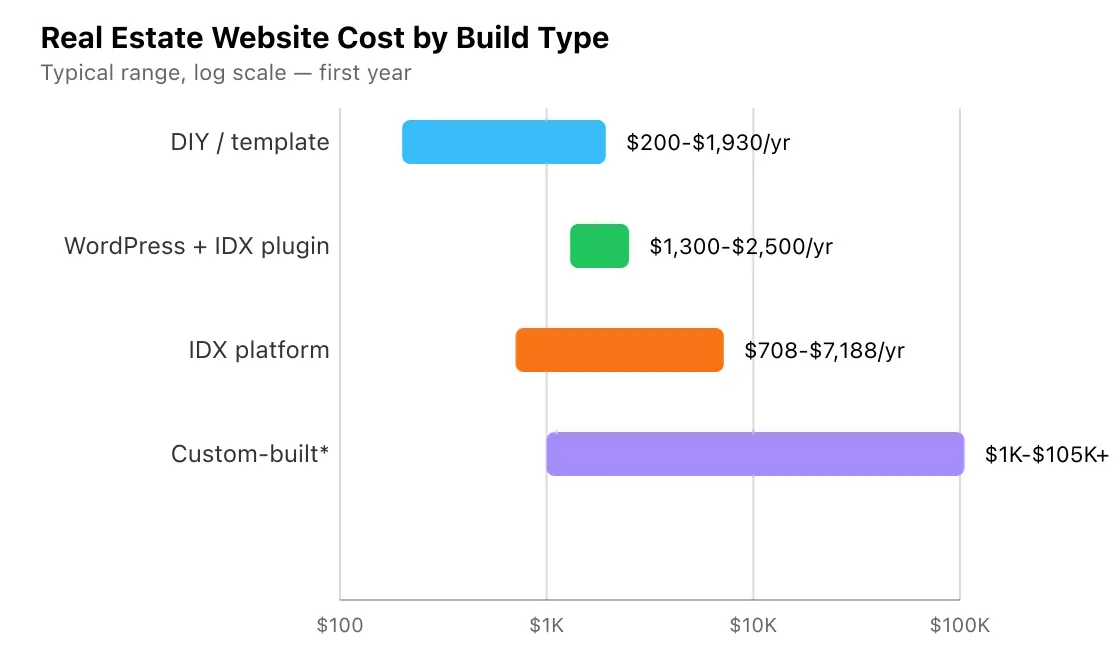
- DIY/template sites run roughly $200–$1,930 in the first year; a WordPress site with an IDX plugin runs roughly $1,300–$2,500/year; real estate-specific IDX platforms run roughly $700–$7,200/year; fully custom builds run $1,000–$105,000+ as a one-time cost, depending on whether you’re pricing by feature or hiring a full development agency.
- Placester’s own IDX-enabled agent plans start at $59/month, with IDX/MLS access added at $25/month per contract (Placester, retrieved 2026-09-01).
- IDX/MLS integration is usually the line item that surprises agents: setup alone can run $200–$2,000 before any monthly fee, and local MLS pass-through fees add another $5–$33/month on top.
- Median total annual business expenses for REALTORS were $8,010 in 2024, and a website is one line inside that budget, not the whole thing (NAR 2025 Member Profile).
- Cost tracks effort, too: DIY and IDX-platform builds can go live without touching code, while WordPress and custom builds mean real setup time, or paying a developer, before launch.
Most buyers still lean on a real estate agent to close the deal. According to the National Association of Realtors’ 2025 Profile of Home Buyers and Sellers, eighty-eight percent of recent home buyers purchased through an agent. That number is even higher for the sellers. In 2025, it reached 91%.
That same report found 81% of buyers rate a listing’s photos “very useful,” meaning the website carrying those photos and homes for sale is doing real work before a buyer ever picks up the phone.
So having a website is a must. The problem is that pricing for that website is genuinely opaque. A template builder, a WordPress site with an IDX (Internet Data Exchange) plugin, a real estate-specific IDX platform, and a fully custom website can all be marketed as “a real estate website” while costing 200 times as much as each other.
Let’s answer the question of how much a real estate website costs in 2026. This cost breakdown covers verified pricing across all four paths, what actually drives the total cost up or down, and how much agents report spending on technology overall.
How much does a real estate website really cost?
A real estate website costs anywhere from about $200 a year to $105,000 or more, and the website build type you choose explains almost all of that spread. A DIY template site is the cheapest option. A WordPress site with an IDX plugin sits just above it, trading a bit more setup work for more control and better SEO customization.
A real estate-specific IDX platform sits in the middle and is what most working agents and teams actually use. A fully custom website costs the most and only pays off at brokerage or enterprise scale.
That same order roughly tracks how much of your own time, or a developer’s, each option demands. DIY builders and IDX platforms are built for agents with no coding background; WordPress and custom builds ask for real setup work, or someone on payroll to do it, in exchange for more control.
The range matters less than knowing which tier fits your business today. A brand-new agent with no listings yet doesn’t need the same website as a five-person team closing thirty transactions a year, and paying for the wrong tier shows up as either wasted spend or a site that can’t keep up with lead volume.
What does a DIY or template real estate website cost?
A DIY builder is the cheapest way to get a basic website live, and it’s the right call for a brand-new agent who mainly needs a professional online presence to point at from social media and business cards. The appeal isn’t just price: these builders are genuinely no-code, so a solo agent can go from sign-up to a live site in an afternoon, no technical skill required.
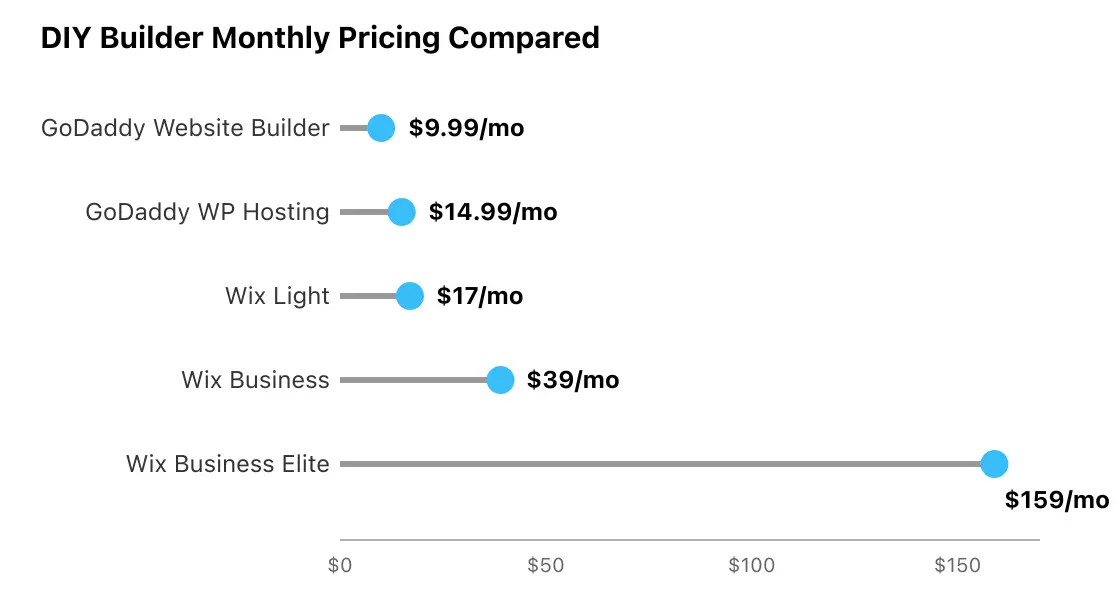
GoDaddy’s Website Builder starts at a flat $9.99/month and includes real estate-specific website templates. The company offers other services, such as fully-managed WordPress hosting that starts at $ 14.99/month, as well as website design service for $499.99 (paid once instead of a monthly fee).
Wix’s paid tiers run from roughly $17 to $159/month depending on plan, with its mid-tier Business plan ($39/month) being the one most small businesses land on.
What that price doesn’t include is IDX. General-purpose builders like Wix and GoDaddy aren’t built to pull live MLS listings into on-site property search, so a DIY site typically becomes a static brochure rather than a place buyers actually search. That’s the trade-off: lowest cost, least lead-generation capability.
What does a WordPress + IDX plugin website cost?
WordPress with an IDX plugin sits between a template builder and a full real estate SaaS platform: more setup work, but more control over web design, branding, and full SEO customization than a closed platform allows.
Showcase IDX‘s Essentials plan runs $94.95/month (two user accounts) and Premium runs $124.95/month (five accounts), both with no setup fee; MLS pass-through fees add another $0–$33/month depending on your local MLS.

On top of the plugin itself, budget for WordPress hosting ($15–$30/month), a real estate-focused theme ($50–$200 one-time), and, unless you’re comfortable installing and configuring an IDX plugin yourself, a web designer or developer to assemble it, a cost that both DIY builders and SaaS platforms otherwise bundle in for you.
Even for an experienced DIYer, realistically budget a few days to two weeks for hosting setup, theme configuration, and MLS approval and testing before the site is fully live. Add it up, and the total cost of a self-hosted WordPress build typically lands close to, or a little above, an entry-level IDX platform subscription, for meaningfully more setup time.
What does a real estate-specific IDX website platform cost?
Most working agents land here: a platform purpose-built for real estate, with IDX/MLS search, lead capture, and a CRM built in rather than bolted on. When you factor in the cost, the time, and the effort required to set up a real estate site, it’s the most efficient option.
Let’s take a look at two real estate website builders in terms of pricing: Real Geeks and Placester. Both publish their pricing plans without hiding the prices and asking you to contact sales, which is becoming a rarity, especially for Enterprise pricing tiers.
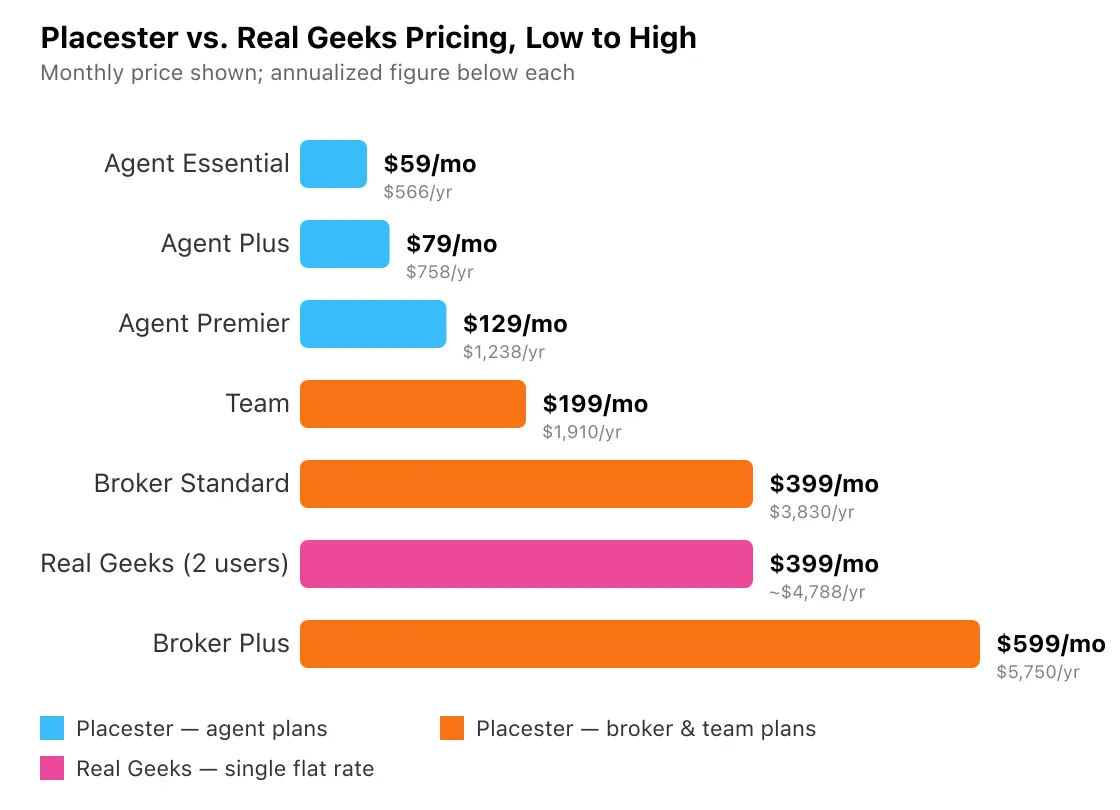
Real Geeks pricing starts at $399/month for a 2-user plan plus a $500 one-time setup fee, with each additional MLS board costing $10/month and lead-generation add-ons (social, search, seller) priced separately at $299-$599/month.
Placester takes a lower entry-price approach and prices its plans in two tracks. For individual agents:
- Agent Essential at $59/month ($566 billed annually),
- Agent Plus at $79/month ($758 annually), and
- Agent Premier at $129/month ($1,238 annually), with IDX/MLS access added at $25/month per contract and built-in AI features included on every tier.
For brokers and teams:
- Team at $199/month ($1,910 annually),
- Broker Standard at $399/month ($3,830 annually, Placester’s recommended plan), and
- Broker Plus at $599/month ($5,750 annually).
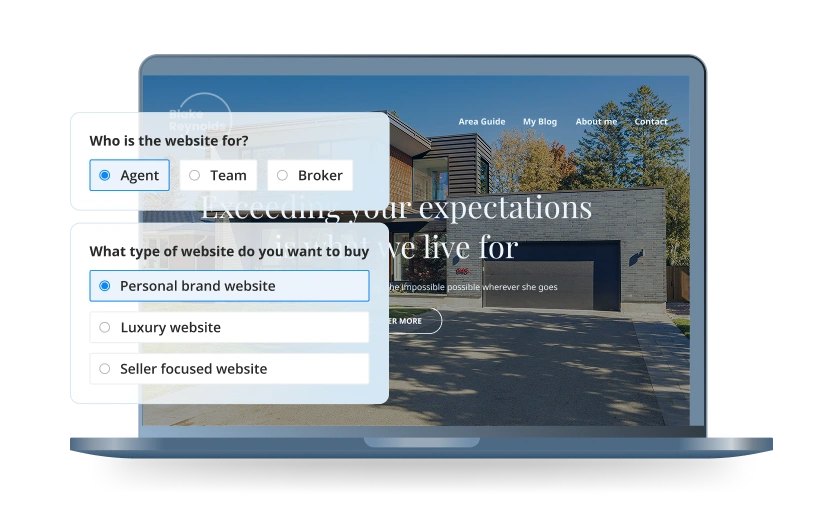
But the price itself isn’t the only difference. Placester uses an AI website builder that allows agents to create and edit websites using prompts. It’s the builder that takes care of the creation.
RealGeeks takes a different approach. It uses a traditional drag-and-drop website builder. The templates it offers can speed up the creation of a website, but it still requires a lot of manual work to get to the ready-to-publish state.
BoldTrail, BoomTown, and Luxury Presence don’t publish pricing publicly, so any figure you see for them is a third-party estimate, not a confirmed price.
AI Websites for Real Estate
Get a custom, ready-to-edit website
in less than 4 minutes.
What does a fully custom-built real estate website cost?
A custom build makes sense once a brokerage’s brand, workflow, or scale genuinely doesn’t fit a template or plugin. To illustrate how much the costs can differ when building a custom realtor website, I found pricing from two agencies: ColorWhistle and Cleveroad.
Pricing here is inherently quote-based, and two agencies can land in very different places for what sounds like the same project, so it’s worth seeing both ends of that range rather than one blended number.
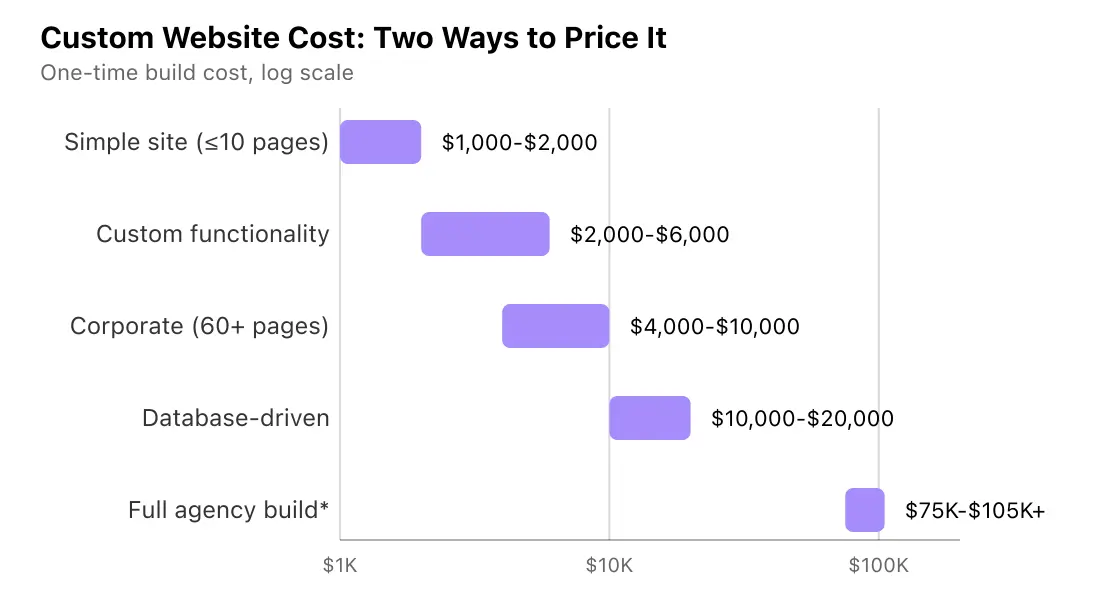
ColorWhistle prices custom builds by site complexity: a simple informational site (10 pages or fewer, minimal interactive features) runs $1,000-$2,000; add custom functionality like property search filters and detail pages across 40+ pages and it’s $2,000-$6,000; a corporate site with 60+ pages, advanced CMS modules, and third-party integrations runs $4,000-$10,000; and a fully custom, database-driven build runs $10,000-$20,000.
Cleveroad, a software development agency, prices the same kind of project on a different basis entirely: a fully custom real estate website runs $75,000-$105,000+, based on a roughly $50/hour development rate typical of its home region (Central and Eastern Europe). That regional rate matters: US-based web development agencies typically bill $100-$150+/hour, versus roughly $45-$70/hour for CEE-region developers of comparable seniority, so hiring a domestic US agency for the same scope can push the total meaningfully above Cleveroad’s own estimate,
Its own feature-by-feature estimate, before agency overhead, runs $18,000-$64,000 across advanced search filters ($4,500-$15,000), high-quality property listings ($2,250-$11,250), interactive map integration ($2,250-$7,500), responsive design ($4,500-$15,000), contact forms and lead capture ($2,250-$7,500), and agent profiles and testimonials ($2,250-$7,500).
The gap between those two numbers is the real lesson: “custom website” quotes vary wildly depending on whether you’re pricing feature-by-feature with a small studio or getting a fully-loaded estimate from a development agency billing by the hour with design, QA, and project management included. Get more than one quote, and confirm exactly what’s included, before you compare numbers.
That range usually buys design and development, not ongoing operation, and it buys time, too: Cleveroad’s own estimate for a full agency build spans 280-750 development hours, which typically stretches to four to six months once discovery, design revisions, and IDX testing are factored in.
A simpler, ColorWhistle-tier site can move much faster, often a few weeks start to finish. Unlike a platform subscription, a custom build’s sticker price rarely includes IDX feed maintenance, security patching, or content updates after launch, so most brokerages still pay a separate monthly retainer once the site is live. Budgeting for the build alone, without planning for that second line item, is the most common way a custom website ends up more expensive than the quote suggested.
What actually drives your website’s price up or down? (hidden costs to watch)
Whatever build type you choose, the same handful of line items explain most of the price difference between the cheapest and most expensive option in each tier, and most of them are the hidden costs that don’t show up in the advertised starting price.
IDX/MLS integration. This is usually the biggest lever. Setup alone commonly runs $200-$500, and can reach $2,000 for a premium, white-glove configuration; ongoing costs typically add $50-$200/month for the primary MLS board, another $30-$100/month per additional board, and a separate local MLS compliance “pass-through” fee of roughly $5-$33/month (Diverse Solutions; Showcase IDX).
Domain and hosting. Cheap and easy to underestimate: $10-$20/year for the domain, plus $100-$500/year for hosting if it isn’t bundled into your platform’s subscription.
Design, branding, and customization. Off-the-shelf templates cost the least; a theme matched to your personal brand costs more; a fully bespoke design costs the most. This is the main variable inside the custom-build range above.
Maintenance and support. Security updates, plugin and theme upkeep, and content changes after launch. Platforms and IDX vendors typically fold this into the monthly fee; WordPress and custom builds usually require a separate retainer or a developer on call.
Lead capture and CRM add-ons. Squeeze pages, automated drip campaigns, and seller-lead tools are often priced as optional modules on top of the base platform, the way Real Geeks prices its social, search, and seller add-ons separately.
Content, copywriting, and SEO. Neighborhood guides, agent bios, and listing descriptions are usually the last line item agents budget for, and the first one buyers notice. A platform gives you the framework; someone still has to write the words and invest in full SEO work that makes a page rank and read as credible.
The reason this matters: 81% of buyers rate a listing’s photos “very useful.” A cheap site that can’t display high-resolution listing photos or a floor plan properly is optimizing for the wrong line item.
How much do agents actually spend on websites and tech each year?
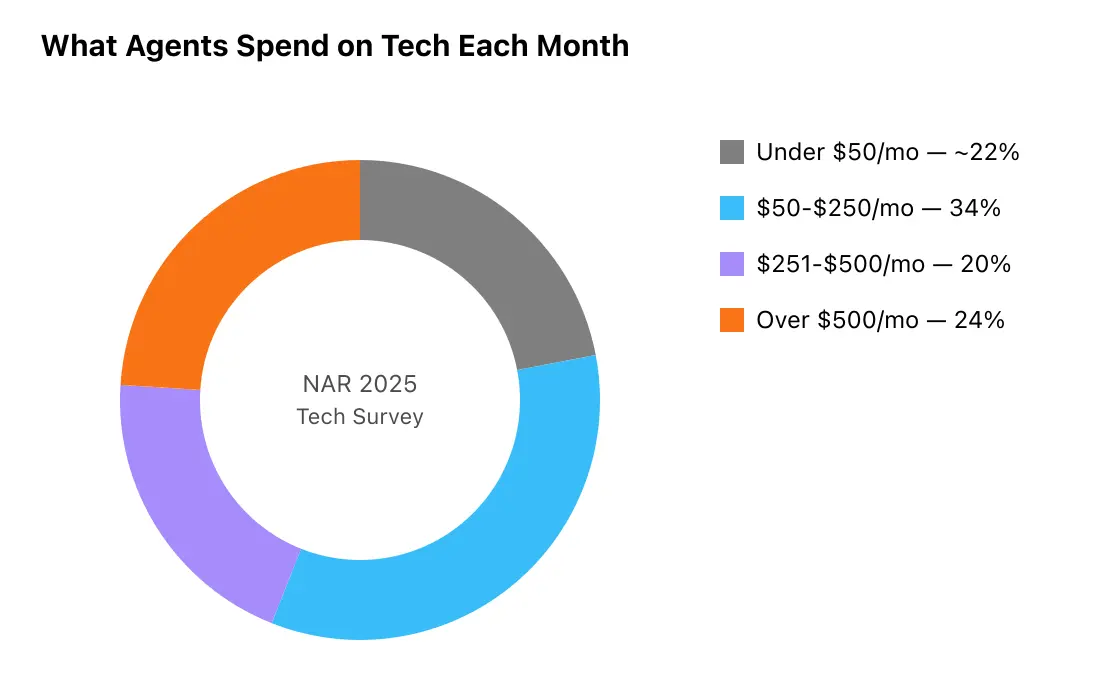
A website is one expense inside a bigger technology budget, and NAR’s own survey data shows most agents are already spending real money on tools out of pocket. Among REALTORS surveyed, 34% spend $50-$250/month on technology tools for their business, 20% spend $251-$500/month, and 24% spend more than $500/month, leaving roughly one in five spending under $50/month (NAR 2025 REALTORS Technology Survey, September 2025).
Zoom out further, and the number gets bigger: median total annual business expenses for REALTORS were $8,010 in 2024, down slightly from $8,450 in 2023 (NAR 2025 Member Profile). That figure covers everything an agent pays for, not marketing or website costs specifically, but it’s a useful anchor: an IDX platform running $700-$2,000/year is a meaningful chunk of that budget, not a rounding error.
DIY, WordPress, IDX platform, or custom-built: how do you choose?
Match the build type to where you actually are, not where you eventually want to be.
| Build type | Typical cost | Time to launch | IDX/MLS included | Best for |
|---|---|---|---|---|
| DIY/template | $200–$1,930/year | Same day, no code | No | Brand-new agents who just need a professional web presence |
| WordPress + IDX plugin | $1,300–$2,500/year | A few days to two weeks | Yes, via plugin | Agents who know WordPress and want more design and SEO control |
| IDX platform (e.g., Placester) | $700–$7,200/year | Minutes to same day, no code | Yes, built in | Most solo agents and small teams actively working buyers and sellers |
| Custom-built | $1,000–$105,000+ one-time | A few weeks to 4–6 months | Yes, but custom-integrated | Brokerages or teams with a distinct brand or workflow and budget for ongoing maintenance |
Choose a DIY/template builder if: you’re new to the business, don’t yet have consistent listing volume, and mainly need a professional website to share. No coding involved, and you can be live the same day. Accept the trade-off: no real IDX search, so it won’t function as a lead-generation engine.
Choose WordPress + an IDX plugin if: you already know WordPress, want more design and SEO control than a closed platform allows, and don’t mind managing hosting, updates, and a plugin yourself, or paying a developer to do it for you. Budget a few days to two weeks before it’s fully live and tested.
Choose a real estate-specific IDX platform if: you’re actively working with buyers and sellers and need live MLS listings, built-in lead capture forms, and a CRM without hiring anyone to build or maintain it, and you want to launch without writing any code, the way Placester’s builder is designed to work. This is the right default for most solo agents and small teams, which is why it’s the most heavily used category on this list.
Choose a custom build if: you’re a brokerage or team with a distinct brand, a specific workflow no platform supports out of the box, real time to spare for design and development (weeks for a simple build, months for a full agency build), and the budget to also pay for ongoing maintenance after launch, not just the initial build.
For most individual agents, the math favors the IDX platform tier: its monthly fee is small compared to a custom build’s upfront cost, and it comes with IDX and lead capture that a template builder simply doesn’t offer, without the setup work or developer a WordPress build requires.
The bottom line
A real estate website’s real cost depends far more on build type than on any single feature. DIY builders are cheapest, least capable, and fastest to launch; a WordPress build with an IDX plugin trades setup work and time for more design and SEO control; IDX platforms like Placester carry the best cost-to-lead-generation ratio for most working agents, launching without any code, starting at $59/month; custom builds cost the most, take the longest, and only make sense at brokerage scale with a maintenance budget planned in from day one.
Before committing to a platform, get the fully-loaded monthly number, IDX fees and add-ons included, not just the advertised starting price.
AI Websites for Real Estate
Get a custom, ready-to-edit website
in less than 4 minutes.
Frequently asked questions
Is a free or cheap real estate website builder good enough to start?
It’s good enough for a professional online presence, but not for lead generation. Free and low-cost builders like Wix’s entry tiers or GoDaddy’s flat-rate plan can produce a clean, mobile-friendly basic website for $10-$40/month. What they generally can’t do is pull live MLS listings into an on-site search, which is the feature most tied to converting visitors into leads.
Do I need IDX/MLS integration on my website?
If lead generation is the goal, yes. IDX is what lets visitors search active properties and homes for sale directly on your site instead of leaving for Zillow or Realtor.com. Budget $50-$200/month for the primary board plus a pass-through compliance fee, on top of your platform’s base subscription. You can add an IDX integration later if you start with a basic site, but expect a separate setup fee when you do.
How much should I budget for a real estate website in the first year?
For most solo agents, $700-$2,000 covers a real estate-specific IDX platform’s subscription and MLS fees for the year, or $1,300-$2,500 for a self-hosted WordPress build with an IDX plugin. Add another $200-$500 if you want a premium IDX setup rather than the standard configuration.
Why do “cheap” all-in-one platforms sometimes cost more than expected?
Because the advertised starting price often excludes IDX fees, extra MLS boards, additional user seats, and lead-generation add-ons, all of which are typically billed separately. Real Geeks’ $399/month base, for example, doesn’t include its $299-$599/month lead-gen packages. Always ask for the fully-loaded monthly total, not just the entry price, before comparing website platforms.
Is it worth paying more for a real estate-specific platform instead of a general website builder?
Usually, yes, if lead generation matters to your business. A general builder like Wix or GoDaddy costs less upfront, but it can’t natively pull live MLS data into an on-site search, which is the feature most closely tied to converting a visitor into a lead. The gap between a $40/month general builder and a $79/month real estate platform is small compared to the lead volume difference IDX search typically produces.
How long does it take to launch a real estate website?
It depends on build type more than budget. A DIY template site can go live the same day since it’s no-code. A real estate-specific IDX platform like Placester is built to launch in minutes once your MLS credentials are approved, no coding required. A self-hosted WordPress build with an IDX plugin typically takes a few days to two weeks, once hosting, theme setup, and MLS testing are done. A fully custom build takes the longest and varies the most: a simple, complexity-tier build can move in a few weeks, while a full agency build like Cleveroad’s estimate (280-750 development hours) typically runs four to six months with multiple rounds of revisions.
Published on