(800) 728 8391



Quick summary:
- 🤖 AI search and GenAI work together: Use generative AI to create content that aligns with how AI search systems process information.
- 🚀 Real estate content AI saves time: Let artificial intelligence handle the heavy lifting while you provide the insight.
- 🛠️ Success requires the right tactics and tools: Specialized AI tools can help strengthen visibility across both traditional and AI-powered search.
For years, real estate content followed a familiar playbook. You researched keywords, published helpful pages, and competed for clicks in Google search results. The rules of the game are evolving rapidly.
AI search tools now answer many questions directly inside the results page.
58%
AI Overviews reduce clicks to the top-ranking result by 58%. Just 10 months earlier, that number stood at 34.5%.
Source: Tim Soulo, Ahrefs
As a real estate agent, you can’t afford to ignore that change. The content strategies that worked a few years ago may no longer deliver the same visibility. Fortunately, the same technology gives you new ways to adapt to the new landscape.
If you understand how AI search works and use the right AI-powered workflows, you can improve your chances of appearing in AI-generated answers. That’s exactly what you’ll learn in this guide.
What is AI in real estate content?
AI in real estate content refers to both the way people discover information through AI-powered search tools and the way agents use generative AI to create content. Understanding how they work together is becoming essential because they now influence how your content gets found and cited online.
AI Search in real estate
AI search changes the traditional relationship between content creators and search engines. Instead of showing a list of links, platforms like Google AI Overviews, ChatGPT, or Perplexity increasingly provide direct answers. These systems analyze multiple sources and generate a response for the user. Therefore, ranking well in search results no longer guarantees the same level of visibility or traffic.
Why does this shift matter? Because more consumers now begin their research inside AI-powered tools.
37%
More than one-third of consumers (37%) now begin their searches with AI tools rather than Google.
Source: Search Engine Land
A buyer looking for information about closing costs or a seller comparing marketing strategies may receive an answer before ever visiting a website. If your content contributes to that answer, you have an opportunity to build visibility and credibility. If it does not, you may lose attention even when you publish valuable information.
Generative AI in real estate
Generative AI (GenAI) addresses a different challenge. Most agents need to publish useful information on a regular basis, but creating high-quality content takes time. AI can speed up the process, helping you move from an idea to a finished piece more efficiently without sacrificing relevance.
At the same time, generative AI creates new risks. Many agents publish content that sounds generic because it relies too heavily on AI-written text. AI tools can also introduce factual errors or produce articles that look nearly identical to content published by other websites.
22–94%
Hallucination rates (how often AI produces false information) range from 22% to 94% across 26 leading models.
Source: Stanford HAI
The most effective approach combines the two perspectives. You need to understand how AI search evaluates information while using generative AI to create stronger content. The agents who learn to do both will be better positioned to maintain visibility as search behavior continues to evolve.
👉 Explore 13 real estate marketing AI trends for 2026.
Why use AI to create real estate content?
AI can help you create better real estate content in less time while making it easier to keep up with the demands of modern search. When used correctly, it supports research, production, and optimization. That gives you more opportunities to publish useful content and increase your visibility across both traditional search engines and AI-powered search platforms.
⏳ Save time on content production
Creating high-quality content takes time that many agents simply do not have. Generative AI can accelerate research and help you build first drafts much faster than traditional workflows.
>10
hours
About one-third of marketing teams report saving 10–14 hours per week with AI. For another third, it’s over 15 hours.
Source: HubSpot State of Marketing
👤 Publish consistently without expanding your team
Many agents understand the value of content marketing but struggle to maintain a regular publishing schedule. AI reduces the workload required to turn ideas into finished content, making consistency more realistic even for solo agents.
📈 Cover more topics that potential clients are searching for
AI can help you identify content gaps and generate topic ideas based on buyer and seller intent. This makes it easier to consistently create materials that align with the questions people ask in AI search tools and traditional search engines.

A lot of the science of marketing will get automated by AI, leaving […] more time for craft.
~Kieran Flanagan, SVP of Marketing at HubSpot
🗂️ Improve content research and organization
One of AI’s biggest strengths is its ability to process large amounts of information quickly. Instead of spending hours gathering background information, you can use AI to accelerate the research process and identify the key points worth exploring further.
That does not eliminate the need for human expertise. It allows you to spend more time adding local market knowledge and original insights that AI cannot provide on its own.
🚀 Scale your content strategy
Publishing one article per month rarely creates meaningful visibility. AI makes it easier to support a broader content strategy without dramatically increasing your workload. Industry data suggests that companies using AI publish substantially more content than those relying entirely on manual workflows.
3–5x
In 2025, 46% of marketers reported producing three to five times more content than a year earlier, with AI playing a central role in the process.
Source: Demand Gen Report
🔎 Adapt to the rise of AI search
Perhaps the most important reason is that AI is no longer just a content creation tool. It is becoming a primary way people discover information online. If AI search systems increasingly decide which sources get cited and surfaced, understanding AI becomes part of understanding content marketing itself.
We’re not trying to rank number one on Google anymore. We’re trying to be cited.
~Casey Hopkins, Placester’s Head of Growth
Optimizing real estate content for AI search: 9 AI-powered tactics
AI search systems do not evaluate content the same way traditional search engines do. Their goal is to generate useful answers, which means they look for information that is trustworthy and easy to understand.
This creates new opportunities for real estate agents who know how to use AI strategically. The tactics below will help you use generative AI to create content that aligns more closely with the way AI search platforms discover, interpret, and surface information.
1. Identify and answer real client questions
Instead of focusing solely on keywords, focus on the questions buyers and sellers ask. Generative AI can help you uncover them at scale. Ask AI tools to discover common concerns for first-time buyers, investors, luxury clients, or homeowners in your market. You can also use AI to group related questions into broader topics and identify gaps in your existing content.
Once you have the right questions, provide clear and direct answers. AI search systems prefer content that addresses a specific query without forcing users to dig through unnecessary information. A concise answer followed by additional context often works better than a lengthy introduction.
Writing for questions is replacing writing for keywords.
~Casey Hopkins, Placester’s Head of Growth
👉 Browse 275 real estate SEO keywords for 2026.
2. Build topical authority
AI search systems favor sources that demonstrate deep coverage of a subject. A single article about home buying carries less weight than a collection of interconnected pages that cover the topic from multiple angles.
Use AI to map the subtopics surrounding your primary content. For example, if you want to rank for “first-time homebuyer,” ask AI to identify related questions, common obstacles, and supporting topics. You may discover opportunities to create content about:
- Down payments
- Mortgage pre-approval
- Closing costs
- Credit scores
- First-time buyer programs
- And so on
Then connect those pages through internal links. This helps AI search systems understand that your website contains comprehensive information on the subject.
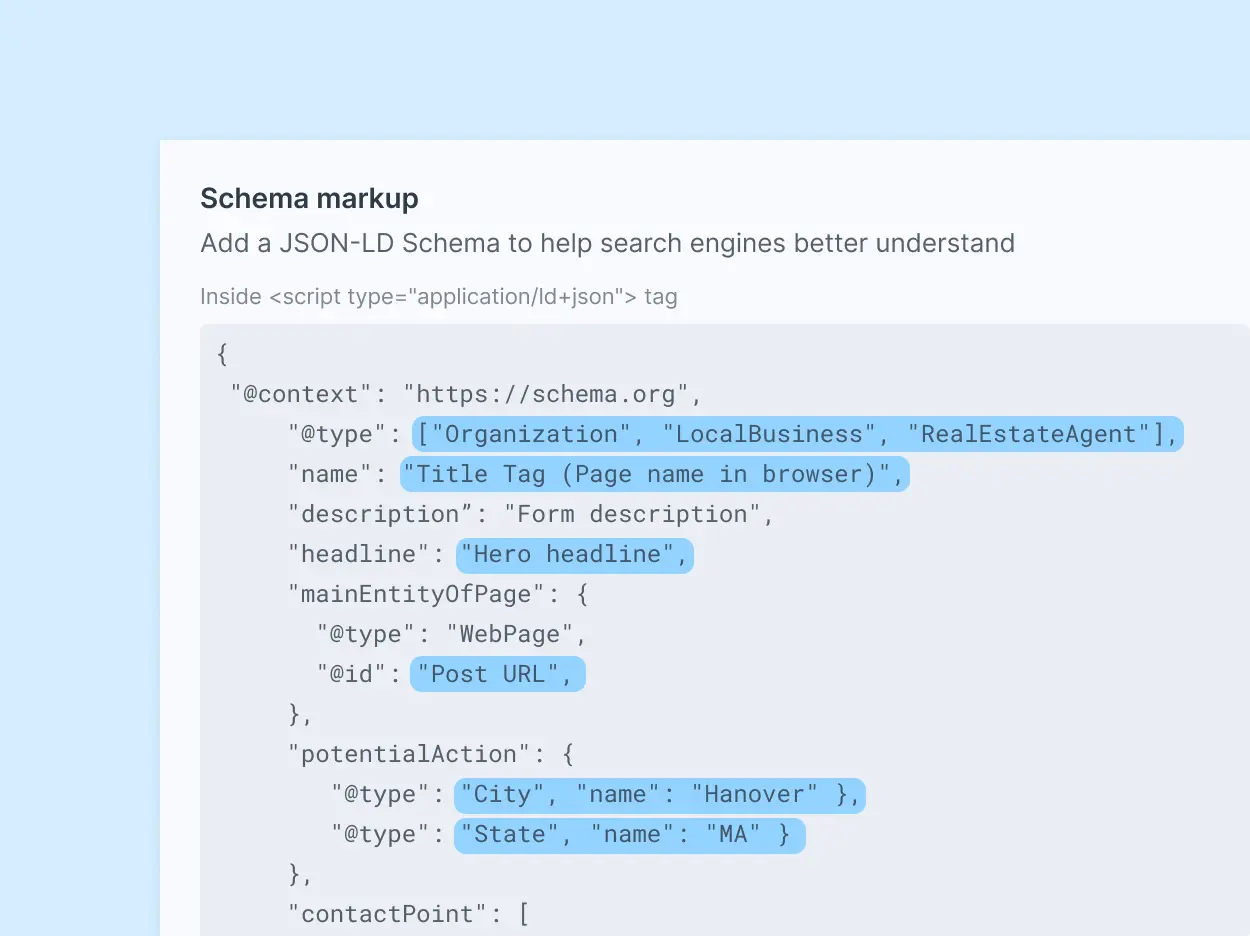
3. Implement schema markup
Schema markup helps search engines and AI platforms interpret key details without having to infer them from the page itself. Wondering where structured data can have the biggest impact?
Start by asking ChatGPT, Claude, or Gemini to review your most important pages and recommend schema types based on the page’s purpose. Focus on:
🧭 Neighborhood guides
📊 Market reports
🏠 Listing pages
❓ FAQ pages
Once you’ve identified the right schema, use the same AI tool to generate the markup. Paste the page URL or content and ask for a valid JSON-LD code that matches the page. Then, verify the output with Google’s Rich Results Test before publishing.
4. Create clear, direct answers
AI search platforms look for content that answers a question quickly. If the answer is buried several paragraphs deep, AI is less likely to surface it.
Use ChatGPT or Claude to identify the primary question behind a topic and draft a concise answer at the beginning of the section. Aim to answer the question in two or three sentences before expanding with supporting details.
Expert tip: A simple prompt such as “Rewrite this section to answer the main question within the first 50 words” can help make your content more AI-search-friendly.
5. Cover the entire topic
If your article explains how to buy a home but ignores financing, closing costs, or timelines, AI may choose a more comprehensive source instead.
That’s why you should paste each draft into your AI tool and ask: “What important questions related to this topic are not covered in this article?” Review the suggestions and add any missing information that would genuinely help the reader.
You can also ask AI to compare your article against the top-ranking pages for the same topic and identify gaps in coverage. The goal is simple: when someone finishes reading your page, they should not need another source to understand the topic.
👉 Save time with proven ChatGPT prompts.
6. Strengthen E-E-A-T signals with first-hand expertise
AI search systems look for evidence that the content comes from a credible source. Generic advice can be found anywhere. Local experience cannot.
E-E-A-T stands for Experience, Expertise, Authoritativeness, and Trustworthiness. Google introduced the concept through its Search Quality Evaluator Guidelines to help assess content quality. While AI search platforms use different ranking and retrieval systems, they still favor information that demonstrates real expertise and credibility.
AI can generate a generic article about almost any real estate topic. What AI cannot easily replicate is your local knowledge, transaction experience, and understanding of the market you serve. Those signals help AI search systems distinguish original insights from recycled information.
Some of the strongest E-E-A-T signals in real estate include:
- Local market observations based on recent transactions
- Original statistics from your market area
- Examples drawn from real client situations
- Commentary on local regulations or market conditions
- Quotes from industry experts
- References to authoritative sources such as NAR, MLS data, or government agencies
Expert tip: You should also make it easy for AI systems to verify who created the content. Include a detailed author bio and link to their social media profiles.

7. Publish original data and keep it updated
AI search systems frequently cite sources that provide information unavailable elsewhere. If your content simply repeats statistics or advice already published on dozens of websites, there is little reason for AI to reference it.
Look for opportunities to include original insights from your business and local market. Examples include:
- Year-over-year changes in local home prices
- Average days on market in your area
- Trends from your own transaction data
- Insights from client surveys
- Analysis of neighborhood-specific market activity
AI can help you identify where original data would strengthen a page. Ask: “Which claims in this article could be supported with unique local data or original research?”
Freshness matters as well. Outdated statistics can reduce credibility and make AI search systems less likely to surface your content. Review high-value pages regularly and replace old numbers with current information.
8. Connect related pages with internal links
Reviewing dozens or hundreds of pages to identify internal linking opportunities can quickly become overwhelming. Instead of manually analyzing every page, use AI tools to uncover relevant connections across your website.
For smaller websites, ChatGPT, Claude, or Gemini can quickly identify pages that should be connected. As your content library grows, dedicated tools such as Link Whisper and InLinks become more efficient. They analyze your entire website and surface linking opportunities at scale.
Internal links help search engines and AI systems see the bigger picture. Instead of evaluating each page on its own, they can follow the connections between related resources and develop a better understanding of your expertise on the topic.
When several articles point readers to the same in-depth guide, that page naturally stands out as an important resource. Over time, this can help reinforce its authority and make its role within your website easier for AI systems to understand.
9. Expand your content beyond the blog
AI search systems pull information from more than traditional articles. A useful insight shared in a video, webinar, podcast, or social media post can become part of the information ecosystem AI uses to understand your expertise.
Instead of publishing a market report and moving on, use AI to break it into multiple formats. Upload the report to ChatGPT, Claude, or Gemini and ask:
“How would you repurpose this content into formats that answer different user needs throughout the buying journey?”
You might turn one report into:
🎬 A short video script explaining the key takeaway
❓ A FAQ section for your website
🌐 A LinkedIn post built around a surprising statistic
💻 A webinar outline
📩 An email for homeowners in a specific neighborhood
Once you have a strong article, use AI to extract the most valuable information and adapt it to different formats. For example:
- Turn market statistics into an infographic with Canva Magic Design.
- Transform a neighborhood guide into a LinkedIn carousel using ChatGPT and Canva.
- Convert a blog post into a short script with Claude or Gemini, then generate the video in Synthesia or HeyGen.
Different formats help you reach people who prefer to watch, scroll, skim, or read in depth. They also increase the number of places where your expertise appears online, giving AI search systems more opportunities to discover and reference your content.
👉 Find the right AI tool for your real estate business.
Best AI for content creation in real estate: 13 powerful tools
Throughout this guide, we’ve referenced ChatGPT, Claude, and Gemini repeatedly. That’s because modern AI assistants are remarkably versatile. For many real estate agents, they are enough to build an effective content workflow. However, you also have other tools at your disposal.
The AI ecosystem now includes professional platforms designed for specific tasks. Some focus on long-form content creation. Others help with SEO research, social media production, or video generation. Choosing the right tool often depends less on overall capabilities and more on the problem you’re trying to solve.
Below are some of the most useful AI tools for real estate content creators, grouped by category:
Top AI writing tools for real estate agents
1. Jasper
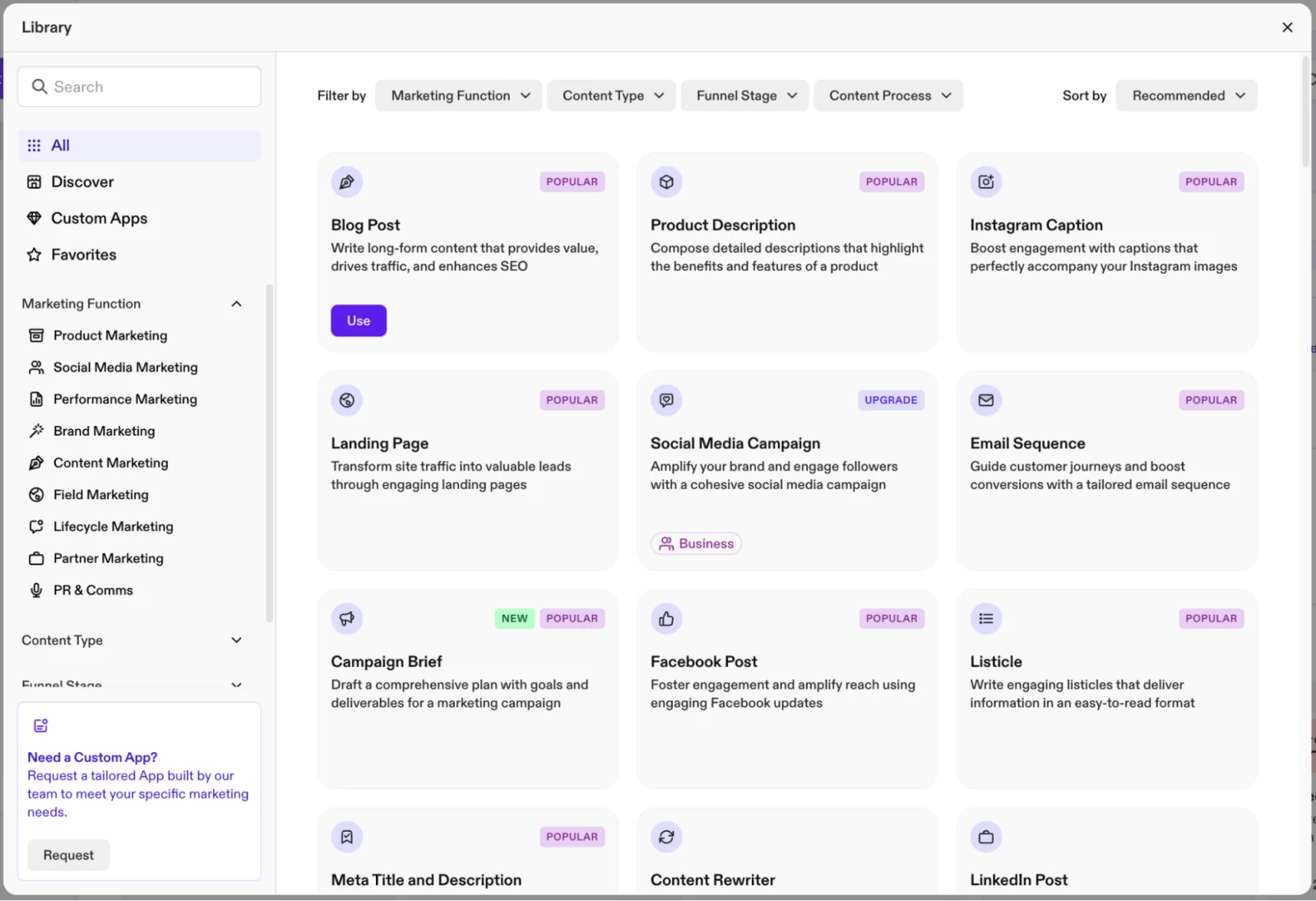
Jasper is an AI writing platform built for marketing teams. Its biggest strength is brand voice training. You can upload examples of your existing content, and Jasper will adapt future outputs to match your tone and style. For real estate agents, this is useful when creating property listing descriptions or email campaigns that need to sound consistent regardless of who creates them.
2. Copy.ai
Copy.ai focuses on content workflows rather than writing alone. It can take an existing asset and adapt it for a different channel with minimal editing. A real estate agent can use it to turn a market report into a LinkedIn post or an email newsletter without starting from a blank page each time.
3. Writer
Writer combines generative AI technology with editorial governance. The platform checks content against predefined style rules, approved terminology, and compliance requirements while it is being written. This makes it perfect for brokerages that need to maintain consistent communication across multiple agents and offices.
4. Byword
Byword is designed for SEO content production. It generates articles directly from a keyword or a content brief and can incorporate search data into the draft. For real estate websites, it is most commonly used to create educational content targeting specific search topics.
👉 Find 100+ real estate blog topics that attract leads.
Top AI tools for real estate social media content
5. Canva Magic Studio
Imagine you’ve just finished a market report packed with useful insights. The problem is that nobody wants to read six pages of statistics on Instagram. Canva Magic Studio helps bridge that gap. Paste the report into the platform, and it can turn key takeaways into visual content that feels native to social media. For agents who already have ideas but lack design skills, Canva often replaces hours of manual work.
6. Buffer AI Assistant
Writer’s block usually appears when you need to publish something in the next fifteen minutes. Luckily, you can feed Buffer’s AI Assistant your existing material, and it will suggest social content tailored to different platforms. Instead of staring at a blank screen, you start with a draft and focus on improving it.
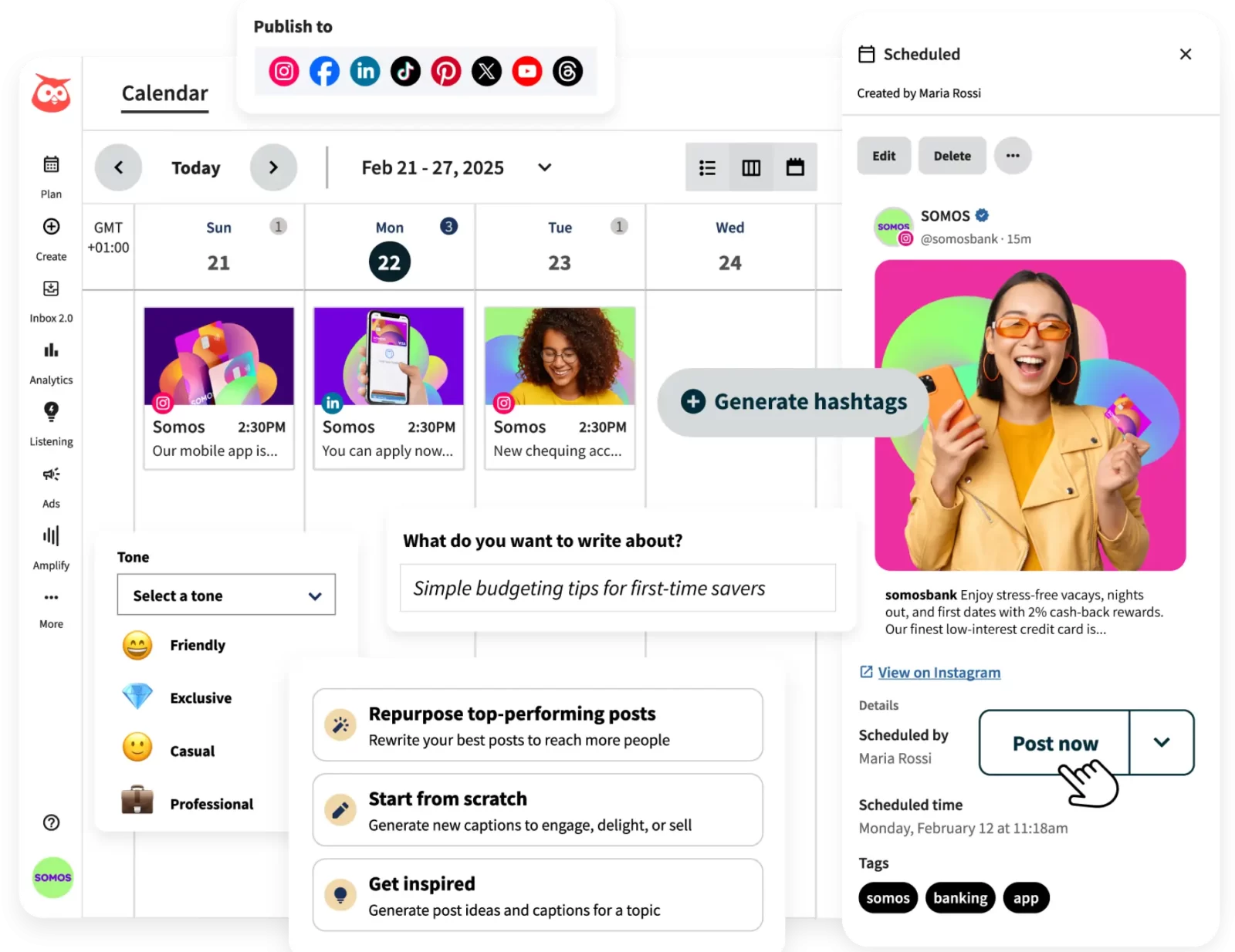
7. Hootsuite OwlyWriter AI
OwlyWriter AI feels less like a content generator and more like a social media brainstorming partner. Running out of ideas for your next post? It can suggest topics based on recent industry trends or a simple prompt. Creating and scheduling AI social media content for real estate happen inside the same platform, which means fewer tools to juggle throughout the day.
👉 Improve your real estate social media strategy.
Top AI tools for real estate SEO
8. Surfer SEO
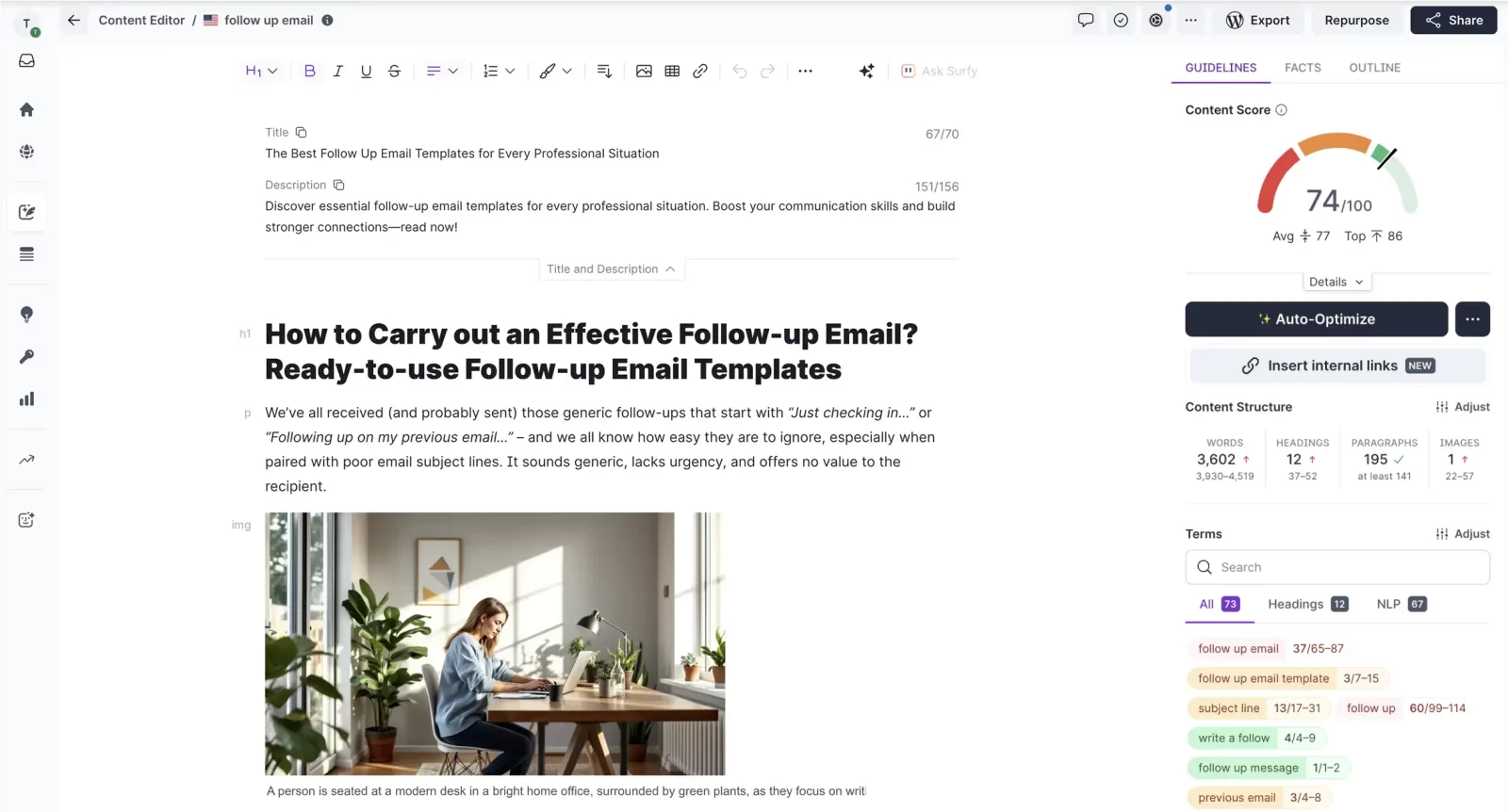
You’ve written a solid article about first-time homebuyers. The question is whether it covers the topic as thoroughly as the pages already ranking in search results. Surfer SEO analyzes competing content and highlights opportunities to strengthen your article. Many real estate agents use it to refine neighborhood guides and educational resources before publication.
9. Clearscope
Clearscope focuses on topical coverage. Paste in a draft, and the platform will show whether important concepts are missing from the discussion. This is particularly useful when creating AI-generated content around competitive real estate topics where depth matters.
10. InLinks
Most SEO tools focus on individual pages. InLinks takes a broader view by helping search engines understand the relationships between topics across your website. It analyzes content, recommends internal links, and helps build topical authority around key subjects.
👉 Learn more about real estate SEO.
Top AI tools for real estate multimedia

11. HeyGen
Some real estate agents love being on camera. Others would rather clean out a garage than record another talking-head video. HeyGen was built for the second group. Write a script, choose an avatar, and the platform will turn your text into a video that looks as if someone recorded it in a studio.
12. Synthesia
Imagine you need a video explaining the homebuying process for first-time buyers. The information is already sitting in a blog post. Synthesia takes that script and turns it into a polished presentation without requiring filming equipment or editing experience. Many teams use it when they need professional-looking videos on a predictable schedule.
13. Runway
Need a custom visual for a neighborhood spotlight? Want to remove an object from footage without opening complicated software? Runway handles tasks that once required a professional editor. For real estate marketers, it offers a way to create more distinctive visual content without hiring a production team.
👉 Get inspired by 21 standout real estate videos.
AI content generation for real estate: mistakes to avoid
AI can help you create content faster, but speed is not the same as quality. Many agents make the mistake of treating AI as a replacement for expertise rather than a tool that amplifies it. The result is content that sounds polished on the surface yet fails to attract traffic and build trust.
Most problems follow a predictable pattern. The good news is that they are usually easy to fix once you know what to look for:
| Mistake | Solution |
|---|---|
| Publishing AI-generated content without reviewing it | Review every draft for factual accuracy before publication. Verify statistics and legal information. |
| Creating generic content that could apply to any market | Add personal touch and market-specific observations. |
| Asking AI to generate an entire article from one short prompt | Build the article step by step. Draft one section at a time and review each part. |
| Ignoring search intent | Ask AI to identify the primary question behind a query and make sure content answers it clearly. |
| Focusing only on keywords | Build AI-driven real estate content around topics and questions rather than repeating target phrases. |
| Publishing outdated information | Review high-value pages regularly and update core data. |
| Covering only part of a topic | Use AI to identify missing questions and content gaps before publishing. |
| Neglecting internal links | Connect related resources so readers and AI systems can easily explore the topic further. |
| Failing to demonstrate E-E-A-T | Include first-hand experience, original insights, and credible sources. |
| Copying AI output word for word | Rewrite sections and adapt the content to your audience. |
| Creating content without a repurposing plan | Turn strong articles into videos, social posts, infographics, or email content to extend their reach. |
AI content in real estate: key takeaways
AI is changing how people discover information online, but it is also giving real estate agents new ways to stay visible. The same technology powering AI search can help you research topics and create resources that are more likely to appear in AI-generated answers. Better yet, many of the tools covered in this guide offer free plans or free trials, making it easier to experiment with AI and boost productivity without a significant investment.
If you’re looking for a more integrated approach, Placester also includes powerful AI features built specifically for real estate professionals. You can generate an entire website from basic information about your business, refine the output with custom prompts, and create content directly within the platform. Get started with Placester today.
FAQ
Can I use AI for SEO content in real estate?
Yes, you can use AI for real estate SEO content, but you should treat it as a research and drafting assistant rather than an autopilot writer. Google says helpful content can perform in search whether it is AI-assisted or human-created, as long as it is original, useful, and created for people.
Will AI overviews replace real estate SEO content?
No, but they will change what SEO content needs to do. Ahrefs found that AI Overviews can reduce clicks to the top-ranking result by 58%, so generic informational content will lose more traffic. Strong real estate content still matters because AI systems need reliable sources to cite, summarize, and reference.
What role does E-E-A-T play in AI search rankings?
Google uses E-E-A-T (Experience, Expertise, Authoritativeness, and Trustworthiness) to assess content quality, especially whether the creator has first-hand experience and credibility. For real estate content, that means author bios, local market insight, original data, and clear sourcing.
What types of content will survive in the AI era?
The strongest content will be hard for AI to recreate from existing summaries. Google recommends unique, non-commodity materials for real estate artificial intelligence search experiences. Industry analysis points to first-hand expertise, original research, case studies, and opinionated analysis as formats gaining value.
Published on
(Last updated on
)