(800) 728 8391



Quick summary:
- Blogging in 2026 still pays off, and it’s actually a very effective tool for lead nurturing and increased visibility.
- How to start a blog for a real estate business in a nutshell? Know your audience, choose the right platform, don’t neglect search engine optimization, and boast your expertise as much as possible.
- To ensure your blog’s success, you should make it visually appealing, genuinely valuable to the readers, post varied content, and track & optimize it with tools such as Google Analytics, Ahrefs, or Semrush.
It’s 2026. People forgot how to read, their brains are rotten from endless TikTok scrolling, and libraries have fallen into decay.
Except…
Buyers consume, on average, 13 pieces of content before making a purchase decision. (Okay, still doesn’t mean the libraries are safe).
As much as everyone is proclaiming their impending doom, blogs and content marketing in general are doing very well, and remain a very important source of both information and new clients.
A good blog is a mine for new leads, search visibility, and greater credibility—especially in real estate.
But what does “a good blog” mean in 2026?
Read our guide to learn about the benefits & principals of blogging for real estate, paired with stats, AI prompts, a checklist, and best tips for writing valuable content.
It’s pretty much everything you need to start (or improve) your blog in 2026!
Understanding the real estate blogging
Blogging for real estate is the practice of creating and publishing content related to the property market on a website.
This can include topics such as home-buying advice, neighborhood guides, market updates, investment tips, and client success stories. Rather than focusing solely on property showcases, a blog helps real estate professionals educate, inform, and engage potential clients throughout their buying or selling journey.
When used strategically, it can become a valuable tool for promoting the author as a local expert, attracting website traffic, and generating leads.
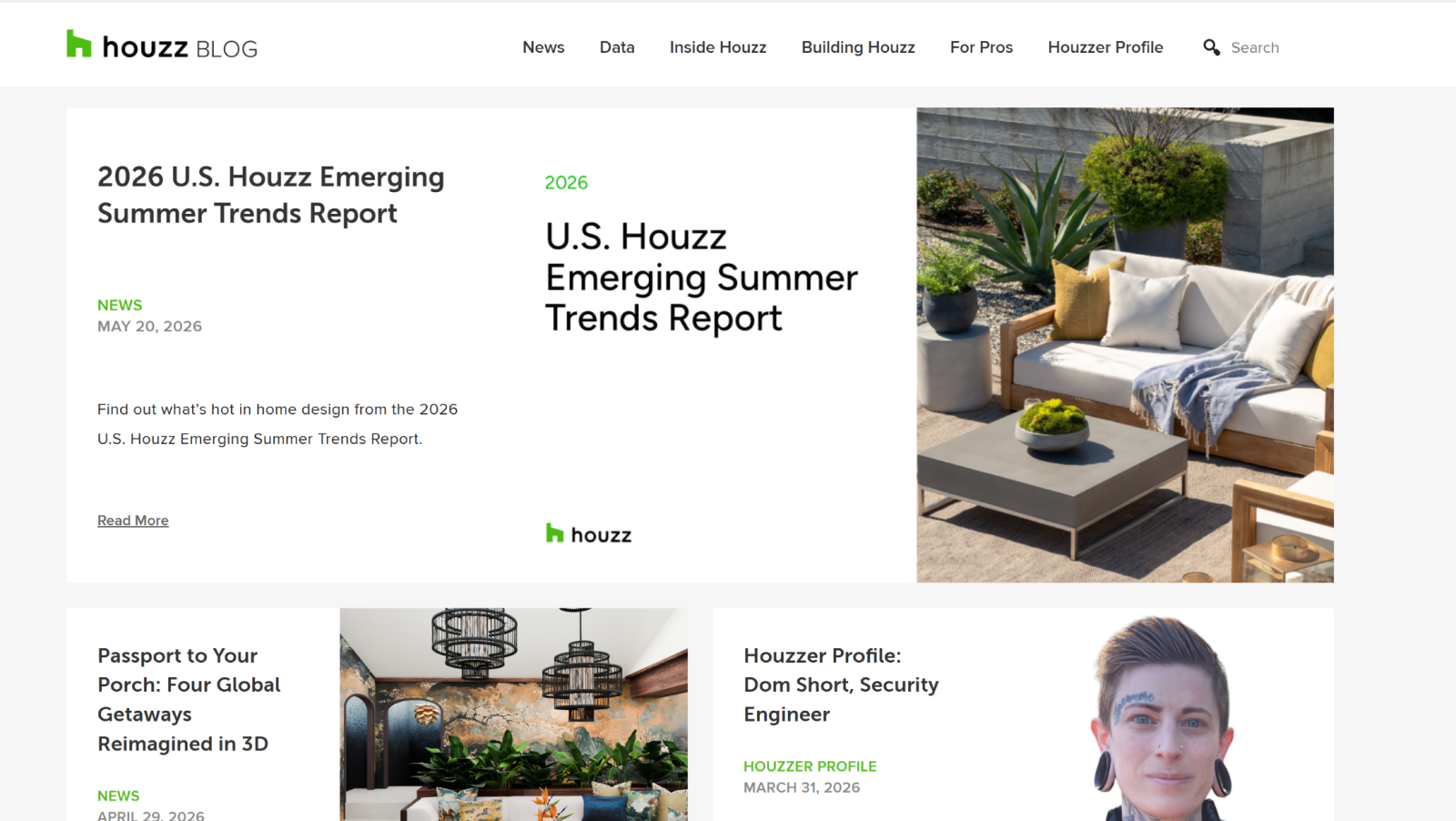
Why is blogging for real estate important?
Having a blog in 2026 still pays off, and the real estate market is actually one where content marketing really makes a difference, as potential clients do need tips, insights, and TRUST in their agent before making any decisions.
Why start a blog as a real estate agent? Here are the top 5 benefits to get you inspired!
Benefit 1: Lead capturing & nurturing
Blogs and content marketing help real estate professionals attract potential clients long before they are ready to buy or sell.
By publishing valuable content such as neighborhood guides, market updates, and home-buying tips, agents can capture leads through contact forms, newsletter sign-ups, or downloadable resources.
This content also helps nurture those leads over time by keeping the agent visible and providing valuable information throughout the decision-making process, which often takes months in real estate.
Research from the Content Marketing Institute found that 74% of marketers say content marketing is good for generating leads, while 62% say it helps nurture leads and audiences over time.
Benefit 2: Dramatic increase in search visibility
Here’s a (kinda sad, if you ask me) fact: in 2026, writing is never just about the audience, but also about search engines.
So while educating your potential clients and providing real content value is absolutely something to strive for as a goal in itself, blogging can be treated as a tool to get your website and brand to show up higher in Google.
In fact, it’s actually great at that.
Recent research found that websites with blogs have up to 434% more indexed pages in Google than websites without blogs.
Why? Because creating a blog post means creating a new webpage within your website, and more indexed pages mean more opportunities for potential visitors to find you. Blog articles also allow you to naturally use lots of long-tail searches that attract organic traffic without paying for ads.
Benefit 3: Websites with active blogs attract more backlinks
Research published in 2026 found that websites with active blogs earn 97% more inbound links on average than sites without fresh content.
What does it mean?
Think of backlinks as recommendations from other websites. When another website links to one of your blog posts, Google sees that as a signal that your content is useful and trustworthy.
For example, an agent who publishes neighborhood guides, market updates, or home-buying tips is more likely to be referenced by local businesses, news websites, or other blogs. As your blog earns more of these links, Google becomes more confident in your website, which can help not only your blog posts but also your property listings and service pages rank higher in search results.
Benefit 4: Blog content remains one of the highest-ROI marketing formats
Even though some people claim it’s outdated, research proves that blogging is still very beneficial for professionals & businesses.
HubSpot’s 2026 marketing statistics report found that blog posts were still among the top 5 highest-ROI content formats for marketers.
What it basically means is that the effort and money you have to put into creating and maintaining a blog are completely outweighed by the benefits it can yield.
Now, don’t get me wrong, having a well-written, consistently-performing blog is by no means easy.
But it’s also a lot less costly than plenty of other marketing efforts.
To use real-world numbers: a content marketing lead costs around $47, while a paid advertising one costs approximately $121.
Benefit 5: Real estate is highly local, and local search dominates Google
People don’t just search for properties. They search for locations.
Before someone contacts a real estate agent, they often search for things like:
- “Best neighborhoods in Austin for families”
- “Living in Downtown Miami”
- “Are schools in Scottsdale good?”
- “Cost of living in Tampa”
- “Moving to Charlotte guide.”
These are not searches that a property listing page is likely to rank for. They are informational searches, and blog posts are often the best way to answer them.
According to a 2025 research, 46% of all Google searches have local intent, and Google’s Local Pack drives 44% of local search clicks.
That strongly benefits hyper-local content like neighborhood guides, school district comparisons, relocation advice, and market updates, so exactly the kind of content real estate blogs excel at.
Your blog allows you to attract people who are researching an area and introduce them to your brand early in their decision-making process.
How to start a real estate blog in 6 steps
1. Define & know your audience
Before you write a single word, ask yourself one important question: Who is this blog for?
Do you want to publish guides for first-time buyers? Do you want to target your content for sellers? Do you want to write a blog for people or companies interested in purchasing properties? Or both?
Think about your audience’s biggest questions, concerns, and goals.
Once you identify that, you’ll be able to choose the right type of voice, the right topics, and even the right visuals. The more specific your target audience is, the easier it becomes to create useful, relevant, and informative content that builds trust and engagement.
2. Choose your main content pillars
Before you get into more niche and detailed blog posts, it’s good to prepare basic clusters of content that will help you begin. It’s about making sure that you don’t start with random topics but rather create a more organized blog structure right off the bat.
Here are a few examples of content clusters for real estate:
💒 Neighborhood & area guides: Local amenities, schools, transportation, safety, restaurants, cost of living, and “best places to live” articles.
🏠 Home buying advice: First-time homebuyer tips, mortgage basics, closing costs, property viewings, and step-by-step buying guides.
💰 Home selling tips: Staging advice, pricing strategies, renovation ROI, preparing for open houses, and seller checklists.
📈 Market updates & trends: Local housing market reports, price trends, interest rate impacts, and predictions for buyers or real estate investors.
💵 Real estate investment content: Rental property advice, ROI calculations, passive income strategies, short-term rentals, and investment hotspots.
When you have those generic clusters in mind, it’s much easier to categorize new articles and create more and more complex guides.
3. Choose the right platform
Once you have hashed out the content map, it’s time to choose where this content is going to be published.
Options you can choose from include:
- Generic content publishing pages: like Medium or Substack
- Standalone content blog-builders: like WordPress, Blogger, Squarespace
- Professional websites with blog features: Wix, Webflow, Placester
For most professional realtors and agents, the best option is to go, well, professional.
Having a fully custom website with your own hosting and a domain setup gives you the most control over design and performance, and also makes you look way more professional than a random blog on Medium.
Platforms such as Wix, Webflow, or Placester allow you to combine your blog, properties, contact forms, and branding all in one place, which creates a trustworthy online presence that you absolutely need to sell properties.
💡 Tip: Using Placester, which is a real-estate-dedicated website builder, is probably your best bet here. Combining website building, IDX integration, lead generation tools, CRM features, and blogging functionality in one place, Placester makes it easier for agents to publish content without needing a separate platform.
4. Know where to find topics
Great topics often come directly from real customer questions.
Pay attention to what clients ask during calls, consultations, or property viewings, because if one person is asking, many others are probably searching for the same answer online.
But you don’t have to rely on your own experience only.
There are many tools you can use to see what queries are trending in your niche and
Here’s where to look for real estate blog topics:
➡️Google Trends: Great for spotting trending topics, seasonal interest, and rising search queries in specific locations.
➡️Ahrefs: One of the most popular engine optimization tools for KW research, competitor analysis, and finding high-traffic content opportunities.
➡️SEMrush: Useful for KW research and content gap analysis. Also good for identifying what competitors are ranking for.
➡️AnswerThePublic: Visualizes real questions people ask on Google, which makes it great for blog inspiration and FAQ content.
➡️Also Asked: Helps uncover related questions and “People Also Ask” search patterns from Google.
➡️Reddit: A surprisingly valuable source for finding real audience questions, frustrations, and trending discussions.
➡️BuzzSumo: Helps identify high-performing articles and popular content in your niche.
➡️Google Search Console: Shows which search queries already bring traffic to your website, making it ideal for discovering content expansion opportunities.
Competitors’ blogs and websites: Not for copying their work, but for keeping track of what other, especially more established blogs cover
5. Create a content calendar
A content calendar helps you plan your topics in advance and stay consistent.
Start by deciding how often you want to publish, whether that’s once a week or once a month (more on the frequency later!). Then, map out topics based on the prepared content pillars, seasonal events, and common client questions.
Having a schedule reduces last-minute stress and makes it easier to maintain a steady flow of content. It also helps ensure you cover a variety of topics instead of writing about the same subjects repeatedly.
If you’re looking for inspiration, here’s a template you can borrow!
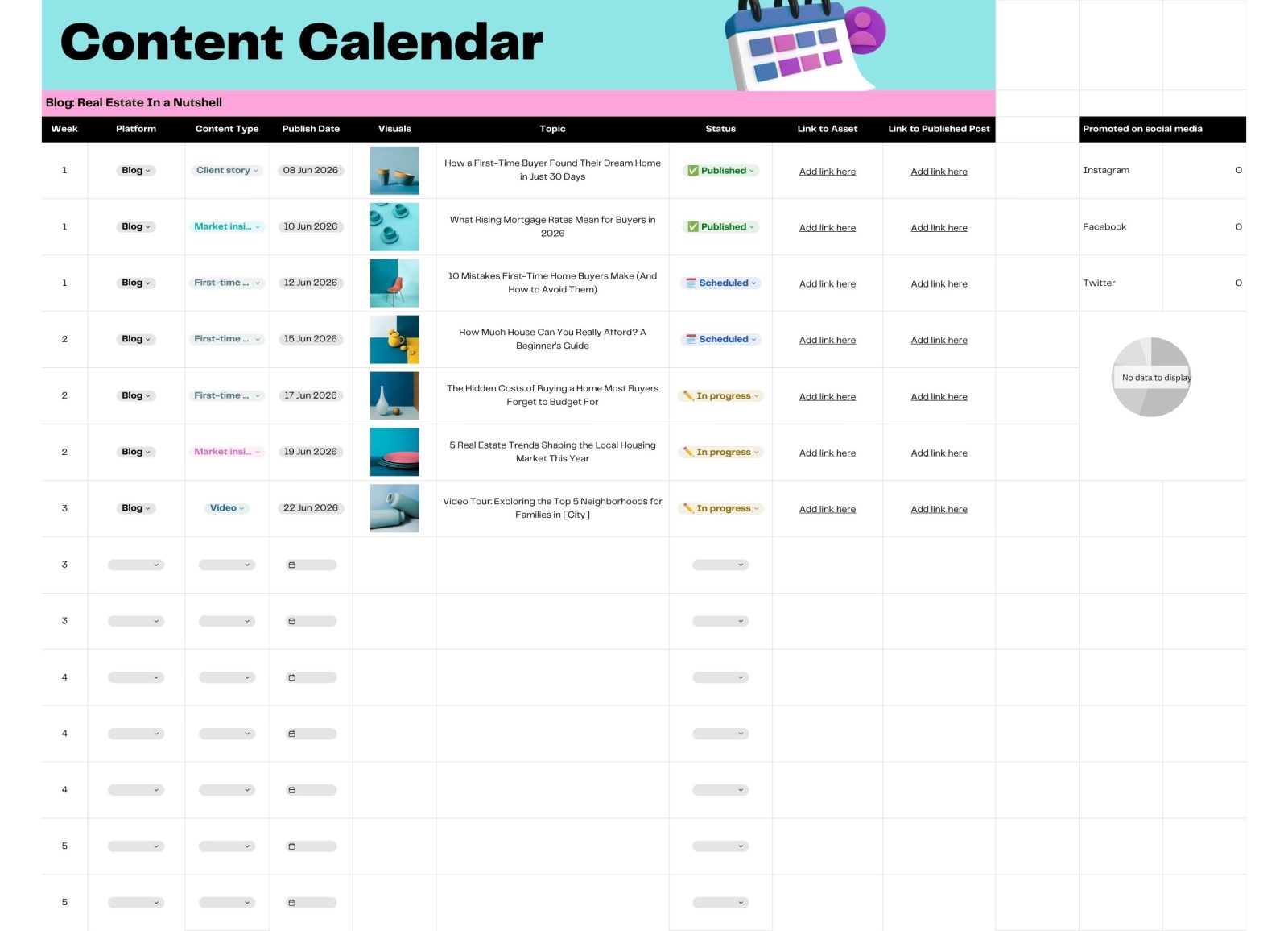
Use this template!
6. Start writing (or consider outsourcing)
Don’t wait until everything is perfect.
Just start writing!
Remember that people don’t visit a real estate blog for literary perfection; they come for expertise and practical tips. You don’t have to be another Dickens to create genuinely helpful and worth-reading content.
At the very beginning, you can try focusing on answering common client questions and sharing your experience (think something like: “7 Things I Always Tell My Clients to Do Before Making an Offer”) rather than trying to rank for highly competitive SEO keywords, which is difficult to do with a brand-new blog anyway.
If, on the other hand, you feel like writing is an absolute no-go for you, a good idea may be to hire a freelancer who will turn your knowledge into content gold.
Best AI prompts for real estate blogs
Now, let’s get this out of the way—having a blog written entirely by ChatGPT is probably not the best idea.
Especially in real estate.
Why?
Because purchasing a property requires a big investment, people turn to reputable sources before committing to it. They need a real-life professional to guide them through it, not generic (and untrustworthy) info provided by AI.
Your audience will resonate much better with an imperfect text written by a true professional than an AI slop that feels fake (even if it has actual insights provided by a person).
Not to mention, from a strictly technical POV, a 100% AI-generated text doesn’t perform that well in Google, especially over time, so your blog may report very low rankings if you rely solely on ChatGPT content.
Having said that, AI absolutely can and should be used to make your work faster and better.
AI can be very valuable when it comes to finding statistics, coming up with new ideas, or giving search optimization insights.
If you want to incorporate it into your work, here are a few prompts that can be used as an example!
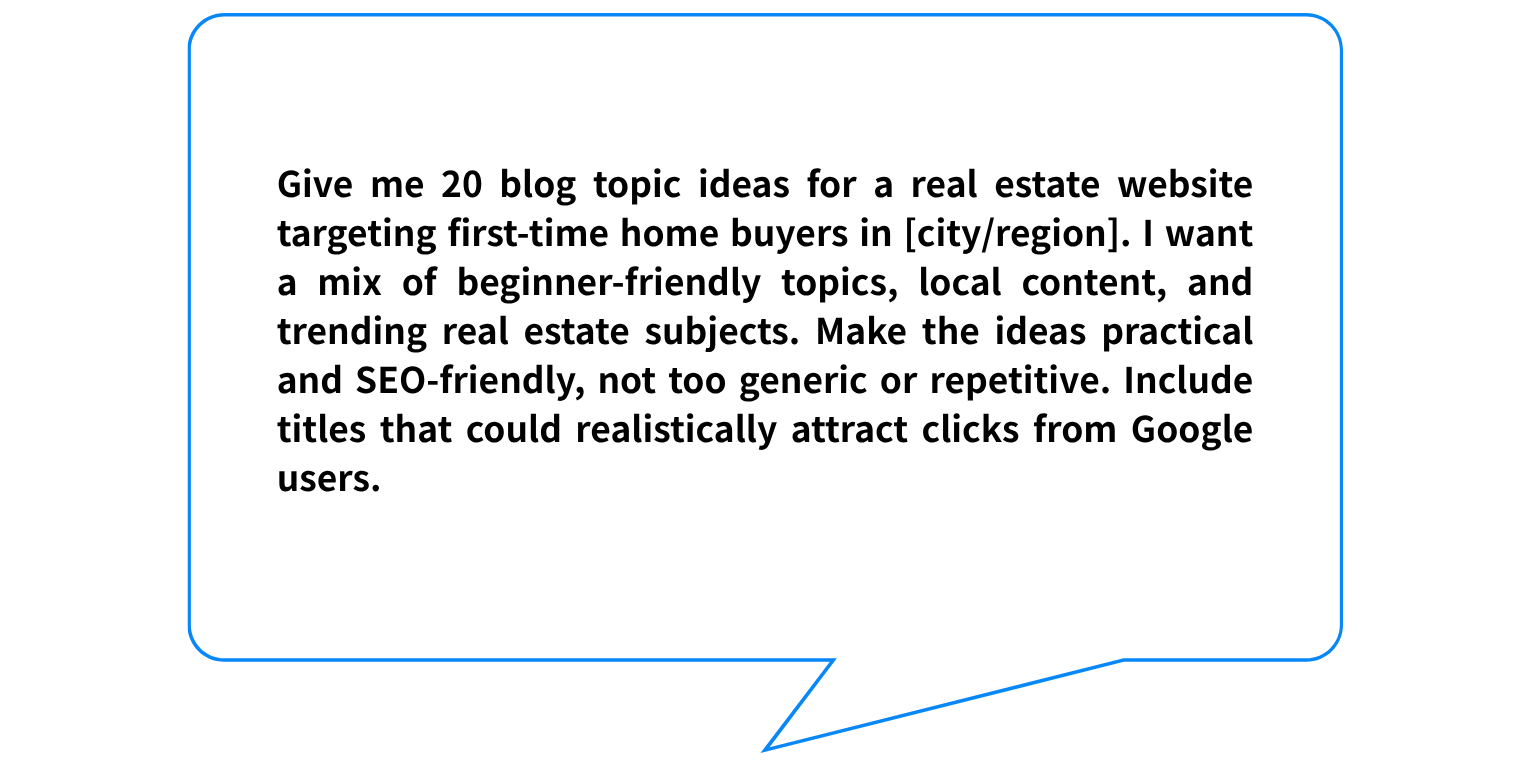
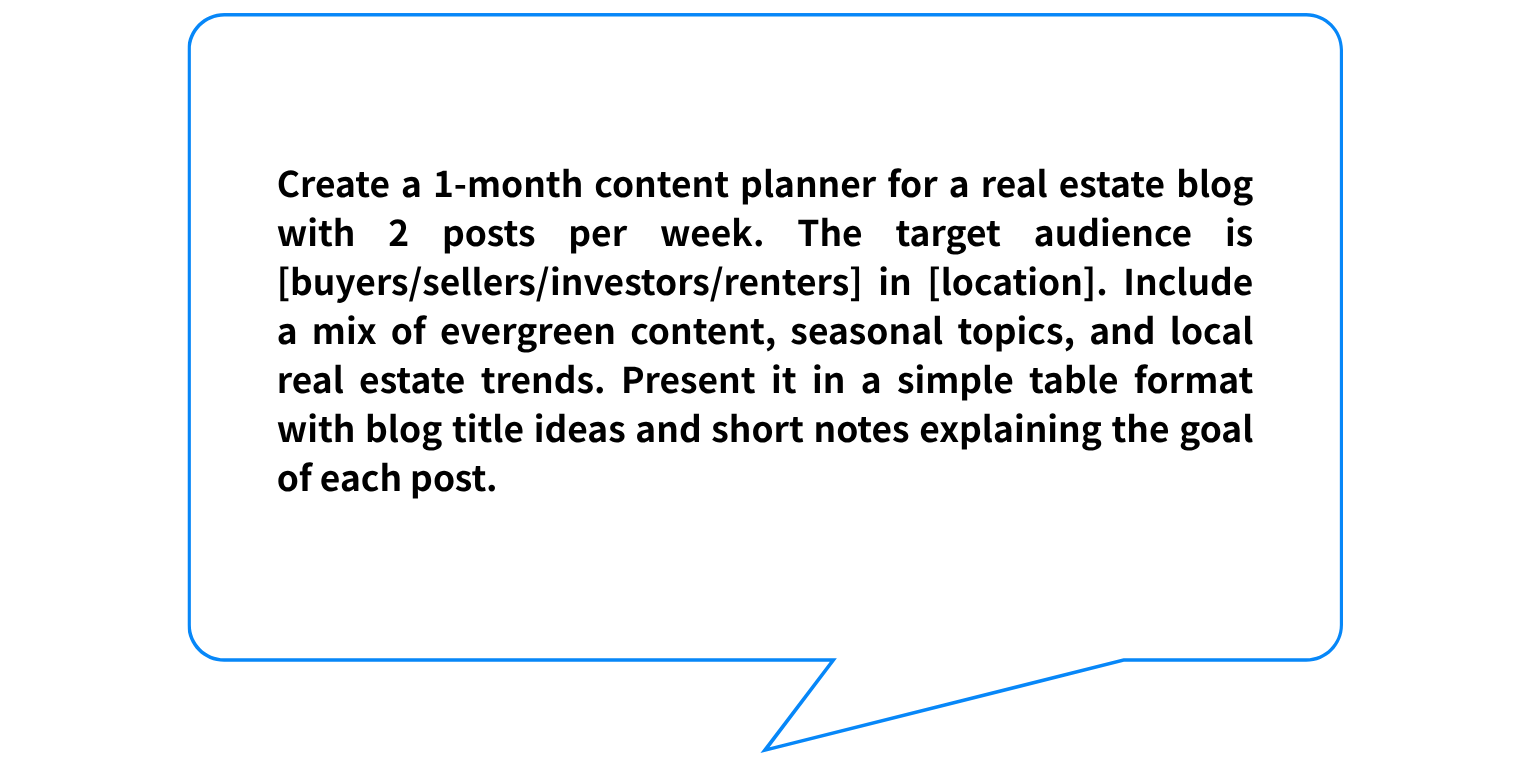
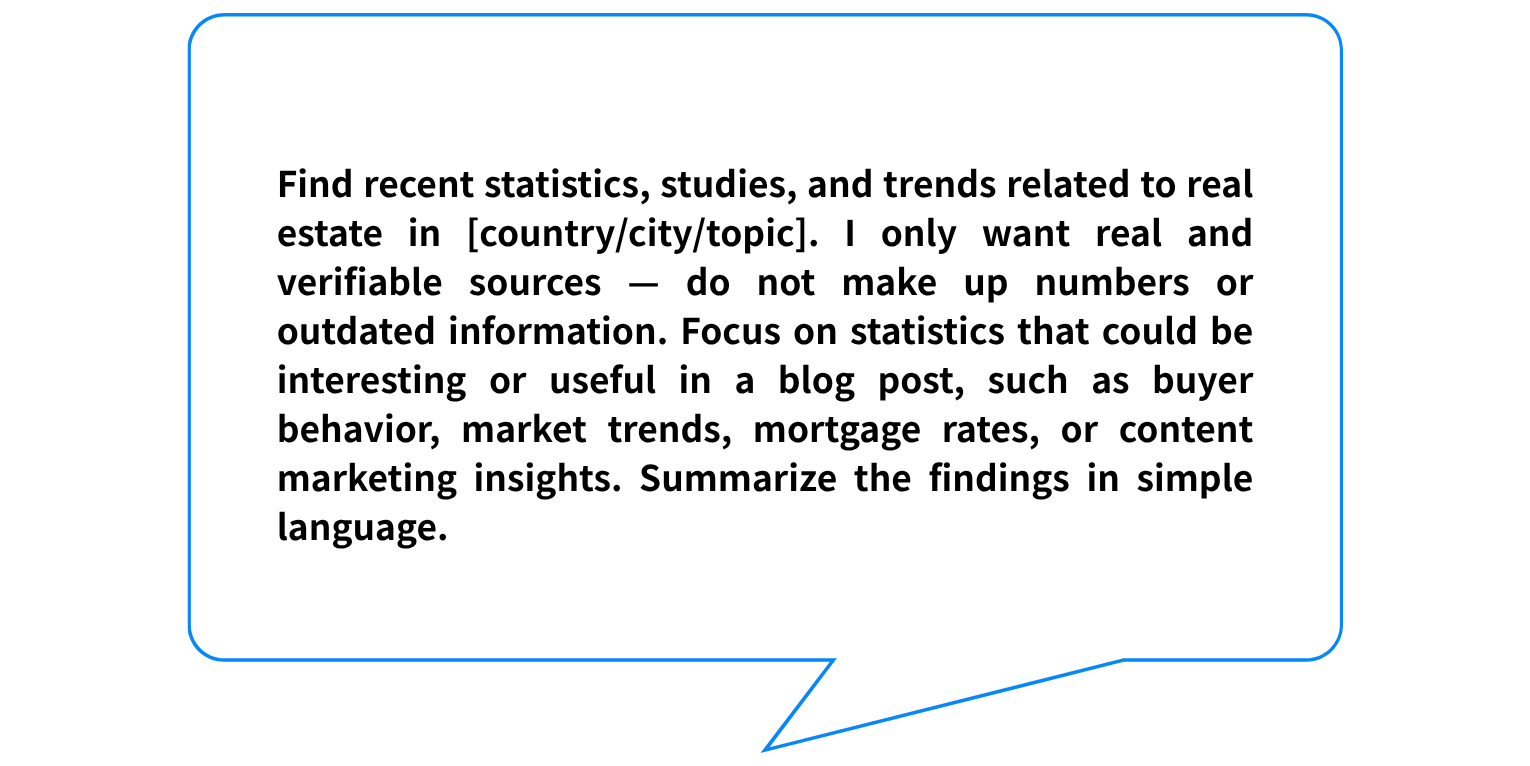
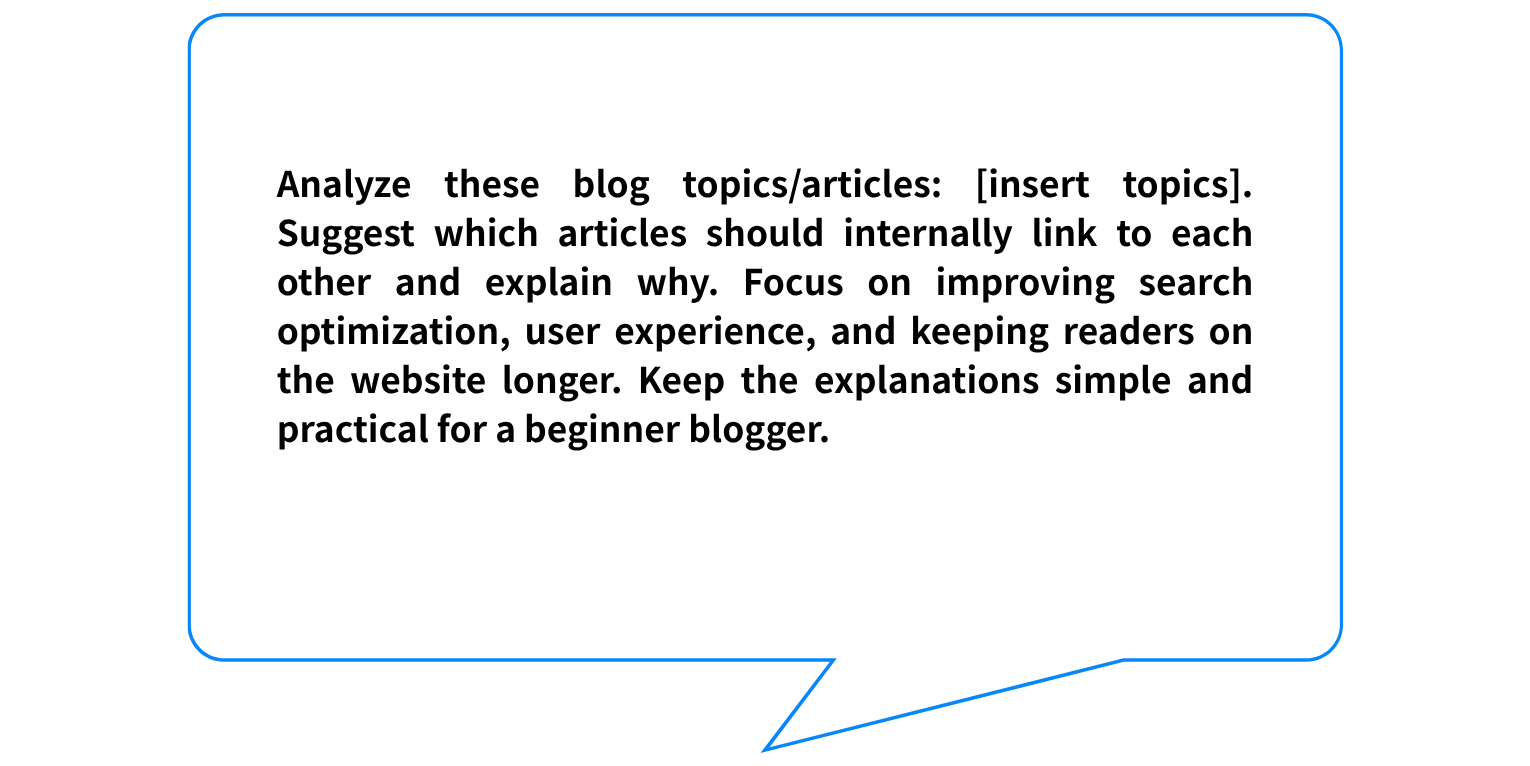
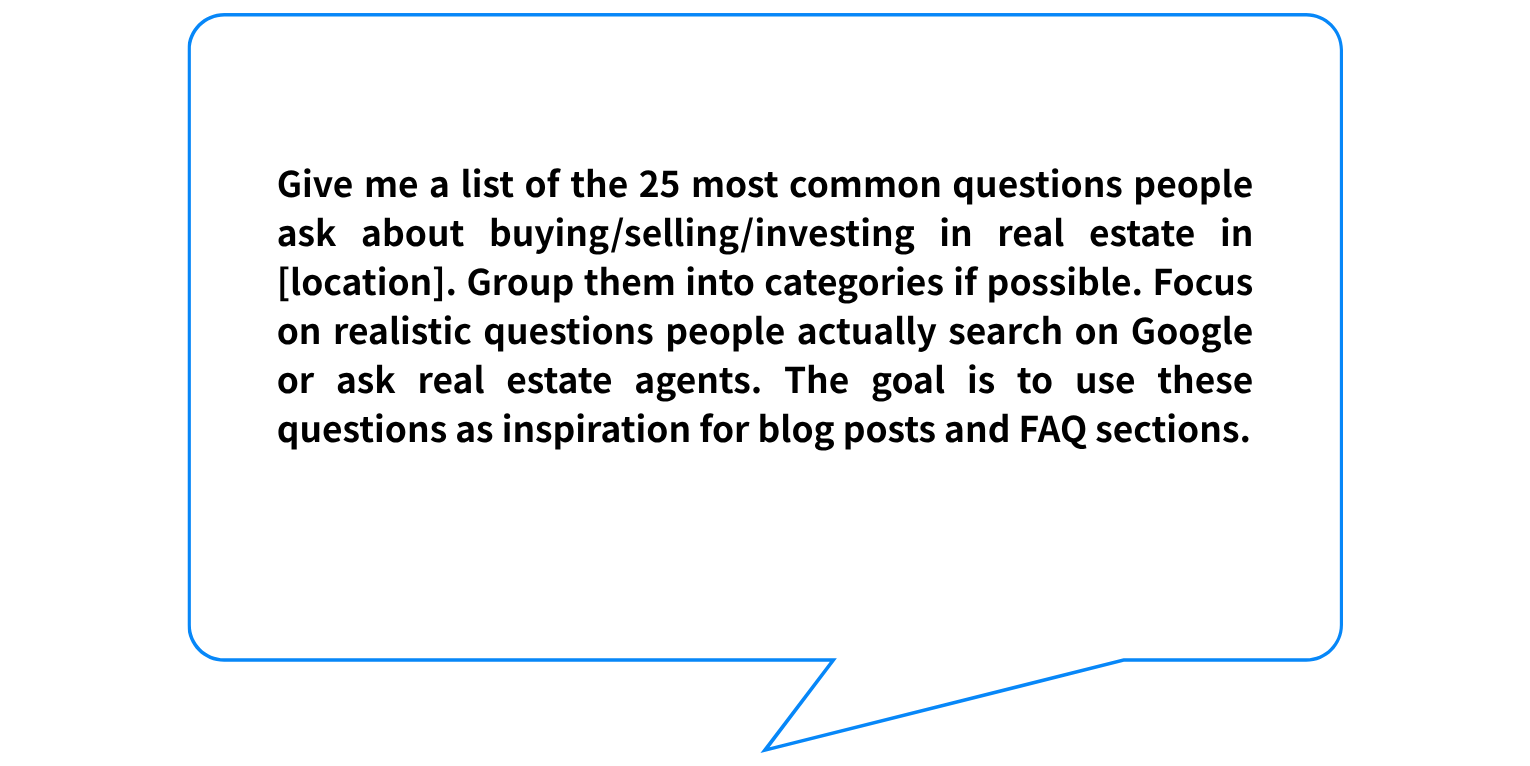
7 principles of blogging for real estate agents (+ expert tips)
1. Make each post visually attractive
While this whole article is one big argument in favor of a claim that people DO still read, it’s important to be realistic about the reality of how we all actually navigate websites.
UX research has repeatedly proven that people scan texts on internet pages more than read every line. That’s why it’s important to make every article on your blog scannable and very visually appealing.
You can do it by:
- using a lot of headers,
- using bolds and italics (when possible),
- limiting paragraphs to 3-4 lines,
- mixing short and longer sentences,
- mixing short and longer paragraphs,
- adding tables and enumerations,
- adding images.
If you have time and resources, you can also try incorporating a video format into your blog posts, as more and more people prefer watching to reading (thanks, TikTok).
2. Answer common questions and address concerns
Here’s something to remember—you’re writing for humans who can be absolutely clueless about the topic that’s like an everyday thing for you.
While your instinct may be to skip obvious facts to promote your properties or yourself, because everyone knows what an escrow is (right?), it’s important to keep in mind that what’s obvious to you isn’t obvious to your readers.
Especially as you start out, try to write down a list of the most common questions people ask you during meetings.
Is there any pattern? Do some questions show up more often than others?
These are your topics.
3. Keep it concise
Most people only read 28% of the words on a webpage, and headlines are the easiest way to grab their attention, so start with a catchy title.
The best titles tell readers what the content is about in a way that captures attention and sparks their interest (extra points if it’s 10 words or less). Next, ensure that you break your posts up into a few smaller subheadings. It will enable people to scan them for key phrases and valuable insights.
If the subheadings include the specific phrases people used to find your content in the first place, that’s even better.
Typically, your blog post should be between 500 and 800 words. It’s okay to go over a bit, but if you have much more to say about a particular topic, consider writing a second (or third and fourth!) post.
Breaking long posts up into series can help drive repeat visits to your site and encourage people to read more of your content—which, in turn, signals to Google that your site is helpful and informative.
4. Remember about engine optimization
Creating great content is only half the battle — people also need to be able to find it.
Marketing tools like Google Trends, Ahrefs, and AccuRanker can help you understand what topics your audience is interested in and how people search for real estate information online.
It’s also important to consider Generative Engine Optimization (GEO), which focuses on making content easy for AI-powered search tools and assistants to understand, summarize, and reference.
Clear structure, accurate information, and direct answers to common questions can help improve visibility across both traditional search engines like Google and AI chatbots like ChatGPT or Gemini.
5. Let your expertise shine
Most people don’t actually know that much about what happens during the home-buying process or what to ask for during an open house.
That’s why they need you.
Blogs are a great tool to position yourself as an expert in your field without sounding too promotional (or like you’re bragging).
It’s all about facts, numbers, stats, and advice that genuinely help people, while also making you look like the person to call when they’re ready for the next step.
Unlike social media posts, blogs don’t have character limits, and they can be as exhaustive as you want them to be, so feel free to let your knowledge and experience shine through every word.
Especially in the AI-ridden world, users actually appreciate it.
6. Create content for every stage of a buyer journey
Not every visitor is ready to buy a property today.
Some are just starting to research neighborhoods, while others are comparing mortgage options or preparing to make an offer. A successful real estate blog includes content for every stage of this journey, which helps you attract and educate potential clients long before they are ready to contact an agent.
It’s something that you can include in the later stages of development, after you’ve exhausted the niche you chose at the beginning, or you can dive in right away and build your content clusters all around different personas.
7. Promote your articles
Unfortunately, even very well-written articles and an incredibly optimized website don’t guarantee success for blogs.
With so much content available online, it’s difficult to stand out, especially if you’re just starting out. That’s why promotion is just as important as all the other steps and tips provided before.
You can promote your articles by:
- sharing your blog posts on social media platforms.
- writing a guest post for local business websites, real estate publications, or community blogs,
- including recent articles in your email newsletters,
- collaborating with mortgage brokers, home inspectors, or local businesses and cross-promoting each other’s content,
- adding links to relevant blog posts in your email signature and client communications,
The more methods you choose, the better, as they all cover different types of audiences and increase the likelihood of your blog being visited.
A short blogging checklist for beginners
With all the rules and tips and best practices in mind, it’s easy to get overwhelmed, especially if you’re just starting.
That’s why I’ve prepared a short checklist for you to follow before and after the launch!
Before launch:
✅Choose your blogging platform
✅Choose 3–5 main blog categories/topics
✅Create a content calendar to keep track of planned & published articles
✅Set up SEO basics (blog title, headers, meta titles, descriptions, internal links)
✅Create a consistent visual style and article format
For every blog post:
✅Research each topic not just for thematic value, but also for the most popular queries
✅Add high-quality visuals or graphics
✅Use internal links to relevant pages/services
✅Include a clear CTA (contact form, newsletter, consultation, etc.)
For long-term growth:
✅Publish articles regularly (at least 2–3 posts per week)
✅Track Google rankings and traffic performance
✅Promote your blog through social media & newsletters
✅Monitor competitors and trending search topics
Following this list isn’t a fool-proof way to make sure your blog succeeds but it definitely will help you get a hold of all the content planning and management without becoming completely overwhelmed.
At least at first!
How often should you post on a blog?
| Quick takeaway for 2026: 1 post/month → usually not enough for meaningful growth 1–2 posts/week → solid baseline for visibility and consistency 3–4 posts/week → strongest growth potential for visibility and leads daily posting → rarely necessary unless supported by exceptional quality and resources |
The frequency with which you should post depends on two main things: how developed your blog is and how many resources you have.
If you’re just starting out, you usually need to focus on quantity a little more to put your blog on the online map. The more indexed pages you have, the better for your visibility and overall credibility of the website.
Having said that, quantity can’t come at the price of quality.
If you physically can’t afford writing or outsourcing multiple articles a week, it may be better to prioritize their value instead of trying to fill your blog with AI.
Good enough is better than perfect, but consistent quality will always outperform rushed quantity.
🔎 Important fact: Companies publishing 16+ blog posts per month generated about 4.5× more leads than businesses publishing only 0–4 posts monthly.
What are common mistakes in blogging for real estate?
One of the most common mistakes in blogging is focusing too much on sales and not enough on actual value for the reader.
Don’t get me wrong, blogging CAN be a way of getting more sales (although it’s a little more complex in the real estate industry), but that’s not its prime purpose.
Many poorly written blogs read more like advertisements rather than helpful resources, whereas buyers—especially first-time buyers—usually look for answers, insights, or local expertise before they’re ready to commit to anything.
They don’t need your self-promotion as much as they need help.
So if you don’t want your blog to fail, here are the main mistakes to avoid in 2026:
📢Being too promotional
As I said, many blogs focus too heavily on selling services instead of helping readers. People are more likely to engage with useful advice, local insights, and practical information than with constant self-promotion.
📄Publishing generic content
Simple articles like “How to Buy a House” without unique perspectives or local expertise rarely stand out anymore. Instead, try adding some personal tips based on your experience and stories inspired by real-life clients or sales you’ve had, which will be incredibly valuable to your readers.
📌Ignoring local SEO
Real estate is highly location-based, yet many blogs fail to target local phrases, neighborhoods, or community topics that buyers actually search for.
Creating hyper-local content such as neighborhood guides, school district comparisons, or local market updates can significantly improve search visibility and attract higher-intent traffic.
Without a strong local focus, even well-written blogs may struggle to reach the right audience.
📆Posting inconsistently
Something I already covered in this article when talking about frequency of posting, but perhaps something that hasn’t really been explicitly voiced.
Consistency matters.
Publishing several articles at once and then abandoning the blog for months makes it difficult to build traffic, authority, and reader trust over time.
🔑Overusing keywords
While SEO optimization is very important, keyword stuffing still hurts readability and performance. Modern content should sound natural and focus on answering user intent rather than repeating phrases unnaturally.
✨ Using AI content without adding expertise
AI-generated articles without personal insights, market knowledge, or real examples often feel generic and untrustworthy. It’s one thing to use AI to help you create content faster, but it’s another to publish nothing but AI slop.
NOBODY—neither people, nor search engines—wants to read that.
⚙️Neglecting updates
Outdated market statistics, broken links, and old neighborhood information can damage credibility and hurt search rankings.
Regular content audits help identify underperforming or outdated posts that need refreshing, especially in fast-changing markets like real estate.
If you don’t have time or knowledge (or both) to do that, you could benefit from occasional SEO reviews by an expert who can spot technical issues, gaps, or optimization opportunities that are easy to miss internally.
Conclusions
Blogging isn’t dead—in fact, it has a slew of benefits.
In real estate, particularly, it can help you gain new clients and build credibility.
To have a successful blog in 2026, you have to:
- choose the right platform,
- build a good content planner and stick to it,
- follow the search engine optimization practices,
- demonstrate your expertise,
- create valuable content intended for humans,
- promote your articles on social media,
- make the blog visually attractive,
- integrate multimedia into posts,
- make the text scannable,
- keep the users engaged.
Ultimately, successful real estate blogging is about consistently providing useful, engaging content that helps potential clients trust your expertise and choose you when they’re ready to buy or sell.
💡Platforms like Placester can make the process easier by providing built-in blogging tools and website templates!
How to implement a blog on a real estate website?
Add a dedicated blog section through your website CMS, organize posts by categories like buying or selling a home and local market trends. Consistent publishing and local expertise are key to attracting traffic.
How long does it take to make $1000 per month blogging?
For most bloggers, reaching $1,000 per month typically takes anywhere from 6 months to 2 years, depending on content quality, strategy, niche competition, and publishing consistency. Blogs can grow faster if supported by strong local expertise and lead generation.
How to make a real estate blog stand out?
Focus on hyper-local content, original market insights, and practical advice that buyers and sellers cannot easily find elsewhere. Adding personal stories, neighborhood guides, and high-quality visuals also helps build trust and engagement.
What is the keyword density’s impact on real estate blog SEO?
Keyword density helps Google understand your topic, but overusing them can hurt readability and rankings. Instead of focusing on a specific percentage, prioritize natural language and relevant query variations throughout the post.
How to use storytelling in real estate blog posts?
Use real-life scenarios, client experiences, or neighborhood transformations to create an emotional connection and make information more memorable. Storytelling helps readers visualize outcomes and builds trust in your expertise.
What is the 80/20 rule for blogging?
The 80/20 rule suggests that 80% of your content should educate, entertain, or provide value, while only 20% should directly promote your services. This balance helps build audience trust and long-term engagement.
Published on
(Last updated on
)