(800) 728 8391




Quick summary:
- In 2026, social media is an essential channel for realtors to be present in.
- The main goal of real estate social media marketing is to promote both the agent/brand and the property.
- Social media marketing for real estate agents should include a set of strategies like experimenting with content types and adjusting content to the right channel, educating your audience, and building a consistent brand.
It’s 2026. Where do people turn to before making the offer on their dream house (or any purchase for that matter)?
You guessed it.
It’s social media. In fact, it’s estimated that around 70% of homebuyers use platforms like Facebook or Instagram during their property search.
It’s easy to see why, as they allow them to quickly and easily check other people’s opinions, compare potential residences, learn about the market, and discover realtors.
That’s why a good chunk of your marketing efforts absolutely needs to be dedicated to creating an interesting and trustworthy social media presence.
But what does it mean in 2026, when everybody and their mom edits shorts of a quality that was once reserved only for pros?
Read on to discover the best real estate social media strategies that will help you stand out.
| Strategy | Key Idea | Use Case |
|---|---|---|
| Choose the right channels | Focus on 3–4 platforms and adapt content to each audience | Instagram reels for property tours LinkedIn posts for market insights Facebook ads for local lead generation |
| Experiment with different content | Use different formats to increase reach and engagement | Short-form video tours Carousel checklists Stories for daily updates Live Q&A sessions |
| Use paid ads as a funnel | Turn attention into leads through targeted ads and landing pages | Facebook/Instagram ad → landing page to book a viewing Retarget users who clicked a listing |
| Educate your audience | Establish yourself as an expert by sharing real estate knowledge | “What is an escrow?” short video Home buying checklist carousel Market update posts |
| Build a personal brand | Show personality and build trust beyond listings | Client success stories Behind-the-scenes content “Day in the life of a realtor” posts |
| Collaborate with other creators | Grow reach and credibility through partnerships | Co-create a video with a mortgage broker Instagram Live with an interior designer Local business features |
| Use series-based content | Stay consistent with repeatable formats | “House of the week” “Myth Monday” “Neighborhood spotlight” series |
| Embrace new tech to showcase properties | Help buyers explore a property and see its potential | Drone footage of the lot 3D tours for out-of-town buyers Virtual staging to show how a space could look |
| Share user-generated content (UGC) | Let clients share their experience in their own words | Repost a buyer’s move-in photo with permission Share a client’s post that tags your account |
| Try AI tools to save time on content | Speed up routine content tasks while keeping your own voice | Draft captions from a listing description Add subtitles to a property video Resize a post for different platforms |
| Use a real estate social media scheduler | Plan posts around a schedule you can maintain | Schedule listing posts for the coming week Plan seasonal content ahead of time Test different publishing times |
| Leverage social media automation | Turn website content into social posts automatically | Create branded videos from new listings Share blog articles on Facebook and Instagram Publish follow-up posts for homes still on the market |
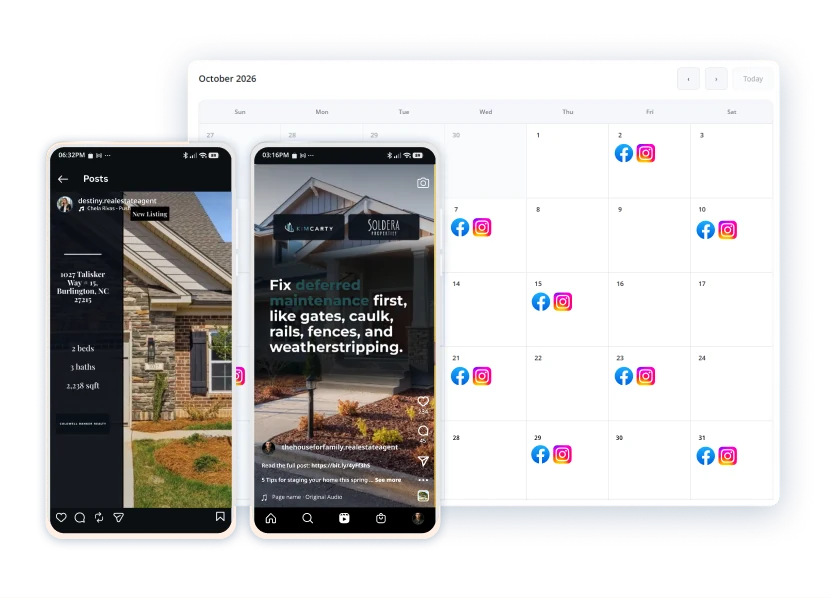
Social Automation
Your social media posting, on autopilot.
Turn your listings and blog articles into branded videos, automatically shared on Facebook and Instagram.
What is real estate social media marketing?
Social media marketing for real estate is a set of actions and strategies implemented on platforms such as Facebook and Instagram to promote properties and attract new buyers or sellers.
As social media becomes the key promotional channel among the younger generations, being present on it is no longer a choice. A weak socials game may not have ruined your chances with their parents, but it will with them.
Especially since Gen Z and Millennials, who use SM platforms the most, make up ~32% of all homebuyers.
The goal of social media in real estate is to:
→ promote the agency/brand,
→ build trust and authority,
→ promote new listings,
→ increase visibility and reach within target audiences,
→ generate leads,
→ educate buyers and sellers about the market,
→ support long-term brand recognition and loyalty.
Running a good social media strategy for real estate can include the most basic SM activities, such as consistent posting, preparing engaging content, responding to comments, and running targeted ads.
The key is to shift the weight of the marketing importance from traditional listings to platforms where you can actually connect and interact with real people.
5 benefits of running SM marketing for real estate
Running a successful social media strategy can yield great results for real estate agents—from bigger brand awareness to, well, higher sales. Below, you’ll find the top 5 benefits that will motivate you to brush up on that IG account as fast as possible.
1️⃣ Increased brand visibility and reach
You know everyone is using social media. But do you know what everyone really means?
Well, researchers Kepios did the math and found that in 2026, social media is being used by around 5.6 billion people worldwide—68.7% of the total global population.
Even though only a small percentage of them will ever come into contact with your channels, that still means that social media allows for unprecedented visibility.
SM platforms give you easy and instant access to massive audiences, which translates to exposure that goes far beyond what traditional local marketing channels could ever provide.
2️⃣ Strong lead generation & higher conversion rates
In 2023, a group of researchers from The Scientific Temper published a study titled “The Role of Social Media in Lead Generation.”
Based on the data collected from 215 respondents, the survey proved that SM channels play an important role in attracting and engaging potential buyers, leading to better business results.
A big part of why can be attributed to the direct interactions—like comments and DMs—that social media allow for. Because new clients can literally text with you as they would with any good friend, they move through the sales funnels much faster.
Social media is also very effective for promoting lead magnets, such as eBooks, consultations, or webinars.
3️⃣ Creative promotional tool
The thing with social media is that it allows for much more freedom than traditional media.
Don’t get me wrong, a well-written article can be very captivating while also providing essential information and fulfilling its promotional role—but it’s probably not going to capture attention as well as a 30-second dynamic and colorful reel.
Using platforms like Instagram gives you an opportunity to show some creativity and stand out from the crowd with very little effort and resources required.
It’s your chance to think outside the box and show a bit of character.
Social media users value authenticity and, even more so, relatability, so if there’s a space for trying out something less strict than e-books and case studies, it’s probably this!
4️⃣ Cost-effective & highly targeted marketing
When compared to traditional advertising, social media offers far superior targeting—and better ROI.
One key reason is that digital platforms typically offer lower cost-per-impression (CPM) and pay-per-click (CPC) models, which simply means that advertisers only pay when users actually engage with their content.
According to a study published via Taylor & Francis, social media advertising can cost as little as $2.50 CPM, which is lower than many traditional media channels.
In addition, research comparing marketing approaches shows that social media advertising is more affordable and accessible.
5️⃣ Real-time market intelligence tool
One easy-to-overlook benefit of using social media for real estate (and any other industry, really) is how much data it provides.
Think about it.
Social media platforms are equipped with tools like TikTok Business Center or Instagram Insights that track everything that’s happening on your channel.
Who viewed what, when, where, and for how long.
Who liked your video, who commented, and who sent it to a friend.
By monitoring those (and many other) metrics, you get a very comprehensive overview of who your audience is and what content they like the best. Not to mention, SM sites also reveal emerging lifestyle trends that influence purchasing decisions, which can help you adapt your content strategy and messaging ahead of time—and later see if it worked.
It’s like a continuous feedback loop that allows you to test, experiment, and get to know your audience.
How to do SM marketing for real estate?
Step 1: As is the case with many industries, marketing for the real estate business starts with knowing your persona.
Who is your communication directed at? Are you speaking to first-time buyers, investors, luxury clients?
Establishing that will be the first step towards building a good strategy, as each group obviously has different priorities, questions, and—perhaps most importantly—budget.
Your tone of voice and overall content need to reflect that.
💡Example: A more educational and reassuring tone will resonate with new buyers, while a data-driven, opportunity-focused approach may work better for investors.
Step 2: An effective SM strategy hinges on adapting the message to the right platform (more on that later). Some channels are more visual and prefer fast-paced content, while others favor professional insights or longer-form explanations.
Step 3: Don’t forget about a balance between promotion and value. Storytelling can take you further than blind sales pushing, and people today engage more with content that feels authentic or helpful—especially on social media.
💡Protip: Focus on creating familiarity rather than selling, so when someone is actually ready to buy, you are the first person they think of.
Step 4: Remember that consistency matters as much (or maybe even more than) as creativity.
A coherent, regularly published content is worth more than one super viral video among the sea of posts that nobody really views. This is true for social media and marketing in general, but it’s particularly relevant for real estate, where people hardly ever make spur-of-the-moment purchases.
12 Best Real Estate Social Media Marketing Strategies
A good social media strategy for real estate is actually a few strategies combined. The key is to “attack” the right platforms, the right audience, through the right content.
Wanna know how to do it?
Here’s our list of the top 12 social media tactics to implement in the real estate industry.
Strategy 1: Choose the right channels
If you want to establish an online presence as a real estate agent, you have to pick the right platform to post on—and then adapt the type of content to the user base.
In 2026, it’s probably best to focus on 3-4 key social media sites that target different audiences so you know that your content is visible across many demographics. Think: Instagram & TikTok for more fun/young-people-directed content and LinkedIn for establishing a more professional network.
Here’s a little guide that will help you nail marketing on the main social media platforms:
- Why use it: Massive reach among buyers + strongest lead generation
- Best for: Local targeting, ads, listing promotion
- Tone: Friendly, local, community-focused, informative
- Content: Property posts, local market updates, client testimonials, community posts, Facebook Groups, lead-gen ads
- Why use it: High engagement + visual storytelling
- Best for: Branding, visibility, showcasing properties
- Tone: Aspirational, lifestyle-driven, personal
- Content: Reels (property tours), carousel tips, behind-the-scenes, high-quality house photos, Stories
🎵 TikTok
- Why use it: Fastest organic growth + discovery (especially among a younger user base)
- Best for: Reach, awareness, attracting new audiences
- Tone: Casual, authentic, entertaining, fast-paced
- Content: Short videos, buyer tips, “day in the life,” trends, myth-busting real estate content
- Why use it: High-quality, referral-driven leads
- Best for: Investors, partnerships, professional credibility
- Tone: Professional, insightful, authoritative
- Content: Market insights, infographics, investment advice, success stories, industry opinions, networking posts,
🎬 YouTube
- Why use it: Long-form content builds trust + SEO visibility
- Best for: Authority, education, long-term lead generation
- Tone: Educational, in-depth, trustworthy
- Content: Full property tours, neighborhood guides, buyer/seller explainers, relocation videos
If you work in a specific area, join local Facebook Groups and pay attention to the questions people ask there. Answer them, share valuable insights, and be genuinely helpful. Over time, group members will see you as the local expert, and when they’re ready to move, your name will already be top of mind.
Strategy 2: Experiment with different content
Not all content performs the same—so experimenting is key.
First, let’s start with the type of publications you have in your social media arsenal. Depending on the platform, you can choose from:
📹 Short-form video
- Reels (Instagram)
- TikTok videos
- YouTube Shorts
🎬 Long-form video
- YouTube videos
- Facebook video posts
🔴 Live video
- Instagram Live
- Facebook Live
- TikTok Live
🖼️ Single image posts
- One photo (listing, lifestyle, graphic)
📚 Carousel posts
- Multiple images or slides in one post (swipe format)
📖 Stories
- Instagram Stories
- Facebook Stories
- Temporary, 24-hour content
✍️ Text-based posts
- LinkedIn posts
- Facebook text posts
- Twitter/X posts
- LinkedIn articles
💬 Interactive content
- Polls (Stories, LinkedIn)
- Q&A stickers
- Quizzes
Good visuals matter most when you’re showing a property. Invest in professional photography whenever you can. If that’s not possible, use a smartphone with a good camera and take multiple angles. For videos, a steady hand and good lighting go a long way.
The most successful channels strive to use all kinds of content with varying frequency, to keep their social media profiles interesting and reach as many audiences as possible.
But if you don’t have that much time and resources to experiment, relying on the key types of publications, like single images, single text posts, carousels, stories, and short videos, can really take you far.
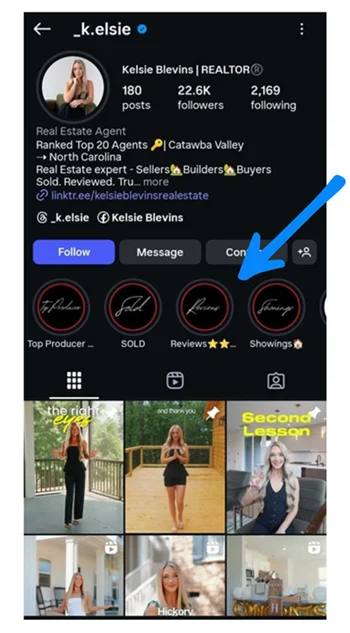
Instagram Stories keep your content fresh and visible at the top of feeds. They’re perfect for quick updates, behind-the-scenes footage, or short property previews. Stories also feel more personal and less polished than feed posts, which helps you connect on a personal level. Since they disappear after 24 hours, save the best ones as Highlights. Organize them into categories, like ‘Sold,’ ‘Reviews,’ or ‘Showings,’ like in Kelsie’s example here:
The video content format, especially, is having a major moment in social media and real estate in general. According to Show My Property, listings with videos get 403%(!) more inquiries than photo-only.
Use them in a social media content calendar to make sure your posts are consistent but dynamic enough that they don’t bore your followers.
💡 Tip #1: A lot of social media content can be repurposed—one property tour can become a reel, a carousel, and a short tip video.
💡 Tip #2: Explore apps for realtors, such as Canva or Calendly, to streamline content creation and posting.
💡 Tip #3: Don’t be afraid to show some unpolished content—authenticity is always valued on social media, especially the less official platforms, like Instagram.
Strategy 3: Use paid ads as a funnel
Social media is not just about creating content and posting fun pictures with half a dozen hashtags.
In fact, you could argue that “real” work begins where no one watches, which is where paid ads come into play.
According to the Digital 2026 Global Overview Report, digital advertising (dominated by social + search) now accounts for over 70% of total global ad spend.
It’s easy to see why, as paid ads help turn attention into real leads.
How does it work?
Instead of posting and waiting, you target specific people. For example, you can run a Facebook or Instagram ad for “Homes under $500K in Austin” aimed at first-time homebuyers. When they click on it, they go to a landing page where they can book a call or request details.
You can also use paid ads to retarget people who clicked but didn’t contact you. This turns simple views into real conversations and potential clients.
Regardless of the social media platform, make it easy for people to take the next step. Include a convincing call to action and a link back to your website so potential buyers can see full details, book a showing, or get in touch.
📝Read more about using Facebook Ads in real estate.
Strategy 4: Educate your audience
Real estate is one of the most common investments in the US.
The problem is… People actually don’t know that much about it. Mortgages, interest rates, escrow, earnest money, equity—this can quickly overwhelm someone who’s not really into the real estate industry.
That’s why an educational social media channel dedicated to this topic can be a goldmine.
Providing tips on how to choose the right property, explaining real estate terms or sharing market insights is a great way of showcasing your expertise AND gaining some loyal following.
After all, most people will want to own a house at some point in their lives, and they will need that information sooner or later.
How do you make this work?
💡Tip #1: The key is to keep your educational content simple, relevant, and consistent. Start by breaking down complex topics into short, easy-to-understand posts—think “What is escrow in 30 seconds?” or “3 things to know before getting a mortgage.” Avoid jargon, or explain it clearly when you use it.
💡Tip #2: Use formats that people enjoy and save, like carousel posts with checklists, short videos, or quick “Did you know?” clips. Focus on real questions your clients ask you every day—those are your best content ideas.
💡Tip #3: Make sure your educational content has a clear connection to real life. Instead of just defining “equity,” explain how it helps someone build wealth over time. When people understand the value behind the information, they’re more likely to trust you. And come back when they’re ready to buy or sell.
Live video tours and Q&A sessions are especially useful for educating your audience because they let you answer questions as they come up. Here, people can ask about what matters most to them, like the buying process, financing, or neighborhoods. It’s an opportunity to show off your expertise and build trust with potential clients.
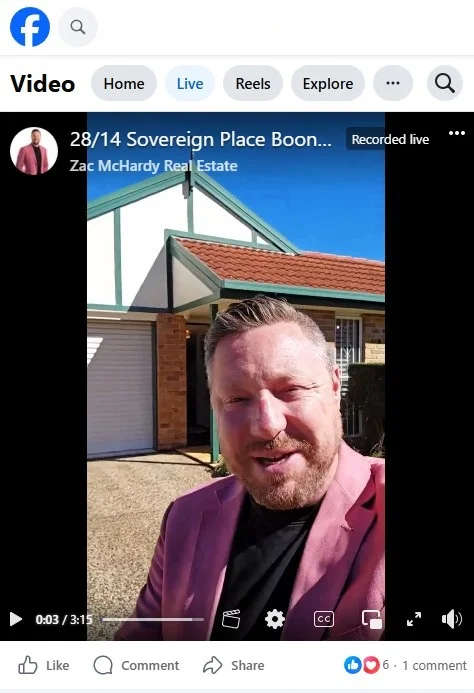
There’s one more advantage of live interactions. Speaking with your audience directly will give you ideas for future content based on real questions. For example, if several people ask about first-time buyer loans, you could write an article, record a short video, or create a carousel post.
Strategy 5: Build a personal brand
Social media was born out of realness.
The idea that you can use it to connect with actual people—not brands, not advertisers, not celebrities—who you would otherwise never meet.
Although it’s evolved way past that, at its core, social media is still about something raw and personal, something that you can’t really get through a faceless article on a blog.
That’s why, as a real estate professional, your social media presence should go beyond what you’re trying to sell. It should reflect who you are and remind users that there’s a person behind every property story.
How can you achieve that?
1️⃣ Start with a clear bio that explains what you do and who you help.
2️⃣ Consistently showcase your personality, your process, and your results.
3️⃣ Share client stories, “things no one sees” moments, and even small wins.
4️⃣ Show your face and speak on camera—people trust people, not just posts.
5️⃣ Pick a consistent tone and style (casual, professional, educational) and stick to it.
6️⃣ Share your opinions and insights on the market—this positions you as a go-to expert.
7️⃣ Engage with your audience—reply to comments, DMs, and questions to build real relations
The goal is to make people feel like they already know and trust you before they ever reach out. When your content feels human, not just promotional, you naturally stand out.
While engaging with the audience, remember about timely responses. If someone asks a question on your post or sends a message, they’re already interested. Make sure those leads don’t get lost in space. Aim to reply ASAP, even if it’s just to acknowledge the message and let them know you’ll follow up. Quick communication builds trust and shows you care.
In fact, responding within the first minute can boost conversions by 391% compared to slower replies (Why Lead Response Time Matters 2025 article by Vendasta).
Pay attention to word of mouth, as well. Around 65% of sellers find their agent through referrals or past clients (The Close, 2024 data). Testimonials let you bring that trust right into your online presence.
Ask buyers and sellers to leave a written testimonial and, if possible, include a photo of themselves or their new home. Video testimonials are even more effective, though a bit harder to get. In a short clip, viewers can hear tone, see emotion, and feel authenticity.
Share these testimonials on your social channels to show proof that you deliver results.
Strategy 6: Collaborate with other creators
You don’t have to do it all on your own.
Collaborating with other creators is one of the fastest ways to grow your reach and credibility. This could be a mortgage broker, interior designer, or even a local influencer. For example, you could co-create a video on “How to prepare your home for sale” or go live together to answer buyer questions.
Influencer marketing is still very powerful—studies show businesses earn around $5 for every $1 spent on influencers, and nearly 70% of consumers trust recommendations from online creators.
These collaborations don’t just bring views, but also bring trust. And in real estate, trust is what turns followers into clients.
Strategy 7: Use series-based content to maintain consistency
When it comes to social media, consistency beats virality.
Going viral is often a right place & right time—or rather right moment & right meme— situation, which is pointless to chase when you’re running an actual business. Especially when you’re not a social media specialist whose entire job is studying internet trends.
And you don’t need to be.
What you, as a real estate agent, can do instead is focus on being consistent and recognizable.
Here’s how you can do it:
- Build recurring formats, such as: “House of the week,” “Real estate Monday myth,” or ” Luxury Friday tours.”
- Use the same structure each time so people recognize it
- Keep a consistent visual identity (same fonts, colors, cover style, thumbnails)
- Assign fixed posting days (e.g., every Monday = tips, every Friday = listings)
- Use cliffhanger-style content (“Part 2 tomorrow…” / “Wait until you see the kitchen…”)
- Turn one idea into multiple episodes (e.g., “Top neighborhoods” → one post per area)
Little series like this will kind of “keep you in check,” and help you make sure that you’re really consistent with your posting.
Check which posts lead to conversations and inquiries. Analytics show you what content attracts attention and what falls flat. Use that data to refine your social media marketing strategy.
Most social media platforms provide built-in insights, or you can use marketing tools to view everything in one dashboard.
Here are the metrics worth tracking and why:
✔️ Reach – how many people saw your post.
✔️ Engagement rate – likes, comments, shares, saves.
✔️ Click-throughs – how many people clicked links in your posts.
✔️ Follower growth – whether your audience is expanding.
✔️ Leads or inquiries – the ultimate sign your content is working.
If a certain type of post performs well, keep creating content just like it. If something consistently underperforms, adjust or drop it.
Strategy 8: Embrace new tech to showcase properties
Tech is raising the bar, and more clients now expect it. In top real estate agents’ feeds, you’ll see drone shots highlighting outdoor spaces. These often look incredible, especially if there’s something special to show off.
3D tours are another powerful form of content. They let people explore a property at their own pace, from any device, which is especially helpful for out-of-town buyers. Hosting virtual open house events on social media is a great way to make these tours more interactive.
Virtual staging is also growing in popularity. But how about a staged garden? Take a plain backyard and show buyers what it could look like with a pool, patio, or landscaping upgrades.
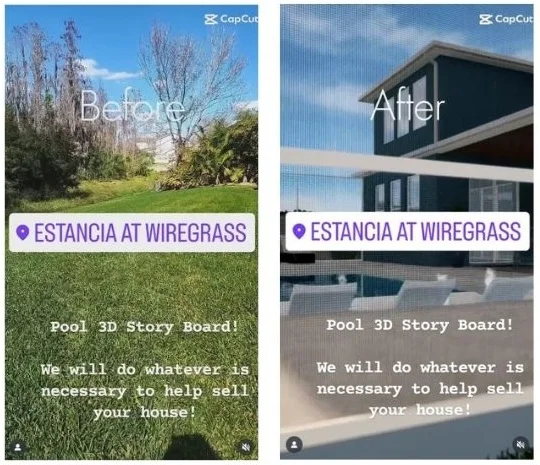
As in the example above, a simple ‘Before and After’ Reel can turn empty grass into a lifestyle buyers get excited about.
Strategy 9: Share user-generated content (UGC)
User-generated content feels 100% authentic because it comes straight from your clients. When a buyer posts a photo of their new home or a seller shares their moving story, it’s marketing that doesn’t look like marketing.
Encourage clients to tag you when they share milestones. With permission, you can repost their content on your own account. User-generated content highlights client satisfaction and shows genuine stories that your future buyers and sellers can connect to.
UGC is also a great way to expand your reach. Every time a client tags you, their network sees your name, introducing you to potential leads who might not have found you otherwise.
Strategy 10: Try AI tools to save time on real estate content
Creating content can feel like a full-time job, but AI makes it easier. The right tools can help you stay consistent while saving hours each week. Here are a few worth trying:
➡️ Jasper – writes captions, blog posts, and video ideas in your brand voice.
➡️ Lately – builds and organizes a content calendar from long-form content.
➡️ Flick – suggests hashtags based on your audience and niche.
➡️ Canva – creates graphics, generates short videos from text prompts, resizes content for different platforms, and adds subtitles to video clips.
➡️ Veed – auto-generate video captions and subtitles.
➡️ Hootsuite – track analytics, suggest best posting times, and manage multiple platforms in one place.
If you’re using a Placester website, you’ll also find AI tools built into the platform. They can speed up content creation while keeping your branding consistent across channels.
Strategy 11: Use a real estate social media scheduler
How often should you post? There’s no magic number for real estate agents. The useful schedule is one you can keep up when showings, calls, and closings fill your week. If you’re working on just one or two social media platforms, use these 2026 benchmarks as a starting point:
| Platform | Posting frequency to test | Times to test, in your audience’s local time |
|---|---|---|
| Up to 1 post a day | Weekday mornings, roughly 8 a.m.–noon | |
| 3–5 feed posts or Reels a week | Around 9 a.m. or 6 p.m. on weekdays | |
| 2–5 posts a week | Wednesday through Friday afternoons, roughly 3–6 p.m. | |
| TikTok | 2–5 posts a week | Evenings, roughly 6–11 p.m.; test weekend mornings too |
| YouTube | About 1 longer video and 1–3 Shorts a week | Sunday–Tuesday evenings for longer videos; Friday–Saturday afternoons for Shorts |
| X | Only if you can sustain frequent posting and replies; the general benchmark is 3–4 posts a day | Weekday mornings, roughly 8–11 a.m. |
| Start with at least 1 fresh Pin a week | Plan around seasonal searches and check your own analytics for timing |
The frequencies come from Buffer’s 2026 guide, and the time windows reflect its analysis of more than 52 million posts. They’re broad benchmarks, so test them against your own results. If agents who post three times a week on Instagram consistently get more showing inquiries than they do from daily Facebook posts, that’s a reason for them to adjust the calendar.
A real estate social media post needs a reason to exist beyond filling a Tuesday slot. A new listing calls for a timely post, while a neighborhood guide can stay useful for months. Your content calendars should outline the topic, format, channel, publishing date, and next step for the reader. Leave room for seasonal content, such as spring buying questions or a local fall events guide. Social media templates can speed up the design, but give every post idea a way to add value for someone interested in real estate services.
If you’re publishing across several channels, a scheduler makes the plan easier to execute:
| Tool | What it helps you do |
|---|---|
| Meta Business Suite | Plan Facebook and Instagram posts, Stories, and Reels in one calendar. |
| Buffer | Queue posts across multiple networks and tailor the caption or posting time for each. |
| Later | Arrange visual content in a calendar and schedule it across platforms. |
| Metricool | Schedule posts and review performance from one dashboard. |
| Hootsuite | Plan posts and use account data to find times when your audience is more likely to respond. |
You can execute an effective social media marketing campaign without adding another tool. If you prefer to plan by hand and only publish a few times a week, download the calendar template below and fill in your next month of posts.
Strategy 12: Leverage social media automation
Scheduling saves you from hitting “publish” every day. Social media automation can take on some of the work before that point, too: turning content you’ve already created into posts and sharing it when it’s relevant.
That matters when your best material is sitting on your website. You’ve written the listing description and published a guide to the neighborhood. Why rebuild both from scratch before you can share images and posts with your followers?
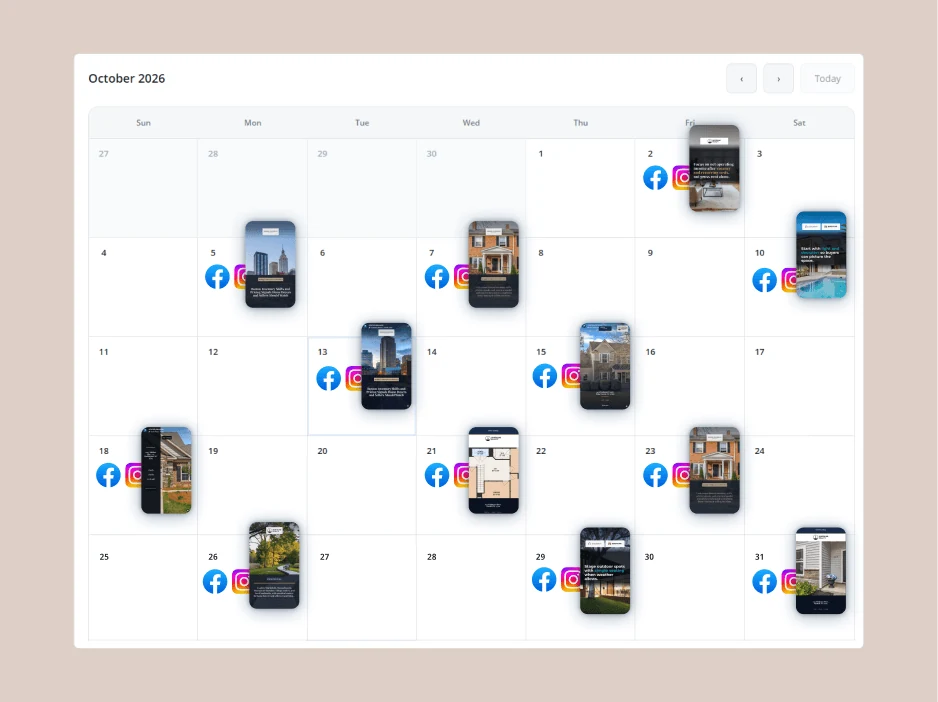
Placester Social Automation connects to your Placester website and creates branded videos from your listings and blog articles. It can publish them to a connected Facebook Business Page and Instagram Business or Creator account.
For properties, you can choose which types to promote and filter by details such as price or number of bedrooms. The feature covers new listings, recent sales, and follow-up posts for homes still on the market. Blog videos link back to the full article, giving interested viewers somewhere useful to go next.
You still have control over how it looks. Social Automation uses the colors, fonts, and logos from your Placester Business Profile, and you can preview video styles before choosing one. Its calendar shows automated posts alongside content you add yourself, so you can see what’s going out and when. You can also publish additional photos or Reels from that calendar.
Want to leverage the potential of social media marketing while spending less time making each post? This gives your listings and articles a route into people’s feeds. It also leaves you time to answer comments and do the personal work involved in generating new clients on social media. You don’t need an entire real estate agency to fully embrace this lucrative marketing channel. Your website can supply much of the material you need to keep posting.
10 common social media mistakes to avoid
If you’re making these mistakes, it’s time to stop. Avoiding them will save you time and bring better results from social media.
❌ Posting only listings, no value content
People want more than endless sales posts. Share a mix of tips, stories, and local insights to keep your feed engaging.
❌ Ignoring comments and messages
Leads can disappear quickly if you don’t respond. Prompt replies show professionalism and help build trust with potential clients.
❌ Using poor-quality images
Blurry or dark photos can make even the best property look unattractive. Invest in quality visuals to present listings properly.
❌ Overposting or ghosting for months
Posting too often overwhelms followers, while long gaps make you forgettable. A steady, manageable rhythm works best.
❌ Forgetting to include CTAs
People may enjoy your posts, but never reach out. Always guide them to call, click, or message.
❌ Buying fake followers
It may look impressive at first, but it damages credibility. Focus on real growth that brings genuine clients.
❌ Being too salesy
Constant hard-selling makes people tune out. Balance promotional posts with value-driven content that educates and builds trust.
❌ Not tailoring content per platform
Different platforms serve different audiences. Adjust your format and tone for the best results on each channel.
❌ Skipping analytics
Without checking performance, you’re guessing. Reviewing insights regularly helps you refine your content strategy and post smarter.
❌ Not keeping up with platform updates
Social media platforms change fast. They introduce new features, tweak algorithms, and update rules that can affect visibility. Staying updated helps you adapt and stay ahead.
Conclusions
A successful social media strategy for real estate includes a mix of:
→ addressing the right platforms
→ adjusting the message and content to the right user base
→ consistency
→ building a personal brand
→ creativity/testing out new things.
By blending those elements into your marketing efforts, you can create a well-oiled machine to educate and attract new clients.
💡Looking for more tips to turn social traffic into leads?
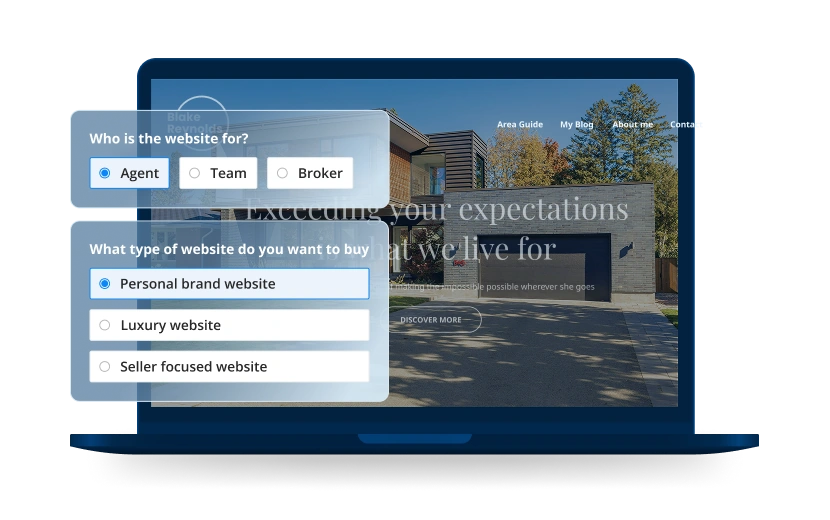
Placester can help! Build a real estate website with lead-capture pages using its AI Website Builder, then use the Social Automation add-on to turn your listings and blog articles into branded videos for Facebook and Instagram.
AI Websites for Real Estate
Get a custom, ready-to-edit website
in less than 4 minutes.
FAQ
Which social media strategy for real estate is the most effective?
The most effective strategy is building a personal brand through consistent, value-driven content (especially short-form video) combined with a simple lead funnel that captures and nurtures leads off-platform.
What are some trending real estate social media ideas?
Short-form videos with storytelling (e.g., “what this budget gets you”), hyperlocal lifestyle content, myth-busting posts, and behind-the-scenes deal breakdowns are currently driving the most engagement.
Where do I find the best real estate SM marketing templates?
You can find high-quality templates on platforms like Canva, Envato Elements, and Creative Market, or by purchasing niche packs from real estate-focused creators.
What is the most effective SM marketing for real estate brokers?
The most effective approach is combining authority-building content (market insights, data breakdowns) with social proof and targeted ads to attract both potential clients and agents.
What is the best commercial real estate social media strategy?
Social media marketing for commercial real estate should include positioning yourself as a market expert through data-driven insights, case studies, and LinkedIn-focused content that speaks directly to investors and business owners rather than general audiences.
How to get real estate leads on social media?
To get real estate leads on social media, you should share valuable, engaging content regularly. Following social media tips for real estate agents helps you stay ahead of the curve. Quick replies to comments and DMs also turn interest into real conversations.
What is the 70/20/10 rule for social media?
The 70/20/10 rule for social media means 70% of posts give value, 20% are shared from others, and 10% are promotional.
Published on
(Last updated on
)