(800) 728 8391



Quick summary:
- Only 12% of Realtors rate their personal or business website as a top-quality lead generation source, but the agents who do are the ones treating it as an owned asset, not a quick lead-gen fix.
- 69% of consumers say a website is essential for a local business to be seen as credible, and businesses with one are rated 41% more trustworthy than those without it.
- A website is one of the few marketing assets that survives a brokerage change fully intact: the domain, the content, and the search visibility all move with you.
- Zillow Premier Agent leads run $181 on average, and up to $400+ in competitive metros, and they’re shared with other agents. Leads through your own site aren’t split with anyone.
- Skipping a website makes sense in a few specific situations, like a brand-new agent with no budget yet, but it’s rarely the right long-term call.
Zillow gets the traffic. Your brokerage already has a page with your headshot on it. So why spend money and time building a real estate agent website of your own?
It’s a fair question, and the honest answer is that it depends on what you’re trying to build. A website isn’t a magic lead generation machine, and for some agents it isn’t the top priority in year one.
But for most working agents, a personal website is one of a few assets in your entire business that you actually own outright.
This guide covers what a real estate website actually is (there’s more than one kind), 11 concrete reasons to build one, and a handful of situations where skipping it is reasonable.
What is a real estate agent website, actually?
Ask ten agents whether they have a website, and you’ll get ten different answers about what that actually means. One person is picturing a full personal brand site with a blog and an IDX search bar. Another is thinking of the single page their brokerage spun up automatically when they got licensed. A third means a one-off landing page they built for a listing that sold three months ago. All three are technically correct, and none of them are talking about the same thing.
That mismatch matters more than it sounds like it should. Most of the debate around whether agents “need” a website comes from comparing the wrong types against each other: someone points to a free brokerage page as proof a personal site is unnecessary, or budgets for a full IDX build when a single landing page would have covered what they actually needed.
The tools solve different problems, cost wildly different amounts, and belong to different owners.
Every agent needs some way for buyers and sellers to find them online, even if it isn’t always a full custom build. Before getting into the 11 reasons to build one, it’s worth sorting out what “a real estate website” can mean. Here are the four types you’re most likely to run into:
- A personal brand website,
- An IDX/listing search website,
- A single property or a landing page,
- A brokerage-provided template page.
Let’s dive a little deeper into each type. On top of learning what each page is, you’ll also see a real-life example.
Personal brand website
A personal brand website is built around you as an agent rather than around any single listing. It typically includes your bio, an active listings feed, client testimonials, the neighborhoods or service areas you cover, and usually a blog for local market content.
This is the site most people picture when they hear “real estate agent website,” and it’s the one that does the heaviest lifting for the reasons covered later in this guide.
Because it’s tied to your name and not to a brokerage or a specific transaction, a personal brand site is also the only type here that keeps compounding in value the longer you run it.
Every blog post, testimonial, and past sale you add makes the site a more complete picture of who you are and how you work, which is exactly the kind of asset a rented profile can never become.
Most agents start here, then layer the other three types on top as needed: an IDX search feature added to the same domain, single-property pages spun up per listing, and a brokerage template kept mostly as a backup or compliance requirement.
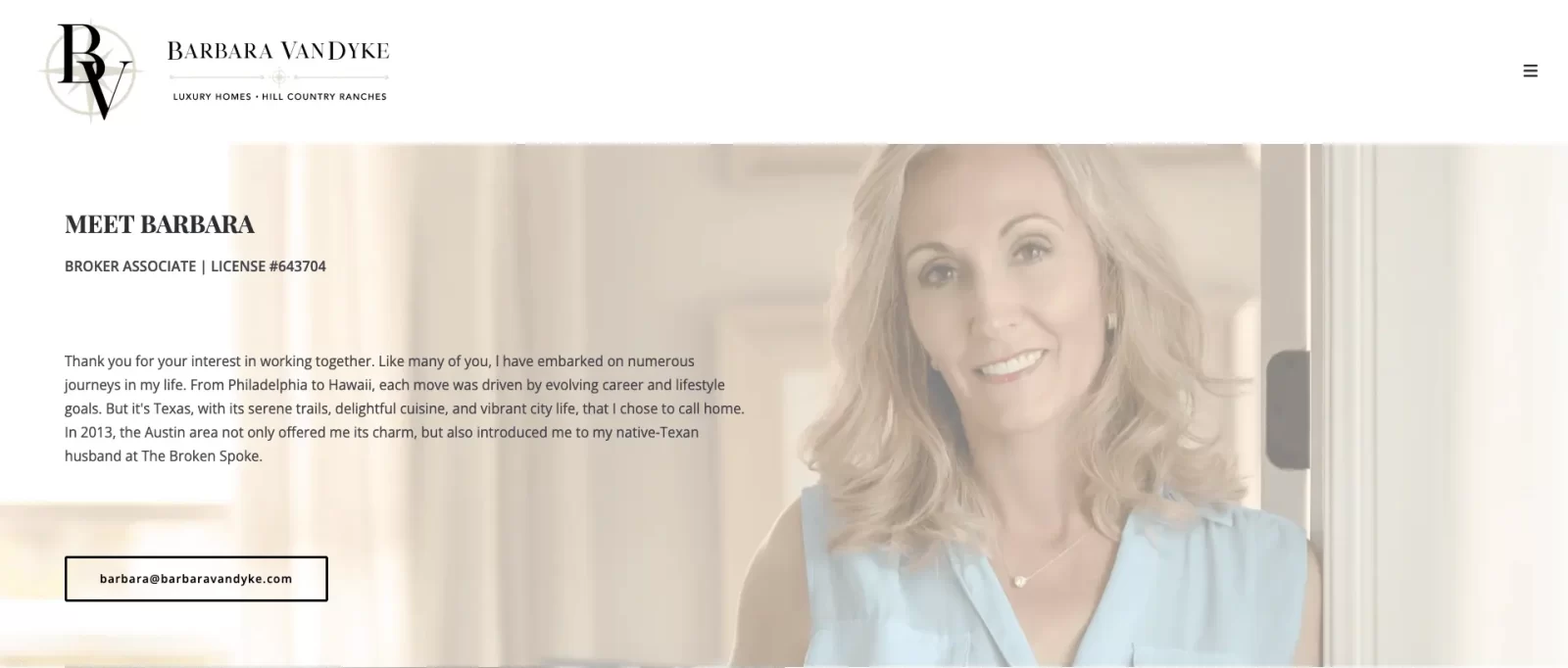
Here’s an example of a personal brand website by Barbara Van Dyke:
IDX/listing search website
An IDX (Internet Data Exchange) website pulls live MLS data directly into your own site, so a visitor can search active listings, filter by price or neighborhood, and view photos without ever leaving your domain. It’s effectively the same search experience as Zillow or Realtor.com, just running under your own brand instead of theirs.
The technical setup usually comes down to a paid IDX feed from your local MLS plumbed into your website platform, at which point the search functionality is mostly maintenance-free.
What you gain in exchange is control over what a buyer sees next: instead of your listing sitting next to five competitors’ ads, a lead who searches on your site stays inside an experience you designed, with your contact form as the only next step.
IDX only pays off if people actually find the search page, so it works best layered onto a personal brand site with its own traffic and search visibility, not as a standalone project. On its own, an IDX feed with no audience behind it is just an expensive widget.
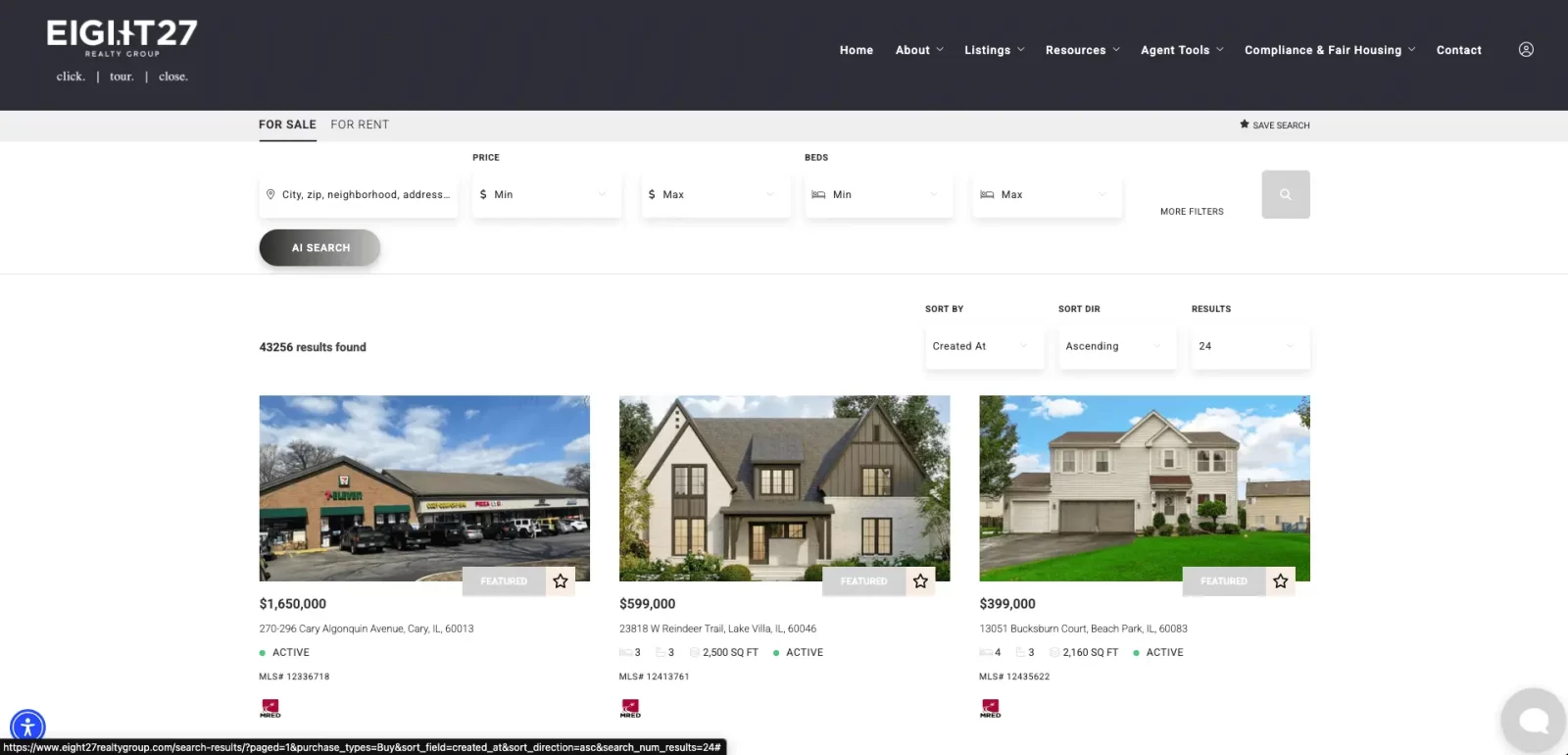
Here’s an example of an IDX page from Eight27 Realty Group:
Single-property or landing page site
A single-property site is a one-off page built for exactly one listing: its own photos, its own headline, its own contact form, and nothing else competing for attention. These are common for luxury properties, new construction, and open houses, where the goal is to make one specific address feel like the only thing that matters.
Because the landing page has a single purpose, it converts differently than a full agent website. There’s no navigation menu pulling visitors toward other listings, no blog post to read first, no distraction, just the property and a clear way to ask about it. That focus is also the limitation: a single-property page has no long-term value once the home sells, and it does nothing to build your personal brand or search visibility over time.
Agents who use these well treat them as a temporary, listing-specific tool that sits alongside a permanent personal brand site, not a replacement for one.
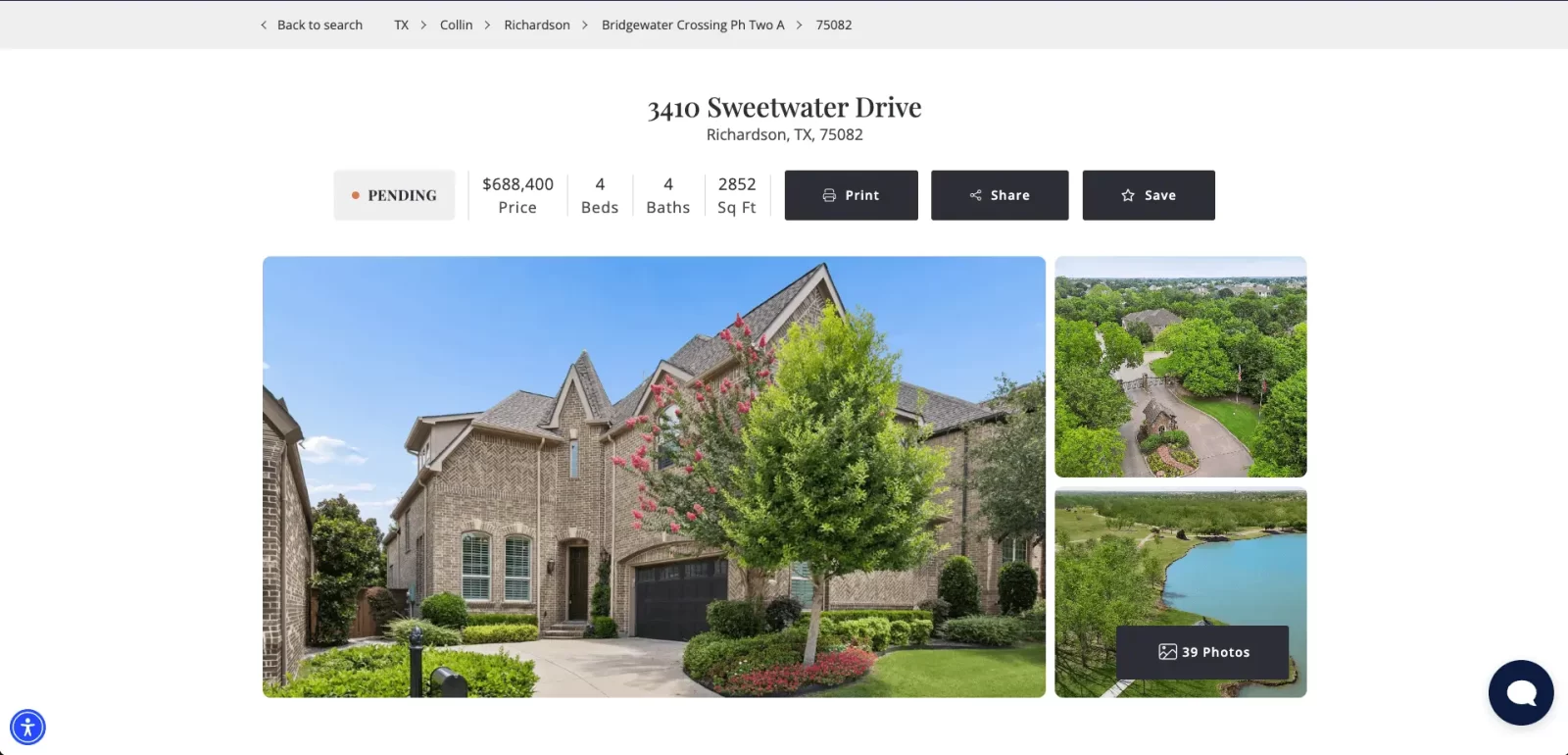
Here’s an example of a listing page for a single property for sale from Cynthia Lopez’s website:
Brokerage-provided template site
Most brokerages give every agent a page on the company website: a template with your headshot, contact info, and current listings dropped into a layout every other agent at the firm shares. It’s usually free, requires no setup on your part, and is often the very first web presence a new agent has.
The tradeoff is that you don’t own any of it. The design, the URL, and the traffic all belong to the brokerage, not to you, and the page is typically deactivated the moment you switch firms or leave the industry. It also can’t be customized much beyond the basics the template allows, so there’s no real way to differentiate yourself from the agent listed right next to you.
A brokerage template page is a reasonable starting point, and it’s worth keeping active even after you build your own site since it costs nothing and adds one more place buyers might find you. It’s just not a substitute for a website you actually control.
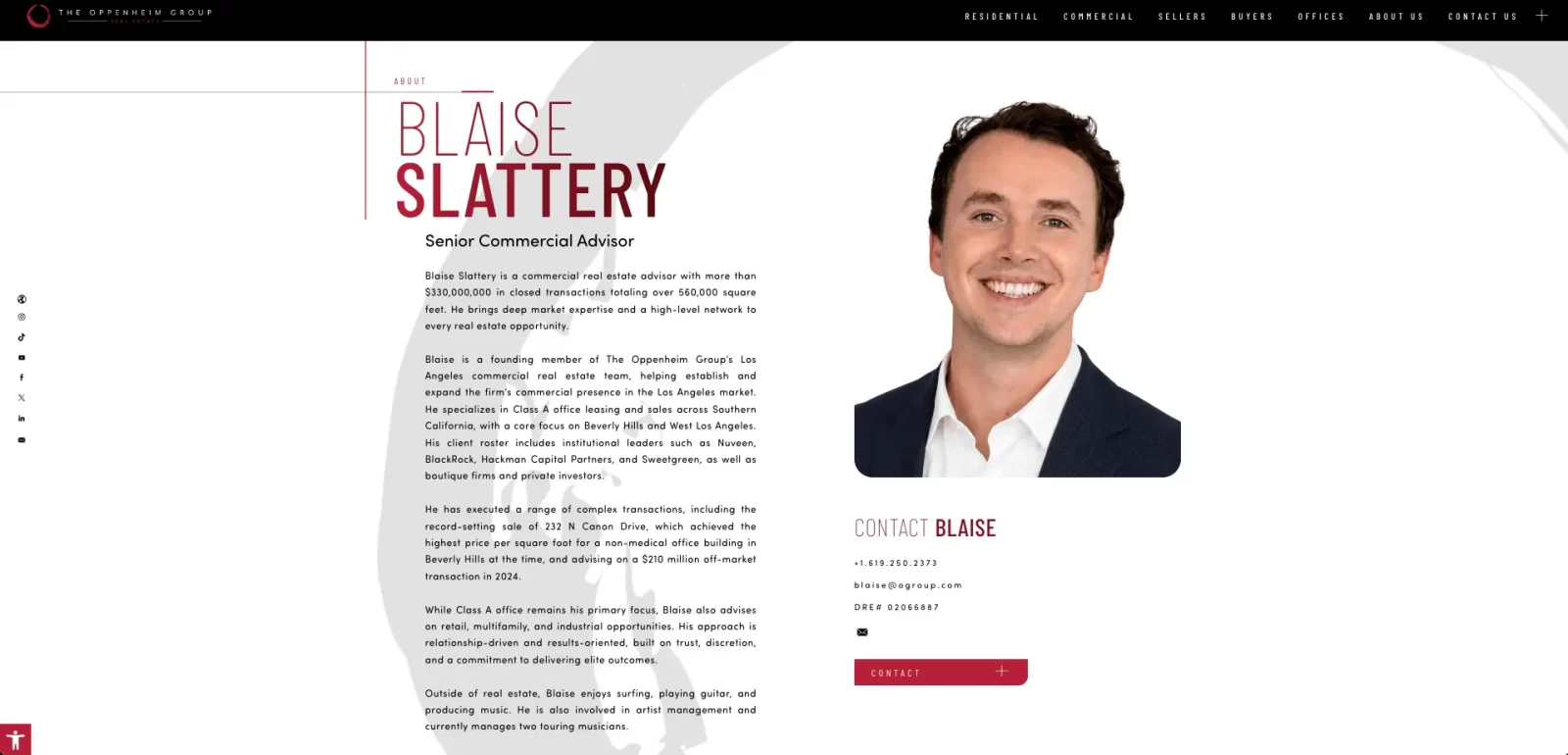
Below is an example of a brokerage template page for a commercial advisor from The Oppenheim Group:
Most of the 11 reasons below assume you’re weighing a real personal website, ideally with IDX search built in, against relying only on a brokerage-shared page or a rented profile on Zillow or Realtor.com. That’s the decision most agents are actually facing.
Should you build a website as a real estate agent? 11 reasons the answer is yes
Ask any successful real estate agent how they generate consistent business, and eventually the answer comes back to something they own outright. Here are the 11 reasons that hold up once you get past the generic “you need an online presence” advice.
1. You actually own it
A Zillow profile, a Realtor.com listing, a Homes.com profile, a Facebook business page: none of it belongs to you. The platform sets the rules, changes the algorithm, and can bury or suspend your profile whenever it wants.
A website tied to your own domain name is the one marketing asset in your business that’s fully under your control, and it can’t be de-ranked or reclaimed by someone else’s policy update.
2. Referrals still check you out online first
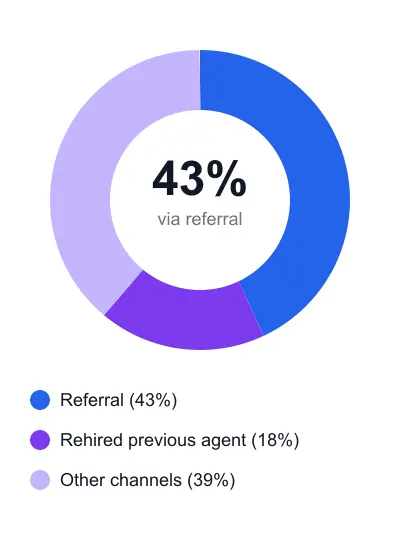
Referrals remain the biggest source of business in real estate: according to the National Association of REALTORS® (NAR), 43% of buyers found their agent through a personal referral, and another 18% rehired an agent they’d worked with before.
But a referral isn’t a closed deal. Most people still search your name before calling, and if what comes up is a bare brokerage bio or nothing at all, you’ve made the easiest lead in real estate harder to convert.
3. It’s the difference between credible and invisible
According to DreamHost’s survey, 69% of consumers say having a website is essential to a local business being seen as credible, and businesses with a website are rated 41% more trustworthy than those without one.
For a real estate professional, whose business is built entirely on trust and where clients hand you their life savings’ worth of a transaction, that gap matters more than almost any other marketing decision you’ll make.
4. Your leads aren’t shared with five other agents
Buying real estate leads from a portal is one of the most common ways agents spend their marketing budget, and Zillow is the most visible example. Per Clever Real Estate, Zillow Premier Agent leads cost an average of $181, climbing past $223 in competitive metro ZIP codes and as high as $400 or more in the busiest markets, and they’re distributed as “share of voice,” meaning the same buyer inquiry can land with several agents at once.
A lead through a contact form on your own site isn’t split with anyone, and every click that gets you there is working for you alone. It’s yours before you’ve spent a dollar chasing it.
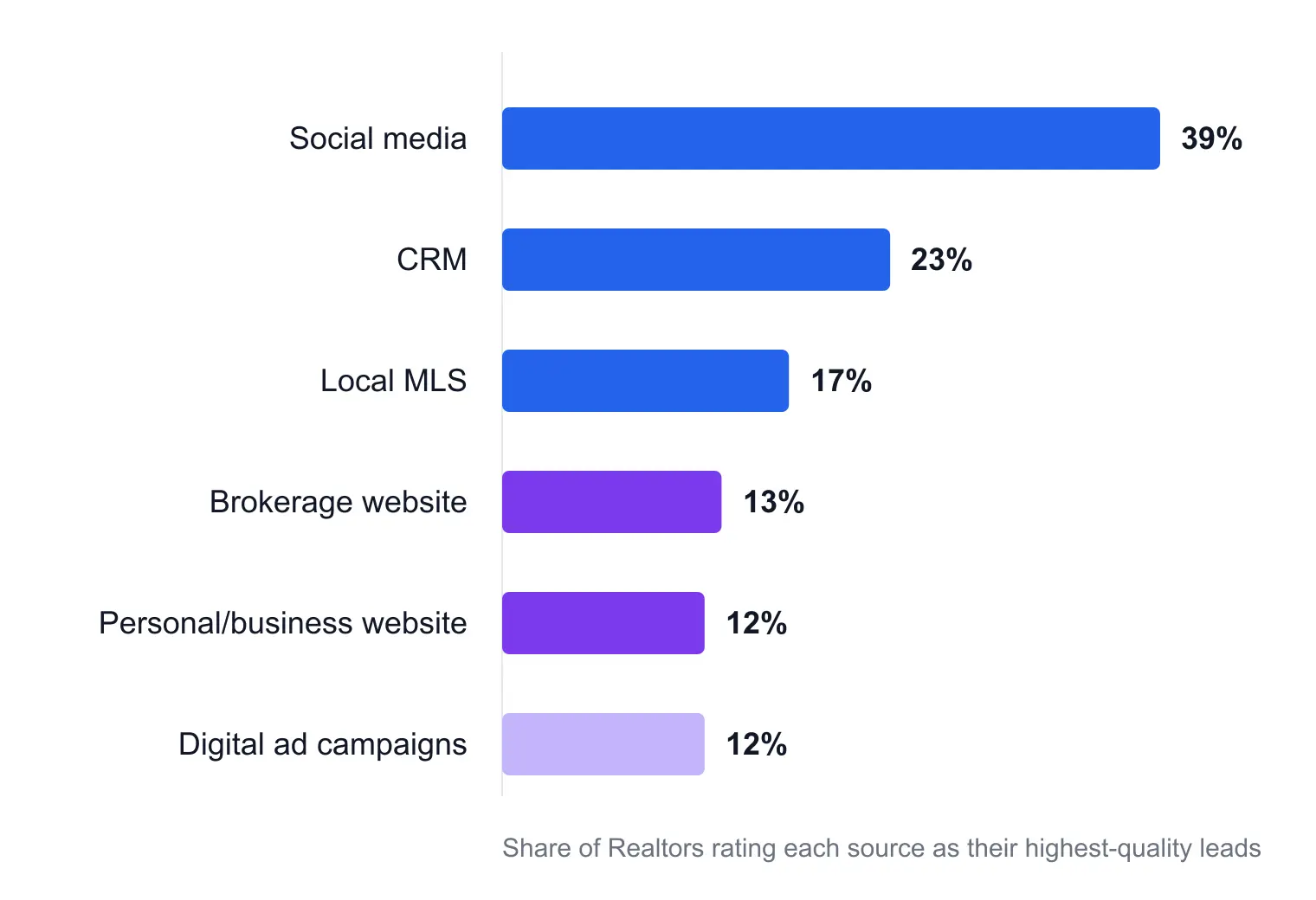
Worth noting: personal and business websites rank a modest 12% here, tied with paid digital ads. That’s not an argument against having one. It’s a sign that a website only pays off once you’re actually using it to capture and follow up on leads, not just parking it as a digital business card.
5. You can actually track what’s working
Ever wonder which listing or blog post actually convinces someone to call you? On Zillow, there’s no way to know. On your own site, Google Analytics shows exactly which pages get traffic, where visitors come from, and how long they stick around before reaching out. That’s data you can use to double down on what’s already working instead of guessing.
Say a neighborhood guide for one specific zip code quietly pulls three times the traffic of everything else on your site combined. Without analytics, you’d never notice, and you’d keep spending equal time on every area you cover. With it, you know exactly where to write the next guide, which listing photos to lead with, and whether a seasonal trend is worth doubling down on instead of guessing where your marketing dollars go.
6. It’s a home base for everything else you’re already doing
Social media posts, listing flyers, email newsletters, print ads: they all need somewhere to send people. Without a website, every one of those channels dead-ends at a rented profile you don’t control. With one, they all point back to a hub that builds your brand a little more with every visit, instead of quietly making someone else’s platform more valuable.
Think of your website as one central hub for your brand, not just another channel.
This is also where consistency starts to compound. Write your bio, your service areas, and your value proposition once on your own site, then reuse that same “master copy” across multiple channels, Zillow, Instagram, mailers, and business cards, instead of writing it fresh every single time.
Buyers and sellers who bounce between your Facebook page, your Zillow profile, and a QR code on a mailer should land on the same story every time, not three different versions of who you are.
7. It doesn’t disappear when you switch brokerages
Change firms, and a brokerage-provided page usually disappears along with your old login, taking whatever traffic and search visibility it built with it. A website on your own domain moves with you. You keep the content, the backlinks, and the rankings you’ve already earned instead of starting over at the new office.
This shows up in an easy way to spot, too: an outdated Zillow profile still listing a brokerage you left two years ago, or an Instagram bio that never got updated after you moved firms.
It looks like you’re not paying attention to your own business, and it makes it harder for anyone doing a quick search to trust that the person they’re looking at is still active and reachable. A website you own sidesteps that problem entirely since there’s only one place to update instead of four.
8. Buyers are searching before they ever call an agent
NAR’s 2025 Profile of Home Buyers and Sellers says 46% of buyers start their home search online, more than double the 20% who begin by contacting an agent directly. If your only online footprint is a shared brokerage roster page, you’re invisible during the exact window when most buyers are forming their first impression of who they want to work with.
That window matters because in today’s market, it’s largely a solo research phase. Buyers are comparing agents, skimming listings, and forming opinions well before they’re ready to talk to anyone, which means the agents who show up during local real estate searches, with real content and a real search experience, get first crack at the relationship.
Many agents only exist online once someone thinks to call them, which puts them at a real disadvantage: they’re competing for attention a lot later in the process, usually against someone who was already there.
9. IDX search keeps buyers on your site instead of Zillow’s
A website with IDX integration lets visitors search live MLS listings without leaving your page. Every minute they spend browsing homes on your site is a minute they’re not spending on a competitor’s Zillow profile, and it gives them a legitimate reason to keep coming back before they’re even ready to talk.
IDX search also quietly does double duty for lead capture and search visibility. Most IDX setups let visitors save searches or favorite listings in exchange for an email address, which is one of the simplest ways to generate leads directly from your own traffic instead of buying them from someone else.
And because IDX pages create real content for individual neighborhoods and price points, they give search engines more of your own pages to show up in search results, or SERPs, for terms like “homes for sale in [neighborhood]” instead of sending that traffic straight to Zillow.
10. It lets you show, not just tell
Testimonials, past sales, video walkthroughs, market reports for your specific farm area: none of that fits neatly into a Zillow bio or a two-line brokerage blurb.
A website gives you room to actually demonstrate expertise in a specific neighborhood or price point, turning your site into a resource people come back to instead of a one-time brochure, which is exactly the kind of proof buyers and sellers say moves them from considering to calling.
11. SEO compounds. Paid leads don’t
Search engine optimization, or SEO, is the slow-compounding version of paid leads: a blog post or neighborhood guide you publish today can keep bringing in organic search traffic for years with no extra spend. Compare that to a Zillow lead: the moment you stop paying, the leads stop coming.
A similar pattern shows up outside residential real estate, too. In a multifamily leasing study across 261 properties, SEO-driven leases cost $87.55 each versus $1,005.45 through paid internet listing services, a sign of how differently owned search traffic and rented ad placements scale over time.
The channels aren’t identical, but the underlying economics- invest once and keep earning versus pay every single time- apply just as directly to an agent’s own website.
When can real estate agents skip a website?
A website isn’t a requirement to sell real estate, and pretending otherwise doesn’t help anyone. It’s still possible to close deals before you launch one, especially early on. Here’s when waiting is genuinely reasonable.
1. You’re brand-new and working off someone else’s book
If you’re in your first 90 days and every lead is coming through a team lead, a mentor, or your brokerage’s referral pool, a website isn’t the highest-priority purchase yet. Get a few closings under your belt first, then reinvest in an asset of your own once there’s an actual pipeline to point it at.
2. Your business runs entirely through a team or top producer
Buyer’s agents on a team where 100% of leads flow through the team leader’s site and brand often don’t need a separate one of their own, at least not while that arrangement holds. The tradeoff is real, though: nothing built in that role travels with you if you ever go independent.
3. You’re a referral-only agent who isn’t trying to grow
A small number of veteran agents work exclusively off a saturated referral network in one tight-knit market and have no interest in expanding. If that’s genuinely your situation and not just a reason to avoid the work, a minimal or nonexistent website might not cost you much. For nearly everyone else building toward more volume, it’s a gap worth closing sooner rather than later.
So, do real estate agents really need a website?
The short version: a real estate agent needs a website more often than not. Not because it magically replaces referrals or outbids Zillow’s ad budget, but because it’s the one place where your brand, your content, and your traffic actually belong to you instead of being rented from a platform that can change the rules whenever it wants. It’s the foundation that helps you attract buyers and sellers instead of waiting for them to find you by accident.
If you’re brand-new or leaning entirely on a team’s pipeline, waiting is fine. For everyone else building an independent real estate business, a website isn’t a nice-to-have add-on. It’s the foundation the rest of your marketing sits on.
Want to learn more about why you need a website in real estate? Check out the conversation between Casey Popkins, Placester’s VP of Growth, and Tristan Ahumada, a Fortune 500 consultant and international speaker. Aside from the reasons mentioned above, they discuss the importance of technical visibility for AI and traditional search engines.
Build a beautiful website with Placester
Now that you know how important it is to have a website in real estate, it’s all about making one. But how do you even go about doing that? You’re not a developer or a designer. And you certainly don’t feel like waiting weeks or spending thousands of dollars on hiring someone to build it for you.
Luckily, you don’t have to go through all that hassle to have a website that looks good and showcases the most important information about you and your listings.
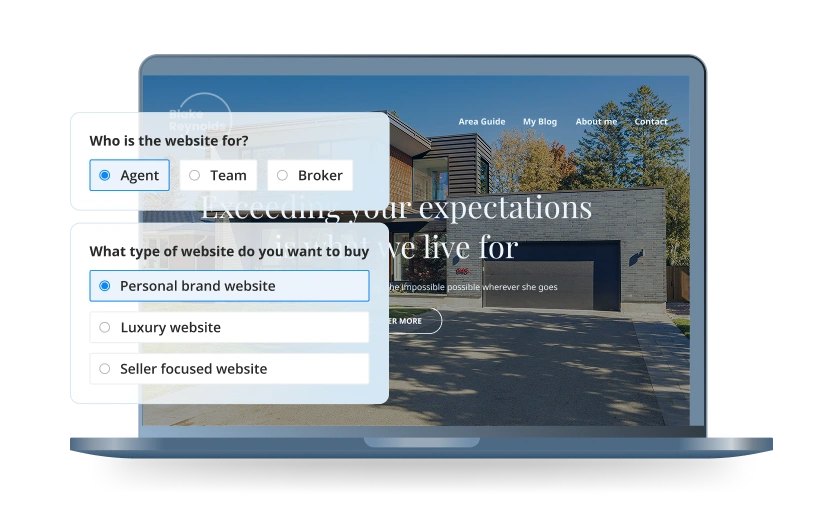
With Placester, you can create a fully personalized website in just a few minutes with no coding at all.
Our AI website builder will create a comprehensive website that contains everything you need for a strong online presence:
- About you page,
- A hero video,
- Agent profiles,
- Testimonials directly from Zillow and Google,
- Your active listings,
- Area and market guides.
Join over 25,000 agents and teams across 600+ MLSs and see for yourself how easy it can be to have a website that’s uniquely yours.
AI Websites for Real Estate
Get a custom, ready-to-edit website
in less than 4 minutes.
Frequently asked questions
What are the benefits of custom real estate website design?
Custom real estate website design offers three main benefits over a generic template: distinct, professionally designed branding, better search and AI visibility, and no forced choice between the two.
– Distinct branding: your site won’t look like the agent two towns over who bought the same template, since your photography, bio, and messaging are built around who you actually are and where you work instead of recycled stock photos and a canned bio.
– Better structure for search and AI: a site built around your actual market, rather than a one-size-fits-all layout, organizes content in a way that’s easier for both visitors and search or AI systems to parse. A templated page with no tailored structure behind it is more likely to get skipped by both.
– No forced tradeoff: custom doesn’t have to mean a fully bespoke, $6,000+ build. Platforms that personalize your bio, branding, and content for you, rather than dropping you into a blank template, get most of the same benefits without the custom-build price tag.
Do I need to know how to code to run my own website?
No. Most real estate website platforms, such as Placester, kvCORE, or Luxury Presence, handle design, hosting, and basic SEO setup for you. Day-to-day involvement usually comes down to updating listings, reviewing leads, and choosing when to write blog posts, not touching code.
What happens to my website if I switch brokerages?
If the site lives on your own domain name rather than a brokerage-owned platform, it moves with you. Your content, backlinks, and search rankings stay intact; you just update your brokerage name and license disclosures. This is one of the biggest practical differences between a personal website and a brokerage-provided page, which is typically deactivated the moment you leave.
How much should I actually expect to spend?
DIY-leaning platforms like Placester run roughly $59 to $129 a month for a solo agent, plus about $25 a month per MLS for IDX access. Full-service providers with dedicated design and support, like Luxury Presence, start closer to $400 a month, and fully custom builds can run $6,000 or more upfront before ongoing fees. One closed deal typically covers a year of the DIY tier, which is often enough to get you started.
Will a website replace my Zillow or Realtor.com leads?
Not immediately, and probably not entirely. Portal leads and website leads do different jobs. Portals put you in front of buyers who don’t know you yet, while your own site captures people already searching for you by name or researching your listings directly.
Most agents run both, alongside social media marketing and other online leads sources, treating the website as the channel that gets cheaper and more valuable over time while paid portal leads stay a fixed, ongoing cost.
Is a free brokerage page good enough instead of my own site?
It can hold you over early on, but it’s shared with every other agent at the firm, disappears if you leave, and usually can’t be customized beyond a bio and a listings feed. If you’re actively trying to build a recognizable personal brand rather than just having a placeholder, it’s not really a substitute long-term.
Published on